|
|

|
KIWC Technical Committee To promote conservation and wise use of wetlands, KIWC organized the Technical Committee consisting of a number of experts in order to create a database through research and monitoring, and to provide technical guidance regarding wetland management. The Technical Committee performs research and investigation with individual themes set every fiscal year. "Communication, education and public awareness to promote conservation and wise use of wetlands." has been adopted as a research theme for FY 2004 through 2006. Directing its attention to "CEPA: Communication, Education, Public Awareness," required by the Ramsar Convention, the committee conducts research centering around case study on methods to deepen local people's understanding of the wetland and to raise awareness of conservation activities. |
| Themes for Study of KIWC Technical Committees |
1995 Eco-tourism in Wetlands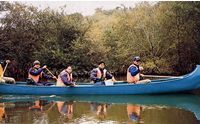 As the fact that the number of people who make use of wetlands as a place for recreation has increased greatly shows, interest in wetlands has been growing. On the other hand, there is concern about damage to environments caused by tourism that attracts many visitors (mass tourism). Accordingly, tourism that has minimal adverse effects on the ecosystem and regional culture, provides opportunities to enjoy nature and culture, and contributes to the region has been called for, and the concept of "eco-tourism" has been attracting more and more attention.
 In fiscal 1995, the KIWC Technical Committee carried out research with the purpose of clarifying the necessity of wetlands and related problems to be solved, with Kushiro Wetland, Lake Akkeshi and Bekanbeushi Wetland, and Kiritappu Wetland as the fields for the research. |
1996-1997 Environmental Research of River Water and Springs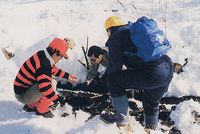 The committee conducted environmental research on flowing river water, rainwater and springs, the three elements of wetland water sources, and examined methods for conserving and maintaining wetlands through the use of both present and past data.
 While collecting and reviewing data in the areas, such as hydrology, botany, ornithology, ichthyology and maintenance engineering, the committee carried out research and investigation for two years from 1996 with Ramsar sites as the targets (Kushiro Wetland, Lake Akkeshi and Bekanbeushi Wetland, and Kiritappu Wetland) for the purpose of comparing and reviewing stable and unstable wetland environments as water resources. |
1998-2000 Environmental Education of Wetlands in Eastern Hokkaido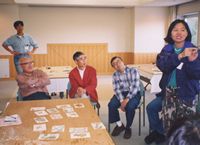 Under the theme "Environmental education in eastern Hokkaido wetlands," the KIWC Technical Committee focused on environmental education and eco-tour programs to be conducted in eastern Hokkaido wetlands, and conducted research from diverse viewpoints from FY 1998 to 2000 by examining the objectives, significance and role of the promotion and awareness raising of regional environmental education.
 Committee members performed research and studies primarily in our own specialized fields in 1998, compiling the progress of our research projects into an interim report in the following year. In September 2000, the Technical Committee conducted joint field research in Kiritappu-shitsugen and at the Kiritappu Shitsugen Center (Hamanaka Town), together with the participants of the JICA Training in Management / Administration and Use of Natural Parks (Eco-tourism). They experienced the environmental education programs actually conducted at the Kiritappu Shitsugen Center for its visitors. Through this hands-on experience, we were able to observe the programs objectively from the viewpoints of participants of the programs. The content of this joint research was included in the final report. |
2001- 2003 Rehabilitation and Restoration of Wetlands Pursuant to the Low for the Promotion of Nature Restoration enforced in 2003, projects to reproduce nature are being carried out in many places, including Kushiro Wetland.
 The KIWC Technical Committee focused on many types of problems affecting wetland environments in the Kushiro area, including wetland aridification and the threat of introduced species. The Committee examined ways to solve these problems and restore and reproduce nature in wetlands from varied perspectives, such as protection of wild fauna and flora, including endangered species, the use of the Ramsar Convention and citizens' activities. The results achieved through the examination was organized in a report (A4-size, 96 pages) and published in March 2003. |
2004-2006 Communication, Education, and Public Awareness of Conservation and Wise Use of Wetlands The committee conducted a field case study on March 10, 2005. The committee members visited Tsurui-Ito Red-Crowned Crane Sanctuary and experienced an environmental education program (card game) designed for children to learn how to conserve Red-crowned cranes.
 The second field case study was held on August 2, 2005. The committee members visited the Kiritappu Shitsugen Center. After presentation about the center's activities and programs carried out by the center, they participated in "Wetlands Exploration (nature watching) Tour". Through these case studies, the committee members exchanged their opinions and ideas with each other. As a summarization of activities for three years, the "2004-2006 Activities Report" was compiled in March, 2007. It made proposals based on case studies which had been conducted over the past two years. |
| 2007-2009 Research on Alien Species Affecting Wetland Ecosystems The Committee is conducted hearing- and questionnaire-based investigation into the status of American Mink (Mustela vison) in the Kushiro region as part of the research on alien species affecting wetland ecosystems in 2009. It was from North America for fur production and increasing in the wetlands including Ramsar sites in Kushiro. On May 8, 2008, the KIWC Technical Committee held a lecture meeting about mink, aiming at deepening the understanding of locals and those concerned with nature conservation about mink and other alien animals prior to the investigation. Through the investigation, we found out that minks are living in almost every region of the riverside of Kushiro-shitsugen Wetland and Bekambeushi Wetland, and around the Lake Akan, and have deep relations with a variety of creatures (such as small animals that serve as prey) as a part of the ecosystem in the region. It was also revealed that minks are a relatively familiar creature for local people according to the result of questionnaires. 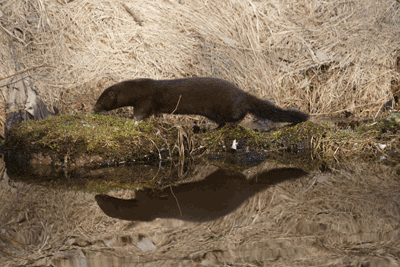 The committee held a debriefing session on March 27, 2010 in Kushiro city. An overview of the investigation was introduced in the session to about 80 people including those who answered a questionnaire.
|
| 2010‐2012 Resident Participatory Water Environment Restoration from the Viewpoint of Biodiversity |
