|
 |
|


|
 The Ramsar Convention is an agreement among countries in order to conserve wetlands. |


 |
Ramsar Sites in Japan | |

|
1. Sarogetsu-genya (Non-forested peatland, Freshwater lakes) 2. Kutcharo-ko (Freshwater lake) 3. Tofutsu-ko (Brackish lake) 4. Uryunumz-shitsugen (Non-forested peatland) 5. Notsuke-hanto and Notsuke-wan (Shallow marine water, Marine subtidal aquatic beds and Sand shore) 6 .Furen-ko and Shunkuni-tai (Brackish lake, Sand shore, Intertidal marsh and marine subtidal aquatic bed) 7. Akan-ko (Freshwater lake) 8. Kushiro-shitsugen (Freshwater marshes/pools) 9. Akkeshi-ko and Bekambeushi-shitsugen (Coastal brackish lagoon, Brackish marsh and Estuarine water) 10. Kiritappu-shitsugen (Brackish marsh) 11. Miyajima-numa (Freshwater lake) 12. Utonai-ko (Freshwater lake) 13. Hotokenuma (Non-forested peatland) 14. Izu-numa and Uchi-numa (Freshwater lakes) 15. Kabukuri-numa and the surrounding rice paddies (Irrigated land) 16. Sakata (Freshwater lake) 17. Oze (Non-forested peatland) 18. Oku-Nikko-shitsugen (Non-forested peatlands, Freshwater lakes) 19. Yatsu-higata (Intertidal mud flat) 20. Katano-kamoike (Freshwater pool) 21. Fujimae-higata (Intertidal mud flat, Estuarine water and Shallow marine water) 22. Biwa-ko (Freshwater lake) 23. Mikata-goko (Brackish lakes, Freshwater lakes) 24. Kushimoto Coral Communities (Coral reef) 25. Nakaumi (Brackish lake) 26. Shinji-ko (Brackish lake) 27. Akiyoshidai Groundwater System (Karst) 28. Kuju Bogatsuru and Tadewara-shitsugen (Non-forested peatlands) 29. Imuta-ike (Freshwater lake, Non-forested peatland) 30. Yakushima Nagata-hama (Sand shore) 31. Manko (Intertidal mud flat) 32. Kerama-shoto Coral Reef (Coral reef) 33. Nagura amparu (Intertidal sand flat) 34. Oyama Kami-ike and Shimo-ike (Freshwater lakes) 35. Hyo-ko (Water storage area) 36. Kejo-numa (Water storage area) 37. Streams in Kume-jima (Permanent streams) (34-37: Wetlands newly designated in 2008) |
|
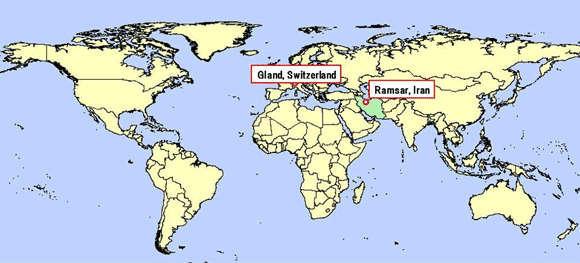
Location of Ramsar and the Convention's Bureau | |