|

|
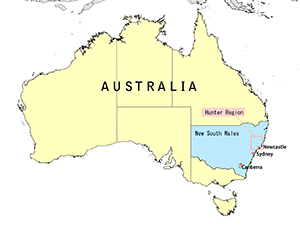
 Wetlands in the Kushiro area (Kushiro-shitsugen, Akkeshi-ko and Bekanbeushi-shitsugen, and Kiritappu-shitsugen) formed a sister-wetland affiliation with Kooragang Wetland and the surrounding wetlands (Since the 2004 renewal of sister wetland affiliation agreements, its name was changed to the Hunter River Estuary Wetlands.) in the Hunter region, New South Wales, Southeastern Australia, in November 1994.
The trigger for the affiliation was a bird of the snipe family, the Latham's snipe. This migratory bird breeds in marshes and grass fields on Japan's main island Honshu and further north (mainly in Hokkaido) in summer and winters in wetlands in Australia.
The Outdoor Science Club of Kushiro Nishi High School in Kushiro City has been studying the birds for many years. After a report on the research activities was presented to Australia through an Australian government official, Kushiro Nishi High School signed a sister-school affiliation with Jesmond High School (the present Callaghan College Jesmond Campus) in the Hunter region, the wintering place for the Latham's snipe.
In addition, the breeding place for the birds (the Kushiro area), which triggered the sister school affiliation, and their wintering place (the Hunter region) decided to enter into a sister-wetland affiliation. This sister wetland affiliation was the first of its kind in Japan.
The sister-wetland affiliation aims to promote conservation and wise use of wetlands and exchange techniques and knowledge of wetland conservation. With the affiliation as a turning point, Japanese and Australian delegations, including wetland experts, have been visiting and inspecting each other's regions to interact and exchange information.
In 2004, which fell on the 10th anniversary of the foundation of sister-wetland affiliations, the contents of the affiliation agreements were reviewed, culminating in the renewal of the agreements. That the sister wetlands would continue to deepen their friendship and technical exchanges was also reemphasized.
|
| Hunter Estuary Wetland |
Area: 2,971 hectares
Altitude: 10 meters
Major types of the wetlands: mangrove forests, salt marshes, coastal wetlands, casuarina forests, brackish and freshwater swamps, open water, tidal flats, sandy beaches and rocky shores
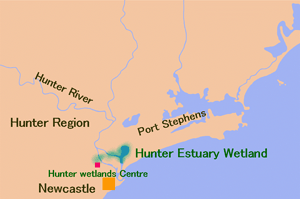
Hunter Estuary Wetland, located in the estuary of the Hunter River in New South Wales, consists of several small islands and sandbars.
Kooragang Wetland and associated wetlands serve as important feeding and resting places for migratory waterfowl. They are also major research and observation fields for bird specialists. This area was designated as a Ramsar site in 1984.
At present, the "Kooragang Wetland Rehabilitation Project" is being conducted by public and private sectors in a unified manner with the purpose of recovering nature lost through long-term development and promoting wiser use of wetlands to enable people and nature to coexist.
Hunter Estuary Wetland was designated as a new Ramsar Site in 2002 combining Kooragang Wetland(a former Ramsar Site) and associated wetlands into one.
|

|
| Hunter Wetlands Centre |
The Hunter Wetlands Centre (formerly The Wetlands Centre Australia) was established in 1985 with the aim of engaging in activities for popularization and awareness raising of conservation of wetlands in the Hunter River basin situated in the Hunter region, which is represented by Hunter Estuary Wetland, and the wildlife that inhabits the area.
The Centre has been conducting inspections by experts and exchange activities with KIWC (Kushiro International Wetland Centre) since 1996. In particular, it is addressing the exchange of knowledge and techniques for methods in which citizens can participate in the activities and for wetland recovery in technological and specialized areas.
|


|
| Port Stephens area |
 This is an administrative district with a population of approximately 70 thousands (2010) stretching along the coast and encompassing the area around the mouth of the Hunter River. Blessed with a mild climate and varied landscapes, including a white sand beach 35 km in length and rocky stretches formed by volcanic activity, the region is one of internationally famous sightseeing areas. Many forests and wetlands in diversified forms are situated around the coast.
The region's main industries include tourism, aluminum refinement, light industry and fisheries. A wide variety of tourism activities have been developed, including diving, sailing and other marine sports, and dolphin watching and other nature observation tours, in addition to traditional sightseeing for enjoyment of the area's beautiful landscapes.
|
|
Newcastle City |
This is the largest city in the Hunter region (with a population of approximately 15 thousands in 2011) and the second oldest city in Australia. Visitors to Newcastle have the opportunity to admire numerous historic heritage sites as well as landscapes featuring natural grandeur including the beautiful beach and several wetlands.
Although Newcastle has long produced good-quality coal and has thrived as an industrial city of coal mining, steel production and coal export businesses, it is transforming into a city of tourism. Agriculture is actively conducted, and, the city is also famous as a wine producing center.
Newcastle is highly regarded as a city of international conferences and conventions, capitalizing on its convenient accessibility to Sydney, Australia's largest city, and its improved accommodation facilities.
|
|
Record of Exchanges |
| June 1989 | Lecture by the Director of the Australian National Parks and Wildlife Service held in Kushiro. Students from the Outdoor Science Club of Kushiro Nishi High School attend the lecture to exchange opinions. |
| December 1989 | Mayor of Kushiro attends the IUCN General Assembly held in Perth. "The research report on Latham's snipe breeding behaviors" by the Outdoor Science Club of Kushiro Nishi High School is presented to the Director of the Australian National Parks and Wildlife Service. |
| October 1990 | Officials of the Australian National Parks and Wildlife Service visit Kushiro Nishi High School. |
| June 1993 | Commemorative lecture by the Director of the Australian National Parks and Wildlife Service held at Kushiro Nishi High School. Sister-school affiliation is discussed and sister-wetland affiliation proposed. |
| November 1993 | A basic accord on sister-wetland and sister-school affiliations is reached with Australian representatives of the Japan Australia Migratory Bird Agreement. |
| November 1994 | Delegation from Kushiro visits Australia. Signing ceremony for sister-wetland and sister-school affiliations is held in the Shortland Wetlands Centre (the present Wetlands Centre Australia) (November 7). |
| December 1994 | The Chief Executive Officer of the Australian Nature Conservation Agency (formerly the Australian National Parks and Wildlife Service) visits Kushiro Nishi High School and conducts exchanges with students of the Outdoor Science Club of Kushiro Nishi High School. |
| May/June 1995 | Persons involved in the Kooragang Wetland Rehabilitation Project and migratory bird researchers perform research on the Latham's snipe in Kushiro and conduct exchanges with experts there. |
| September 1995 | Delegation from sister school, Jesmond High School, visits Kushiro to conduct exchanges with students of Kushiro Nishi High School and citizens of Kushiro. |
| March 1996 | Delegation from the Kushiro area visits Australia to inspect the sister wetlands and surrounding facilities and exchange information. |
| October 1997 | Delegation with two exchange students from the Australian sister school visits Kushiro. |
| May 1999 | Officials of KIWC and the Shortland Wetlands Centre exchange opinions and information in the 7th Conference of the Contracting Parties to the Convention on Wetlands held in Costa Rica, Central America. |
| August 1999 | Delegation consisting of three people, including the Mayor of Port Stephens, inspects the registered wetlands under the Ramsar Convention in the Kushiro area and exchanges opinions with representatives of Kushiro. |
| September 2001 | Experts from KIWC (Kushiro) visit the sister wetlands, inspect the wetland recovery project, and exchange opinions about future cooperation with officials involved in the Wetlands Centre Australia, the Kooragang Wetland Rehabilitation Project and the sister school. |
| April 2002 | Delegation consisting of eight people, including the Chairman of the Sister Cities Committee in Port Stephens, visits Kushiro to inspect the sister wetlands and conduct exchanges with citizens of Kushiro during visits to their homes and a meeting on nature conservation. |
| February 2003 | Experts from the Kooragang Wetland Rehabilitation Project attend the citizens' forum on wetland restoration, inspect the sister wetlands in the Kushiro area to study wetland recovery and restoration and exchange opinions with local people concerned. |
| July 2003 | The Chairwoman of the Wetlands Centre Australia participates in the project commemorating the 10th anniversary of the Ramsar Conference in Kushiro and exchanges opinions with people in Kushiro on how to conserve wetlands in the future and involve citizens. |
| September 2004 | A delegation consisting of 19 citizens, which was organized by the Port Stephens Sister Cities Committee, visited Kushiro. They toured sister wetlands and related facilities, visited Hokkaido Shibecha High School and participated in social events along with locals engaged in nature conservation and international exchanges, deepening their friendships with people in the Kushiro area. |
| November 2004 | Three representatives of the KIWC, including the President of the KIWC (Yoshitaka Ito, Mayor of Kushiro City), visited Newcastle City and Port Stephens to sign the renewal of sister-wetland affiliation agreements on the 10th anniversary of the foundation of such affiliations. In addition to touring sister wetlands, they traveled to areas covered by the Kooragang Wetland Rehabilitation Project and the Wetland Centre Australia, as well as participated in a workshop where details of future wetland exchanges were discussed. |
| April 2006 | The delegation of Port Stephens Sister Cities Committee with 11 citizens visited Kushiro. They were invited to the welcome party sponsored by Kushiro City and enjoyed a homestay program of three overnights stay. |
| November 2007 | The delegation of 32 citizens, headed by Mayor of Kushiro City (concurrently the president of KIWC), visited the cities of Newcastle and Port Stephens in Australia. They stayed at homes of locals and exchanged friendship at welcome events and the party. They also observed the restored area in Kooragang Wetland and engaged in the commemorative planting of trees. |
| November 2008 | A delegation of Port Stephens Sister Cities Committee with 6 citizens visited Kushiro. They participated in the observation tour in Kushiro Wetland, and joined at the exchange party sponsored by local governments of Kushiro area and NGOs. After the event they were invited to homestay program by voluntary families. |
| April 2011 | Port Stephens Sister Cities Committee made a donation of 1,000 AUD to Kushiro area to serve a support of damages by Great East Japan Earthquake. |
| July 2012 | KIWC staff met with people involved in the conservation of the Hunter Estuary Wetlands at the venue of Ramsar COP11 in Romania, and discussed possible future exchanges with both wetlands. |
| November 2012 | KIWC and Wetland Care Australia exchanged photo and artworks of Kushiro/Australian wetlands, and had the exchange exhibitions in Kushiro and Hunter Estuary Wetland. |
|
|