�@
�@�@
|
�¡Participation in �gAsian Wetland Symposium 2001�h |
|
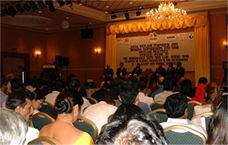 �gAsian Wetland Symposium 2001�h was held at Penang, Malaysia from August 27th to 30th, 2001. It was attended by about 400 participants from 37 countries centering on Asia. �gPenang Statement,�h aiming at further promotion of partnership in the Asia Pacific region, was adopted. �gAsian Wetland Symposium 2001�h was held at Penang, Malaysia from August 27th to 30th, 2001. It was attended by about 400 participants from 37 countries centering on Asia. �gPenang Statement,�h aiming at further promotion of partnership in the Asia Pacific region, was adopted.
Since many of the �gAsian Wetland Symposium 2001�h participants had also participated in JICA Training Course or international conferences in Kushiro, many old friendships could be renewed.
In the symposium, KIWC introduced �gActivities of KIWC including Monitoring Research on the Ramsar Site Kushiro Wetland,�h which was of great interest to the participants.
|
|
�¡Exchange with sister wetlands, �gKooragang Wetland and associated wetlands�h |
|
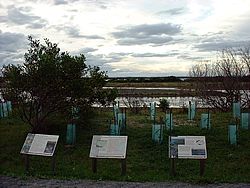 A wetland specialist of KIWC, visited the Kooragang wetland and associated wetlands in Australia, which were sister wetlands of the Ramsar sites in the Kushiro region, from August 31st to September 5th, 2001. The expert had the opportunity to share information with staff members of local organizations and discussed our exchange program in the future. A wetland specialist of KIWC, visited the Kooragang wetland and associated wetlands in Australia, which were sister wetlands of the Ramsar sites in the Kushiro region, from August 31st to September 5th, 2001. The expert had the opportunity to share information with staff members of local organizations and discussed our exchange program in the future.
The Kooragang Wetland Rehabilitation Project (KWRP) was in progress, which provided us with useful information in promoting wetland conservation activities of the same kind.
|
|
�¡International Workshop and Public Symposium on �gClimate Change and Wetland Conservation�h |
|
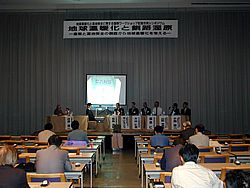 The International Workshop on Climate Change and Wetland Conservation, whose theme was to consider the prevention of global warming issues and conservation of natural environment, was held at Kushiro Tourism and International Relations Center on September 20th and 21st, 2001. It was convened by the National Institute for Environmental Studies and jointly organized by Wetlands International Japan and
KIWC. The International Workshop on Climate Change and Wetland Conservation, whose theme was to consider the prevention of global warming issues and conservation of natural environment, was held at Kushiro Tourism and International Relations Center on September 20th and 21st, 2001. It was convened by the National Institute for Environmental Studies and jointly organized by Wetlands International Japan and
KIWC.
On September 21, an open symposium was also held. It was attended by specialists who had participated in this workshop from home and abroad, and related persons who came from local companies. These local companies were promoting advanced initiatives in Kushiro to prevent global warming issues.
In this symposium entitled �gGlobal Warming and the Kushiro Wetland,�h they presented the fact that wetlands function as carbon sinks and so prevent global warming. On the other hand, it might cause a large amount of greenhouse gas emissions if they are destroyed.
About 130 participants debated global warming from the viewpoints of both industries and wetland conservation.
|
|
�¡Workshop for Riparian Buffer Zones and Citizen�fs Forum |
|
�gInternational Workshop on �gEfficiency of Purification Processes in Riparian Buffer Zones, their Design and Planning in Agricultural Watersheds (organized by the Organizing Committee for International Workshop on Riparian Buffer Zones and co-organized by KIWC)�h was held at Kushiro Tourism and International Relations Center from November 5th to 9th, 2001. Citizen�fs Forum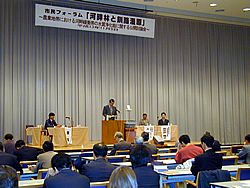 �gRiparian Buffer Zones and Kushiro Mire�h was held as a program on the final day. �gRiparian Buffer Zones and Kushiro Mire�h was held as a program on the final day.
With 90 specialists from home and abroad gathered together, we took the opportunity to organize public debates featuring four of them. They shared with us the latest information which, besides being useful for the conservation of the Kushiro wetland, was presented in a way that the general participants could clearly understand. The information included how much the riparian buffer zones have contributed to the purification of the water which flows into the wetlands and lakes and how to effectively construct them.
|
|
�¡Implementation of the �g2001 Management / Administration and Wise Use of Natural Parks (Eco-Tour) JICA Training Course�h |
|
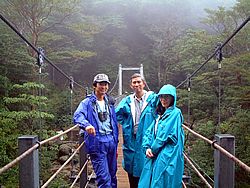 From September 17 to October 25, 2001, the �g2001 Management/Administration and Wise Use of Natural Parks (Eco-Tour) JICA Training Course�h was implemented, in which two trainees from two countries participated. From September 17 to October 25, 2001, the �g2001 Management/Administration and Wise Use of Natural Parks (Eco-Tour) JICA Training Course�h was implemented, in which two trainees from two countries participated.
This training course is intended for administrative officials in charge of natural park management / administration and eco-tours in Asia, and has been conducted since 1998 by the Japan International Cooperation Agency (JICA) Hokkaido International Centre (Obihiro) as an implementing body, and the Kushiro International Wetland Centre as an accepting body.
In this year�fs training course, Kirishima-Yaku National Park in the Kyushu-Okinawa Area (Yakushima) and Iriomote National Park (Iriomote Island) were added to the previous training sites, i.e., national parks in Eastern Hokkaido (Daisetsuzan National Park, Akan National Park, Kushiro Shitsugen National Park and Shiretoko National Park).
Trainees experienced management methods and wise use applicable to the regional characteristics, and learned concepts, technical know-how and methods for eco-tourism through various eco-tour experiences, such as canoeing and hiking, and practical training for spring water, marsh and wild animal surveys.
|
|
�¡JICA Training Course on �gConservation of Biological Diversity of Wetland Designated as Ramsar Convention�h |
|
From January 18 to February 12, 2002, the �gTraining Course on Conservation of Biological Diversity of Wetland Designated as Ramsar Convention�h was conducted by JICA (Japan International Cooperation Agency) Hokkaido International Centre (Obihiro) as an implementing body, with the KIWC as an accepting body.
The purpose of this training is to introduce case examples of eco-tours, activities of organizations and related facilities in Hokkaido, where climatic conditions are similar to that of Mongolia, to help realize the establishment of eco-tourism projects, including bird watching, at Lake Ogii (Ogii Nuur), a repository of wild birds, especially waterfowl. This time, five participants from the Environmental Ministry of Mongolia and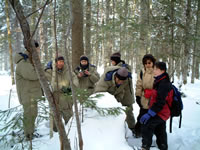 those from local government bodies along the shores of Lake Ogii visited several natural parks in eastern Hokkaido, including Ramsar sites, and learned about the operation system of eco-tourism and accompanying challenges. At the same time, the participants were given the opportunity to actually experience eco-tour programs (nature hiking, horse-back trekking and environmental education programs) to discover the value of wetlands, which used to be merely a habitat area, as an eco-tour resource. those from local government bodies along the shores of Lake Ogii visited several natural parks in eastern Hokkaido, including Ramsar sites, and learned about the operation system of eco-tourism and accompanying challenges. At the same time, the participants were given the opportunity to actually experience eco-tour programs (nature hiking, horse-back trekking and environmental education programs) to discover the value of wetlands, which used to be merely a habitat area, as an eco-tour resource.
|
|
�¡Workshop on Environmental Education and Eco-tourism at Crane Network Sites in Northeast Asia |
|
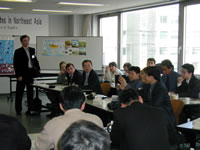 For four days from February 27 to March 2, the �gWorkshop on Environmental Education and Eco-tourism at Crane Network Sites in Northeast Asia�h was held by the Ministry of the Environment, the Wild Bird Society of Japan, the City of Kushiro, the Crane Workshop Kushiro Executive Committee (Kushiro City, towns of Kushiro, Akkeshi, Shibecha, Hamanaka, Akan and Tsurui, and KIWC). For four days from February 27 to March 2, the �gWorkshop on Environmental Education and Eco-tourism at Crane Network Sites in Northeast Asia�h was held by the Ministry of the Environment, the Wild Bird Society of Japan, the City of Kushiro, the Crane Workshop Kushiro Executive Committee (Kushiro City, towns of Kushiro, Akkeshi, Shibecha, Hamanaka, Akan and Tsurui, and KIWC).
The Northeast Asian Crane Site Network was established in 1997 to enforce international cooperation in the protection of cranes which migrate, crossing national boundaries. Five areas in Japan, including Kushiro Wetland (Kushiro-shitsugen), participated as members.
This workshop followed a similar workshop in China last year. It was held for the purpose of investigating environmental education, visitor management at network sites, and preparing a �ghandbook on environmental education and eco-tourism.�h About 40 participants from seven countries (including 5 observers) reported on their activities over the past year and actively discussed future challenges. Aside from this workshop, they visited the facilities related to the protection of cranes to experience actual protection measures.
On the final day of the workshop, a symposium titled, �gFor the Protection of Cranes in Northeast Asia,�h was also opened to the general public. The results of this workshop will be reported at the 2002 Ramsar Conference in Spain.
|
|
�¡JICA Training Course on �gConservation and Wise Use of Wetlands as Crane Site�h |
|
From February 26 to March 9, 2002, the �gTraining Course on the Conservation and Wise Use of Wetlands as Crane Site�h was held for two specialists of the Royal Society for Protection of Nature, an NGO in Bhutan, with JICA Hokkaido International Centre (Obihiro) as an implementing body and KIWC as an accepting body. Because the Phobjikha Wetland in Bhutan is an important habitat for the endangered black-necked crane, the Royal Society for Protection of Nature is mainly promoting conservation activities of the cranes and the wetland.
This training course was realized through the following history: one of the specialists of the association participated in the �gJICA Training Course on Wetland Conservation and Protection of Migratory Birds�h
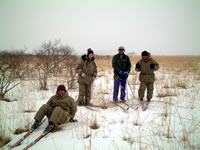 in 1996 (with KIWC hosting institution). In 2001, after he returned, a specialist of the Kushiro City Zoo was dispatched by JICA to Phobjikha as a short-term expert. in 1996 (with KIWC hosting institution). In 2001, after he returned, a specialist of the Kushiro City Zoo was dispatched by JICA to Phobjikha as a short-term expert.
The participants attended as observers in the �gWorkshop on Environmental Education and Eco-tourism at Crane Network Sites in Northeast Asia.�h After they studied examples of Red-crowned crane protection and dissemination & awareness-raising campaigns in eastern Hokkaido, they examined Bhutan�fs relevant policies.
|
|
�¡Visit by Australian Delegation from Sister Wetland to Kushiro |
|
An Australian delegation of eight people from Port Stephens, related to the �gKooragang Wetland and associated wetlands,�h which have a sister wetland relationship with the Ramsar sites in eastern Hokkaido (including Kushiro-shitsugen), visited Kushiro from April 23 to 26 in 2002.
The delegation paid a courtesy call on the mayor of Kushiro, who is also President of KIWC, and deepened their friendly relationship after fully enjoying magnificent nature of the Kushiro area through a programs including canoeing down the Kushiro River and home visits. At the exchange meeting held in conjunction with their visit, presentations of nature and conservation activities at Port Stephens and Kushiro Wetland were made to allow participants to share valuable information and experiences for nature conservation and sustainable development of both areas.
|

�@
|
