
|
|
■Winter Wetland Eco-Tour |
|
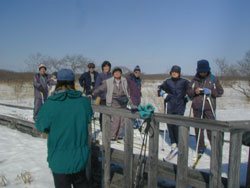 On February 25 (Sat.), 2006, a winter wetland eco-tour to enjoy the wetlands in winter was held at the Onnenai Visitor Center. Nine citizens from the Kushiro area participated in the tour. In the morning, the participants skied into the forests, which one can only enter in the winter season, guided by an instructor, Mr. Koichi Wakayama. They observed holes in the timber made by woodpeckers, and footprints and eating traces made by animals such as Red-crowned cranes, Mountainhares and Red-backed voles in the forests and from the boardwalks. They also observed the winter buds of willies.
In the afternoon, Mr. Satoshi Yanagi, a teacher at Kushiro Seien High School, lectured them on the history of the study of snow and the mechanism of snow crystallization. They simulated making snow crystals using plastic bottles and observed the crystals growing like a bird feather. They also observed the structure of ice crystals using a polarized glass sheet. The participants were surprised at the structural difference between store-bought and natural ice. They fully enjoyed the beautiful designs of ice. They were interested in the rich activities of nature, moved by fresh discoveries, and enjoyed them in seldom visited wetlands.
|
|
■JICA Training Course on Crane Conservation in Bhutan |
|
From March 3 (Fri.) to March 20 (Thu.), 2006, a training program concerning the "Capacity Building for Management of the Black Necked Crane Information Center in the Phobjikha Conservation Area" was implemented.
Four participants consisted of related administrative heads, an administrative officer in charge, and staff of Royal Society for Protection of Nature. The participants visited wetlands in eastern Hokkaido, including the Kushiro wetlands (a red-crowned crane habitat), and went through a program of dissemination and environmental education training conducted by the facility set up in each wetland for nature walking and exhibition. They also learned about useful case examples for the coexistence of regional development and crane conservation, such as eco-tours, that utilize rich natural resources symbolized by the cranes. Furthermore, they discussed how to apply these programs to the activities in Phobjikha.
On March 18, the participants participated in the "International Crane Forum" and joined the study-tour the next day. During these events, they discussed activities for crane conservation and environmental education operated in Japan, China and Korea with the experts from each country.
Though the training schedule was rather hard for the participants, due to a lot of fieldwork in midwinter, they were able to finish training with the support of the citizens in the area which was offered for the friendship of the Hokkaido Bhutan Association etc.
|
|
■International Crane Forum - Future of Cranes and Ourselves |
|
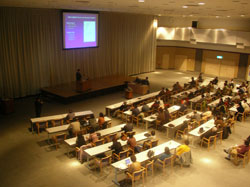 On March 18 (Sat.), 2006, "International Crane Forum: Cranes and Our Future", co-organized by the JICA Obihiro International Center and Tancho (Red-crowned crane) Protection Unit, was held at the Kushiro Tourism and International Relations Center. Approximately 100 citizens participated.
Activities for conservation and dissemination of cranes in eastern Asia were introduced through various programs, including a presentation of case examples from abroad and panel discussions. There was also a keynote speech by Ms. Masako Inoue, who is the communication director of Kushiro City Zoo and president of the co-organizer, "Japan Crane and Stork Network".
One of the speakers, Mr. Kim Jin-Han, senior researcher of "Korea Biological Resource Center", was one of the participants in the JICA group training course "Conservation of Wetlands and Migratory Birds" organized by the KIWC before, and now is an active operator in Korea as a key person for the conservation of the cranes.
JICA participants from Bhutan were in Kushiro to learn about the conservation of cranes and also participated in this forum. In the exchange party after the forum, slides of past JICA training programs were introduced at the forum site, which was decorated with photos and ethnic costumes introducing Bhutan's nature and culture.
The Hokkaido Bhutan association's Kushiro branch provided these articles for exhibition. The participants enjoyed tea and cakes from Japan, China, Korea and Bhutan in a friendly atmosphere.
On the following day, March 19 (Sun.), a study tour was held for the lecturers of the forum and JICA participants from Bhutan. At the Akan International Crane Center, they experienced an environmental education program and discussed how to improve the method for research on the ecology of cranes.
Later, at the Tsuru-Ito Tancho Sanctuary, the crane conservation activities by citizens were introduced and the participants exchanged their views on the coexistence of cranes and human beings while introducing the situation in each country.
|
|
■International Crane Art Exhibition |
|
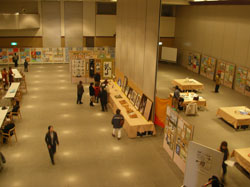 On March 18 (Sat.) and from March 29 (Wed.) to April 2 (Sun.), 2006, the "International Crane Art Exhibition" was held. We recruited genre-straddling hand-made work based on the "crane", and nearly 400 wonderful pieces of work from kindergarteners to seniors mainly from the Kushiro region and other regions were applied for. The works ranged from paintings to calligraphies, artwork and handcrafts, etc.
At the same time, paintings of cranes by children of Bhutan and photographs, paintings and patchworks from England, Russia, Australia and Korea were exhibited with a comment on each work.
On March 18, these works were also exhibited at the "International Crane Forum" that was held at the Kushiro Tourism and International Relations Center. These original "cranes" pleased the eyes of the participants and let us recognize the meaning of our cranes that symbolize the ecosystem of the wetlands in Kushiro Area.
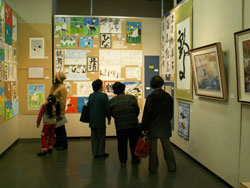 From March 29 to April 2, the exhibition was also held at Manabotto Nusamai (Kushiro lifelong study center) and attracted many people. It was impressive that so many people greatly appreciated the work and asked us about the relationship between the countries participating in the exhibition and the Kushiro area.
|

|