
|
|
2006 JICA Training Course "Conservation, Restoration and Wise Use of Wetland Ecosystems and Their Biological Diversity" |
|
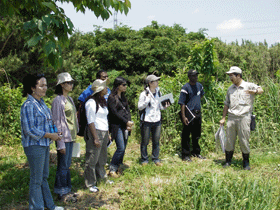 From May 22 (Mon.) to July 4 (Tue.), 2006, the Japan International Cooperation Agency (JICA) group training course on the "Conservation, Restoration and Wise Use of Wetland Ecosystems and Their Biological Diversity" was held. JICA Obihiro International Center was the administrative institution, and the Nature Conservation Bureau of the Ministry of the Environment and the KIWC were the hosting institutions.
This course, which was the third session for this theme, was provided for six participants from six countries (Dominican Republic, Indonesia, Mongolia, Solomon Islands, Vietnam and Zambia) who were researchers and mid-level administrative officers involved in environmental and nature conservation.
Various case examples were presented in the course, illustrating approaches to the restoration and rehabilitation of damaged environment in Japan, from the Kushiro wetlands in Hokkaido to the tidal flats on Japan's mainland and to the coral reefs and mangrove coast in Okinawa, in order to conserve ecosystems and biological diversity in wetlands. Participants took part in many practical training programs such as environmental education and eco-tours, and learned sustainable use of natural resources in wetlands through firsthand experience.
During the training, the participants were able to interact with many citizens through home visits, and discussions with university students studying about eco-tourism and environmental conservation.
|
|
UNITAR Training Workshop in Kushiro |
|
A training workshop was held from August 27 (Sun.) through 31 (Thu.), 2006, under the auspices of the United Nations Institute for Training and Research Hiroshima Office for Asia and the Pacific (UNITAR HOAP) and the co-host of the KIWC. This was the sixth joint workshop in Kushiro hosted by the UNITAR and the second joint workshop hosted by UNITAR HOAP.
The theme of the workshop was "Ecosystems, Water and Biodiversity." Aiming to acquire new knowledge and techniques in the conservation of ecosystems and biodiversity, with a focus on the water environment, 44 administrators and experts participated from 27 countries, primarily developing nations in the Asia-Pacific region
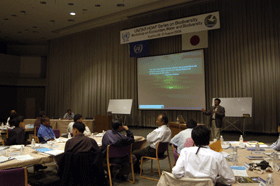 In addition to lectures and hands-on training provided at the main venue, the Kushiro Tourism and International Relations Center, an overnight field tour to Kushiro wetland and Lake Akan was organized to learn from actual cases related to the management and use of wetlands registered under the Ramsar Convention, and to interact with local residents. Participants are expected to play a leading role in conservation activities in their own countries by disseminating and extending what they have learned through the workshop and follow-up activities.
In between training activities, Kushiro Ezo Drum performances and flower arrangement demonstrations were held with the cooperation of local cultural organizations, winning great popularity with the participants.
|
|
2006 JICA Training Course "Administration / Management and Wise Use (Eco-tour) of Natural Parks" |
|
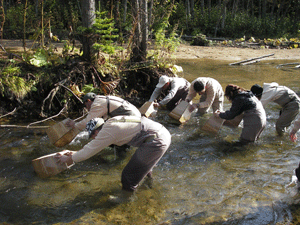 From October 2 (Mon.) to November 10 (Fri.), 2006, a JICA group training course on the "Administration/Management and Wise Use of Natural Parks," was held with the JICA Obihiro International Center as the administrative institution and KIWC as the hosting institution. In the current fiscal year, the last group training course was held, in which six people participated from four countries (Bhutan, Bosnia-Herzegovina, Nepal and Rumania). The participants were all middle-ranking administrative officers involved in tourism and environmental conservation in their respective countries.
The program included hands-on experience training of eco-tours primarily in natural parks in eastern Hokkaido, lectures on natural park systems and concepts of ecotourism, and inspections of Hokkaido's environmental education programs. The participants also visited Kyoto and Tokyo to learn about eco-tours featuring places of cultural and historic interest. Based on what they learned through these programs, the participants prepared a plan of action for introducing and implementing eco-tourism in their own countries, presenting it in front of the others at the end of the course.
From October 2 (Mon.) to November 10 (Fri.), 2006, a JICA group training course on the "Administration/Management and Wise Use of Natural Parks," was held with the JICA Obihiro International Center as the administrative institution and KIWC as the hosting institution. In the current fiscal year, the last group training course was held, in which six people participated from four countries (Bhutan, Bosnia-Herzegovina, Nepal and Rumania). The participants were all middle-ranking administrative officers involved in tourism and environmental conservation in their respective countries.
The program included hands-on experience training of eco-tours primarily in natural parks in eastern Hokkaido, lectures on natural park systems and concepts of ecotourism, and inspections of Hokkaido's environmental education programs. The participants also visited Kyoto and Tokyo to learn about eco-tours featuring places of cultural and historic interest. Based on what they learned through these programs, the participants prepared a plan of action for introducing and implementing eco-tourism in their own countries, presenting it in front of the others at the end of the course.
During the training, which lasted over a month, the participants also had opportunities to visit local households and elementary schools. Their host families, who developed close friendships with the trainees, attended the closing ceremony to share in the joy of successfully completing the course.
|

|