
|
|
KIWC Technical Committee's 1st On-Site Study Meeting in Fiscal 2007 |
|
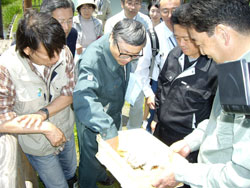 On July 4 (Wed.), 2007, the KIWC Technical Committee's On-Site Study Meeting in fiscal 2007 was held by Lake Harutori, Kushiro City.
As the first activity for the Research on Alien Species Affecting Wetland Ecosystems, which will be conducted for three years from this fiscal year, 13 people including members of the KIWC Technical Committee and observers inspected how alien organism surveys were performed in Lake Harutori.
On July 4 (Wed.), 2007, the KIWC Technical Committee's On-Site Study Meeting in fiscal 2007 was held by Lake Harutori, Kushiro City.
As the first activity for the Research on Alien Species Affecting Wetland Ecosystems, which will be conducted for three years from this fiscal year, 13 people including members of the KIWC Technical Committee and observers inspected how alien organism surveys were performed in Lake Harutori.
After Dr. Shinichi Hiruta, a professor at the Kushiro Campus of the Hokkaido University of Education and one of the KIWC Technical Committee members, explained the state of the inhabitation of Signal crayfish (Pacifastacus leniusculus) in the lake, the participants visited the survey site, where they inspected how Signal crayfish caught were removed and subsequently how their measurements and other data were collected.
Participants raised questions and exchanged opinions about how to participate in volunteer activities intended to exterminate Signal crayfish, their relations with Japanese crayfish (Cambaroides japonicus), a native species, and so on.
|
|
2007 JICA Training Course for Wetland Conservation |
|
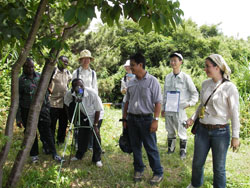 From May 21 (Mon.) to July 3 (Tue.), 2007, a Japan International Cooperation Agency (JICA) group training course on the "Conservation, Restoration and Wise Use of Wetland Ecosystems and Their Biological Diversity" was held. The JICA Hokkaido International Centre in Obihiro was the administrative institution and the Nature Conservation Bureau of the Ministry of the Environment and the KIWC were the hosting institutions.
This course, which was the fourth session as a group training course, was provided for six participants from five countries (China, Kenya, Mexico, the Philippines and Uganda) who were researchers and middle-ranking administrative officers involved in environmental conservation and nature protection.
During the training, the participants visited all types of wetland nationwide, ranging from wetlands in Eastern Hokkaido to tidal flats and countryside forests (Satoyama) in the Tokyo Metropolitan Area in Honshu, the mainland of Japan, and to garden ponds in Kyoto, and mangrove forests and coral reefs in Okinawa. The participants experienced in the environmental education programs and eco-tours offered in these wetland areas, and based on their experience, devised specific plans for the sustainable use of natural resources in their respective countries.
During the long training period, which lasted for one and a half months, the participants visited ordinary households in Kushiro and enjoyed exchanges with locals with the cooperation of local volunteers.
|
|
"Workshop for Considering the Wise Use of Kushiro Wetland and Lake Akan" |
|
On July 27 (Fri.), 2007, the Workshop for Considering the Wise Use of Kushiro Wetland and Lake Akan was held at the Kushiro Lifelong Learning Center under the joint auspices of the specified nonprofit organization "Wetlands International Japan."
This workshop was held for locals as a project commemorating the 20th anniversary of the designation of Kushiro Shitsugen National Park and was attended by approximately 40 people, consisting mainly of local residents engaged in fisheries, tourism and so forth in the Kushiro region and Lake Akan.
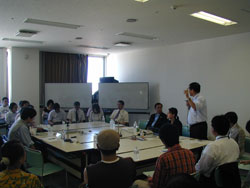 After people involved in fisheries and tourism had introduced case examples, all the participants sat in a circle and discussed industrial promotion friendly to wetland environments and commonalities and differences between the two wetlands. A plethora of opinions were voiced concerning the formulation of proper use guidelines, the marketing of the regions' distinctive characters and so forth.
|
|
Lecture Meeting / Ikebana (Japanese traditional flower arrangement) Demonstration "Traditional Arts for Wetland Restoration" |
|
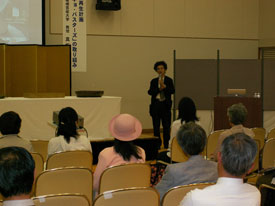 On July 28 (Sat.), 2007, the lecture meeting "Traditional Arts for Wetland Restoration" was held at the Kushiro Lifelong Learning Center. In commemorating the 20th anniversary of the designation of Kushiro Shitsugen National Park, Dr. Akio Maita, a professor at the Kyoto Saga University of Arts, introduced the landscape restoration project for Osawa Pond in Kyoto as an example of using Japanese traditional arts, which place a high value on harmonization with nature, for nature restoration projects.
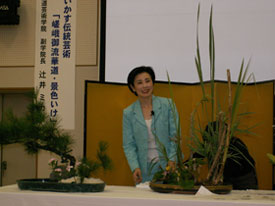 In an effort to restore the ecosystem and landscape of Osawa Pond, which was devastated by the feeding damage of Grass carp (ctenopharyngdon idellus), an exotic fish, Professor Maita explained that he had played a central role in organizing the Grass Carp Bustards consisting of experts in a host of fields, local residents, students and so forth. He also pointed out that restoration plans have been under way in the environment, civil engineering, landscape architecture fields and many others and that they aim to realize the ancient image of Osawa Pond expressed in the "Keshiki-ike (scenic arrangement)" at the Saga Goryu School of Ikebana (Japanese traditional flower arrangement) under the restoration plans.
At the venue, Ms. Mika Tsuji, Vice President of the Academy for the Saga Goryu Ikebana and one of the key persons for the restoration plans, demonstrated the Keshiki-ike and the beautiful yet somewhat nostalgic water landscape arranged in the vase fascinated the approximately 40 participants.
|

|