
|
|
The 2nd On-site Study Meeting of KIWC Technical Committee |
|
On September 1, 2007, the second KIWC Technical Committee's On-site Study Meeting in FY 2007 was held at Nenohi Park in Akkeshi Town.
As one of the activities of "Alien Species Affecting Wetland Ecosystem", which is the theme from FY 2007 to FY 2009, we monitored the rampant condition of Redbeckia laciniata and exterminated some of them.
Redbeckia laciniata is an asteraceous plant which is native to North America, and is rapidly proliferating in Hokkaido in recent years.
The extermination work was part of experimental monitoring research which Akkeshi Town started this fiscal year to prevent Rudbeckia laciniata from invading important areas in respect of landscape and ecosystem conservation such as Bekanbeushi Wetland in the town.
About 70 people including volunteers and interested persons from in and out of Akkeshi Town participated in the work.
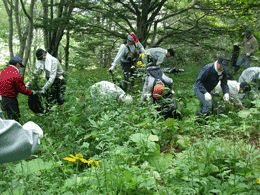 From the KIWC, 9 people including the technical committee members participated. After they were lectured about the rampant condition of Rudbeckia laciniata in Akkeshi Town, they weeded in the monitored community.
In the discussion meeting after the weeding work, information about the pattern of distribution of alien species, the rampant condition in wetlands in the Kushiro area, etc. was exchanged. We also discussed the importance of preventing the entry of alien species to important areas in respect of ecosystem conservation, disseminating the concept and educating people.
|
|
Kushiro Wetland Eco-tour, "Lake Toro Expedition in Autumn" |
|
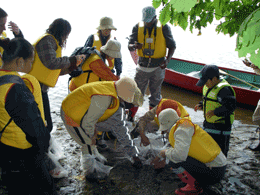 On October 6, 2007, an eco-tour for the local residents was held. 19 people from Kushiro City, Kushiro Town and Shibecha Town participated and visited Lake Toro in the Kushiro Wetland. 9 JICA participants who came to Japan to learn about eco-tourism also joined the tour, and they tried canoeing under the beautiful blue sky.
They enjoyed the autumn nature of the lakeside, finding wild grapes and fruits of Rosa rugosa, or measuring the quantity of the spring water flowing from the forest into the lake.
After canoeing, they tasted boiled "water chestnuts" which had been gathered in summer. A water chestnut is a nut of waterweed which grows on the surface of Lake Toro. They have been used as a preserved food, or medicine, for a long time in this area. It was the first time for most of them to taste it. They really liked it and said "It's tasty like a chestnut!".
For the JICA participants, it was the first exchange with the local residents since they came to Japan. They made good friends with each other through canoeing or sharing water chestnuts.
|
|
JICA Mongolia Training Course, "Participatory Environmental Conservation" |
|
From November 19 to December 3, 2007, a training course by JICA Obihiro International Center targeted for Mongolia, "Participatory Environmental Conservation" was held.
It was provided for 6 participants who are officials in national or municipal government, or local entities concerned, as part of the "Catchment Area Management Model Project" which JICA promotes at Ogii Nuur, a Ramsar site.
The training sessions were held in Kanto and Hokkaido, and KIWC was in charge of the one in Hokkaido.
Participants joined an eco-tour utilizing local industries such as fishery or horse production.
They received explanations about ingenuity and points to remember to operate tours, and learned about the ways to exhibit materials in the nature-based facilities, and what kind of environmental education programs were implemented.
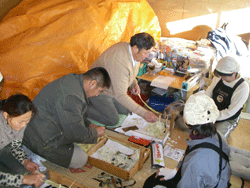 Oggi Nuur residents, who cooperated with our research there when KIWC sent specialists in 2001, participated in this training.
We had a happy reunion in Kushiro, and shared the latest information about Oggi Nuur.
Oggi Nuur residents, who cooperated with our research there when KIWC sent specialists in 2001, participated in this training.
We had a happy reunion in Kushiro, and shared the latest information about Oggi Nuur.
|
|
Participating in Official Delegation to Sister Wetlands in Australia |
|
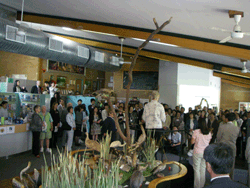 The official visiting party to sister wetlands in Australia (A total of 23 people participated) was organized for a project commemorating the 20th anniversary of the designation of Kushiro Shitsugen National Park.
They visited Hunter Estuary Wetlands, sister wetlands in New South Wales, and stayed there from November 2 to November 8, 2007.
The visiting party included Kushiro City Council members, those in regional commerce and industry, and citizens who are interested in international exchange.
The superintendent of Shibecha Town participated to represent the KIWC, and a wetland specialist of KIWC Bureau accompanied the delegation as a supporter.
The official visiting party to sister wetlands in Australia (A total of 23 people participated) was organized for a project commemorating the 20th anniversary of the designation of Kushiro Shitsugen National Park.
They visited Hunter Estuary Wetlands, sister wetlands in New South Wales, and stayed there from November 2 to November 8, 2007.
The visiting party included Kushiro City Council members, those in regional commerce and industry, and citizens who are interested in international exchange.
The superintendent of Shibecha Town participated to represent the KIWC, and a wetland specialist of KIWC Bureau accompanied the delegation as a supporter.
At Hunter Estuary Wetlands, a Ramsar site, we planted memorial trees with the members of the Kooragang Wetland Rehabilitation Project who have been working on the nature restoration project for many years.
We also interacted with many people including the local bird-watching group, environmental conservation volunteers, and those involved with the wetland center.
|
|
Kushiro Wetland Eco-tour, "Lake Toro Expedition in Autumn" |
|
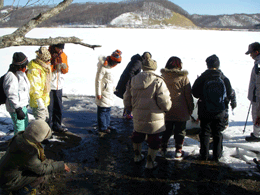 On February 2 2008, an eco-tour for the local residents was held as an event related to "World Wetlands Day (February 2)", a memorial day established to commemorate adoption of the Ramsar Convention. 19 people participated and went to Lake Shirarutoro, which is located to the east of the wetland, by a winter-only train called "SL Fuyu-no-Shitsugen-go". This train runs along the Kushiro Wetland, and participants observed the meandering Kushiro River and herds of Sika deer through the window on the way to the lake.
On the frozen surface of the lake, they looked for footprints or traces of food of Red foxes, Red-crowned cranes or Sika deer, imagining the behaviors of the animals, and enjoyed beautiful snow and ice. They were surprised at the warmth of spring water that does not freeze at freezing temperature, and the loud noise ice makes when it swells and clashes with itself. They realized the asperity of winter nature in Hokkaido and the strength of the wildlife living there. At the lakeside, they could directly observe Red-crowned cranes which came flying in pairs.
They warmed themselves up at hot-springs at the lakeside after they became cold. After that, they received a lecture about "World Wetlands Day" and this year's theme, "Healthy wetlands, healthy people" was explained using some case examples.
|

|