
|
|
KIWC Technical Committee Lecture Meeting: The Disappearance of River Otters and Increasing Mink Populations |
|
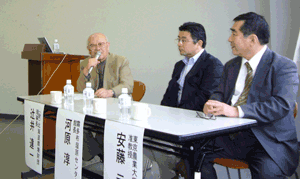 On May 8 (Thu.), 2008, the KIWC Technical Committee held a lecture meeting entitled The Disappearance of River Otters and Increasing Mink Populations at the Kushiro Tourism and International Relations Center.
With Dr. Tatsuichi Tsujii (Chair of the KIWC Technical Committee and President of the Hokkaido Environment Foundation) leading the meeting, Atsushi Kawahara (a KIWC Technical Committee member and President of the Kiritappu Wetland Center) and Motokazu Ando (an Associate Professor at the Department of Applied Biophilia at Tokyo University of Agriculture's Faculty of Agriculture) served as lecturers and introduced the latest information on the relationships between alien mammal species and native animals in Hokkaido with a focus on mink(Mustela vison), which have been observed in increasing numbers in the Kushiro area in recent years.
Mr. Kawahara's lecture, entitled Mustelids in Hokkaido, introduced differences in the appearance and ecology of such animals within the prefecture in clearly understandable terms using slides and stuffed specimens. He explained that different mustelid species live in diverse environments ranging from rivers to mountains, and that the invasion of the mink - a relatively large member of the weasel family - might have caused changes in the distribution of native weasels.
In his lecture, entitled Widespread Distribution of Alien Mammals Centering on Mink and Surveys on Such Distribution, Mr. Ando introduced the state of habitat distribution of alien mammals, including mink, in Japan. He explained that once an alien animal enters and begins multiplying in an ecosystem, controlling it becomes extremely difficult, which highlights the importance of preventing invasion per se as well as taking measures before alien species begin multiplying.
Also covered during the lecture meeting was how the river otter (Lutra lutra) - a member of the weasel family once commonly seen in rivers in Japan - has now disappeared. This example was used to illustrate the paramount importance of responding promptly and carrying out promotional and educational activities to protect wildlife, as well as the need to draw on this experience in future activities.
Approximately 80 locals and nature conservationists attended the lecture meeting, which also saw lively question and answer exchanges.
On May 8 (Thu.), 2008, the KIWC Technical Committee held a lecture meeting entitled The Disappearance of River Otters and Increasing Mink Populations at the Kushiro Tourism and International Relations Center.
With Dr. Tatsuichi Tsujii (Chair of the KIWC Technical Committee and President of the Hokkaido Environment Foundation) leading the meeting, Atsushi Kawahara (a KIWC Technical Committee member and President of the Kiritappu Wetland Center) and Motokazu Ando (an Associate Professor at the Department of Applied Biophilia at Tokyo University of Agriculture's Faculty of Agriculture) served as lecturers and introduced the latest information on the relationships between alien mammal species and native animals in Hokkaido with a focus on mink(Mustela vison), which have been observed in increasing numbers in the Kushiro area in recent years.
Mr. Kawahara's lecture, entitled Mustelids in Hokkaido, introduced differences in the appearance and ecology of such animals within the prefecture in clearly understandable terms using slides and stuffed specimens. He explained that different mustelid species live in diverse environments ranging from rivers to mountains, and that the invasion of the mink - a relatively large member of the weasel family - might have caused changes in the distribution of native weasels.
In his lecture, entitled Widespread Distribution of Alien Mammals Centering on Mink and Surveys on Such Distribution, Mr. Ando introduced the state of habitat distribution of alien mammals, including mink, in Japan. He explained that once an alien animal enters and begins multiplying in an ecosystem, controlling it becomes extremely difficult, which highlights the importance of preventing invasion per se as well as taking measures before alien species begin multiplying.
Also covered during the lecture meeting was how the river otter (Lutra lutra) - a member of the weasel family once commonly seen in rivers in Japan - has now disappeared. This example was used to illustrate the paramount importance of responding promptly and carrying out promotional and educational activities to protect wildlife, as well as the need to draw on this experience in future activities.
Approximately 80 locals and nature conservationists attended the lecture meeting, which also saw lively question and answer exchanges.
 The KIWC Technical Committee is planning to conduct hearing- and questionnaire-based investigation into the status of mink in wetlands in the Kushiro area as part of the Research on Alien Species Affecting Wetland Ecosystems theme of its studies from 2007 to 2009. This lecture meeting was aimed at deepening the understanding of locals and those concerned with nature conservation about mink and other alien animals prior to these studies, and the organizer called on participants to cooperate in the investigative activities involved.
|
|
JICA 2008 Training Course in Wetland Conservation |
|
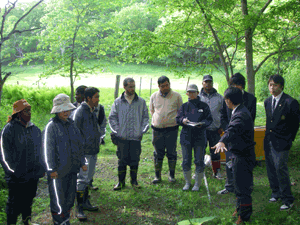 From May 19 (Mon.) to July 1 (Tue.), 2008, a Japan International Cooperation Agency (JICA) group training course entitled Conservation, Restoration and Wise Use of Wetland Ecosystems and Their Biological Diversity was held. The JICA Obihiro International Center served as the event's administrative institution, while the hosting institutions were the Ministry of the Environment's Nature Conservation Bureau and KIWC.
This session - the last part of a five-year training course - was attended by seven middle-ranking administrative officers and experts involved in wetland and biodiversity conservation from each of seven countries (Brazil, China, Kenya, Malaysia, Nepal, the Philippines and Uganda).
During the training, the participants visited all types of wetland nationwide, ranging from wetlands in eastern Hokkaido to tidal flats and countryside forests (Satoyama) in the Tokyo Metropolitan Area of Honshu (Japan's mainland), garden ponds in Kyoto and mangrove forests and coral reefs in Okinawa. The attendees experienced the environmental education programs and eco-tours offered in these wetland areas. Based on their observations of exhibitions and research facilities concerning wetland ecosystems, the participants devised/presented specific plans for the sustainable use of natural resources and the conservation of wetland ecosystems and biodiversity in their respective countries.
During their stay of almost two months in Japan, the participants deepened their understanding of Japanese people and their lifestyles. With the cooperation of local volunteers, they visited ordinary households and schools in Kushiro and enjoyed an exchange program that included trading views with university students learning about eco-tours.
|
|
A joint UNITAR workshop |
|
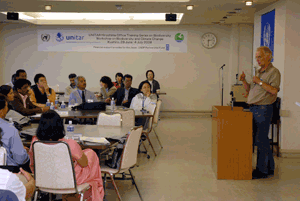 From June 29 (Sun.) to July 4 (Fri.), 2008, the United Nations Institute for Training and Research (UNITAR) and KIWC co-organized a training workshop on biodiversity for Asia and the Pacific region. This was the seventh UNITAR training workshop to be held in Kushiro, and was the last of three UNITAR workshop sessions entitled Series on Biodiversity, which started in 2004.
Based on the theme of biodiversity and climate change, the workshop welcomed 35 participants from 22 countries primarily in Asia and the Pacific region, including environmental policy makers, project managers for environmental conservation and development, and researchers in the fields of biodiversity and climate change. The attendees also included past participants (UNITAR Kushiro Alumni) returning to Kushiro with the results of their ensuing research activities.
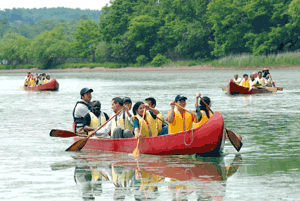
As well as attending lectures and case studies, the participants also joined a two-day, one-night study tour to Kushiro Wetland and Lake Akan. Based on knowledge and experience obtained from this program, the attendees also engaged in practical training, breaking into groups and devising/presenting plans to conserve and manage actual wetland ecosystems.
 At the main site of the workshop (Kushiro City Kohryu Plaza "Saiwai"), a hands-on program to showcase the Japanese tea ceremony and flower arranging was also held with the cooperation of local cultural organizations. The program was well received by the participants, many of whom had never tried the tea ceremony or flower arranging before.
|
|
JICA 2008 Training Course in Eco-Tourism |
|
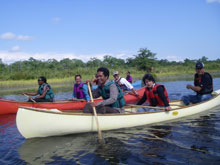 From September 8 (Mon.) to October 15 (Wed.), 2008, a Japan International Cooperation Agency (JICA) group training course entitled Management for Eco-Tourism and Sustainable Use of Natural Parks was held. The JICA Obihiro International Center served as the administrative institution, while KIWC acted as the hosting institution. The course was attended by six middle-ranking administrative officers and engineers involved in national park operation and tourism promotion from five countries (Argentina, Indonesia, Laos, Samoa and Uganda).
Eco-tours have recently attracted attention as a method of regional development via conservation and sustainable utilization of regional natural and cultural resources. Through lectures and practical training, the participants learned about various aspects of eco-tours (including theory, monitoring and operation/management) primarily from case studies on national and prefectural parks in eastern Hokkaido - a place characterized by its rich natural environment - with numerous eco-tour examples utilizing fisheries, dairy farming and other existing industries. To conclude the training course, the participants devised and presented action plans according to the circumstances of their home countries based on the knowledge and experience they had gained from the sessions.
During the course, which lasted for more than a month, the participants also enjoyed interaction with locals in an exchange program that included visits to local households and schools.
|
|
JICA 2008 Training Course in Participatory Environmental Conservation |
|
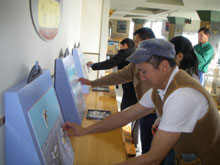 From October 27 (Mon.) to November 7 (Fri.), 2008, a Japan International Cooperation Agency (JICA) group training course for Mongolia entitled Participatory Environmental Conservation was held. At Ogii Nuur, a Ramsar site, a visitor center is currently being constructed as part of JICA's Catchment Area Management Model Project. By way of preparation for the center's operation, four officials from national/local governments and a local NGO participated in the course.
The training was held in Kanto and Hokkaido, with KIWC in charge of the Hokkaido sessions. During the course, the participants visited national parks and nature-based facilities at Ramsar sites in eastern Hokkaido, and learned about methods of exhibition and explanation through inspection and practical training. They also learned techniques for the implementation of facility-based environmental education programs and eco-tours. The attendees shared their respective ideas about specific plans to promote environmental conservation and utilization through the participation of local residents, and also expressed their aspirations to apply the example of public-private partnership learned during the training course to their home countries.
|
|
Participation in the 10th Meeting of the Conference of the Contracting Parties to the Convention on Wetlands |
|
From October 28 (Tue.) to November 4 (Tue.), 2008, the 10th Meeting of the Conference of the Contracting Parties to the Convention on Wetlands was held in Changwon, South Korea. From KIWC, the Director-General of the Secretariat and two staff members participated in the event. The KIWC representatives engaged in public relations activities using posters and pamphlets in the Wetlands International Japan (WIJ) booth at the exhibition hall of the convention center that served as the conference venue. They also made presentations at peripheral events to introduce KIWC's efforts to promote the conservation and wise use of wetlands. Furthermore, as many previous participants in international wetland conferences and training sessions hosted by KIWC also attended this conference, the KIWC representatives exchanged recent news and the latest information concerning wetland conservation with them.
During their stay in Changwon, the representatives visited City Hall and wetlands near the conference venue to learn about the situation of wetlands in South Korea - Japan's nearest neighbor.
|
|
Official delegation from sister wetlands in Australia visits Kushiro |
|
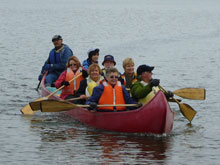 An official delegation from Australia's Port Stephens, the location of the Hunter Estuary Wetlands Ramsar site (which has a sister relationship with the one in Kushiro) visited Kushiro in November 2008. The delegation was comprised of six members of the Port Stephens Sister Cities Committee (an organization operated by local residents) and was headed by Ted Tindall, a member of the committee. They were in Kushiro from November 13 (Thu.) to 17 (Mon.), 2008, and inspected Kushiro Wetland while enjoying stays at local households.
A welcome tea party was held on November 14 (Fri.) with the attendance of representatives from the local governments concerned and people involved in wetland conservation, as well as Kushiro citizens who joined the official delegation to the Hunter Estuary Wetlands Ramsar site in November 2007. They celebrated their reunion and cherished memories of their exchange trips through slides shown during the party, thereby forging closer relationships between representatives of the sister wetlands in a casual, friendly atmosphere.
An official delegation from Australia's Port Stephens, the location of the Hunter Estuary Wetlands Ramsar site (which has a sister relationship with the one in Kushiro) visited Kushiro in November 2008. The delegation was comprised of six members of the Port Stephens Sister Cities Committee (an organization operated by local residents) and was headed by Ted Tindall, a member of the committee. They were in Kushiro from November 13 (Thu.) to 17 (Mon.), 2008, and inspected Kushiro Wetland while enjoying stays at local households.
A welcome tea party was held on November 14 (Fri.) with the attendance of representatives from the local governments concerned and people involved in wetland conservation, as well as Kushiro citizens who joined the official delegation to the Hunter Estuary Wetlands Ramsar site in November 2007. They celebrated their reunion and cherished memories of their exchange trips through slides shown during the party, thereby forging closer relationships between representatives of the sister wetlands in a casual, friendly atmosphere.
|

|