
|
|
Mink Research by the KIWC Technical Committee |
|
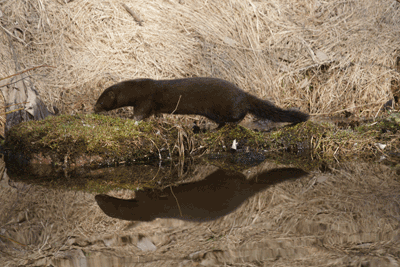
With the theme of FY2007 to FY2009 "Alien Species Affecting Wetland Ecosystems", the KIWC Technical Committee, which is composed of 9 specialists in wetlands and ecosystems, has conducted investigations and public awareness activities on alien species seen in the Kushiro region. In FY2009, the last year of research study activities on "Alien Species Affecting Wetland Ecosystems", we focused on American mink from North America (invasive alien species), and conducted a questionnaire survey from May to November to grasp inhabiting situation of mink in Wetlands designated under the Ramsar Convention (Kushiro-shitsugen Wetland, Lake Akkeshi, Bekanbeushi Wetland, Kiritappu Wetland and Lake Akan) and their surrounding areas, and to collect information on mink farms which dotted the surrounding area before. We distributed 479 questionnaires to nature conservation groups, wildlife conservation officers, tourist agencies, etc. and received 221 responses, which included 472 cases from witnesses. (response rate was about 46%.) From distribution of sighting spots or situations of sighting, we found out that minks are living in almost every region of the riverside of Kushiro-shitsugen Wetland and Bekanbeushi Wetland, and around the Lake Akan, and have deep relations with a variety of creatures (such as small animals that serve as prey) as a part of the ecosystem in the region. These questionnaire results showed that about 80% of respondents had an opportunity to visit the surveyed wetlands for nature observation, fishing, or on business, and furthermore, nearly 80% of respondents could picture the shape of a mink, or knew it well. In addition, 60% of respondents said they had seen wild minks, and the result revealed that minks are a relatively familiar creature for people who are involved with Ramsar sites in the Kushiro region.
|
|
Holding of a Debriefing Session on Mink Research |
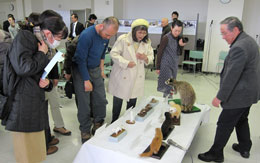 A debriefing session on mink research entitled "Minks and Alien Species in Kushiro Region" was held on March 27, 2010 at the Kushiro Lifelong Learning Center under the auspices of KIWC Technical Committee.
About 80 people, including those who answered a questionnaire, nature-loving folks who take an interest in wetlands and other related parties, attended the session. In the session, an overview of the "investigation on the state of the inhabitation of minks around Ramsar sites in the Kushiro region" implemented in 2009 was introduced, then Atsushi Kawahara, a member of the committee and president of the Kiritappu Wetland Center, explained the current state of introduced mustelid species including minks. Next, with Hisashi Shinsho, the senior technical member of the committee, leading the session, we exchanged opinions with participants on how to get along with alien species including minks in the region in the light of the results of the survey. Tatsuichi Tsujii, chairman of the committee and president of the Hokkaido Environment Foundation, offered comments, and participants also expressed their opinions vigorously. At the site, some items such as photos of minks provided during the survey, stuffed mustelid animals including minks and mink fur goods, were exhibited and attracted attention from participants. |
|
JICA 2009 Training Course on Eco-Tourism |
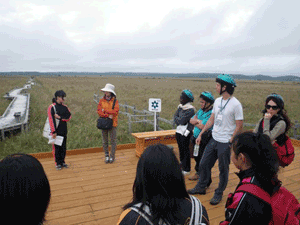 From September 7 to October 13 of 2009, a JICA group training course entitled "Management, Operation and Sustainable Use of Natural Parks (Eco-tour)" was held. The OBIC served as the administrative institution, while KIWC acted as the hosting institution. This year, the last year of the five-year course, 5 middle-ranking administrative officers involved in national park operation and tourism promotion participated from 3 countries (Argentina, Laos and Uganda).
To promote "Eco-tours", which have recently attracted attention as a method of regional development via conservation and sustainable utilization of regional natural and cultural resources, in their own countries, the participants learned various facts on eco-tours through a variety of programs such as lectures on theory and development of laws, inspection of natural parks, and actual experience of eco-tours utilizing rich natural environment, fisheries, dairy farming and other existing industries in eastern Hokkaido. Based on these experiences, they organized their ideas with the advice of the course leader (instructor of the training) and through discussions conducted during the training between instructors and members, and presented action plans on the final day. Although participants spent a busy one and a half month period due to many outdoor activities and tough schedules, they also played a part in exchanges in private sectors. For example, they were entertained by local people through an exchange program including visits to local households, and interacted with children via practical training for an environmental education program at elementary schools. |
|
JICA 2009 Training Course on Participatory Environmental Conservation |
|
From October 26 to November 12 of 2009, a JICA group training course for Mongolia entitled "Participatory Environmental Conservation" was held. At Ogii Nuur (Nuur means a lake.), a Ramsar site, an information center for visitors and a facility for activities of local residents have recently established as part of JICA's "Catchment Area Management Model Project". As a cooperation project, training for developing human resources who manage facilities has been conducted since 2007, and it ended this year. Total of four people, consisted of local persons who have already been involved in planning and operation of the center as a staff member and officials from national and local governments who take a supporting role on these activities from the administration side, participated in the training. Based on cases of public organizations which have been conducting regional eco-tours and environmental education activities at nature information facilities in national parks and Ramsar sites in eastern Hokkaido, participants learned exhibition methods and other knowledge necessary for promoting awareness for local residents and collaboration with them. 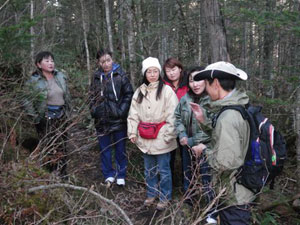 Since the participants were all women, team work was good and willingness to study or research was high.
 At the debriefing session held on the last day of the training, they presented concrete and practical proposals to utilize the absorbed knowledge in each position. We are looking forward to their practical activities after they return home. |
|
Winter Eco-tour 2010 held to mark World Wetlands Day |
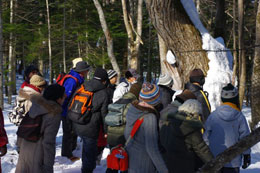 To mark this year's World Wetlands Day (every February 2nd), the "Winter Eco-tour 2010" was held for local residents on January 31, 2010. A total of 26 people, including staff members as well as tour participants, visited Lake Akan, which is one of the Ramsar sites in the Kushiro region, and enjoyed walking in the lakeside forests and on the frozen lake.
 Lake Akan, 420 meters above sea level, is a caldera lake located in Akan National Park. Although this area is especially cold in Hokkaido, participants enjoyed following in the footprints of Ezo Red Squirrels and Ezo Shika Deer or observing plants perish in winter, etc. by making their way through the knee-deep snow. Despite the cold bitter midwinter, there was no snow around Bokke (mud volcano) near a promenade along the lake due to underground heat, and the participants were surprised at the warm ground and growing fresh moss. After the stroll, they moved to a municipal multipurpose facility, "Marimu-kan Hall", which utilizes heat from hot spring water as a heater, and enjoyed bingo games featuring "what one found on the lakeside." The theme of World Wetlands Day in 2010 is "biodiversity and climate change in wetlands". In light of deteriorating environment of wetlands, which have rich biodiversity, due to recent climate change and impact of human activities, we are calling for a "sympathy" to conserve wetlands. This tour was a good opportunity to ponder the theme together because Lake Akan is surrounded by rich environment such as rivers, forests, volcanoes, etc., and is inhabited by many valuable animals and plants including marimo. |
|
Co-hosting of Environmental Seminar "Environmental Policy and Measures against Climate Change of the EU" |
|
The seminar on Environmental Policy and Measures against Climate Change of the EU, which was hosted by the Kushiro Nature Conservation Office of the Ministry of the Environment and KIWC, was held on February 19, 2010 at the Kushiro Tourism and International Relations Center.
In this seminar, Ms. Julie Raynal, who is the first secretary of the Delegation of the European Union to Japan, spoke on environmental policy conducted at the initiative of the EU in European countries where measures against global warming are advanced. Ms. Raynal studied at the faculty of law of Nice Sophia Antipolis University and Graduate School of Sorbonne University, and has been working as a legal expert of the EU, and also been engaged in international negotiations on climate change and measures for European climate change. 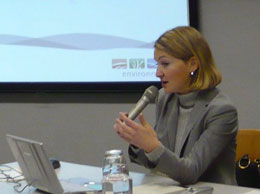 This time, she explained to general audience comprehensibly about the current situation of the environmental policy of the EU, climate change, biodiversity, waste disposal policy, contents of international conference, etc., and also emphasized the significance of conserving forests and wetlands as a measure against global warming.
 |
