
|
|
Eco Life Fair 2011 - Blessings of Wetlands: Tourism and Local Goods of Ramsar Sites |
|
The Eco Life Fair 2011 was hosted by Japan's Ministry of the Environment in Tokyo's Yoyogi Park on June 4 and 5, 2011. Every year, the Board of Municipalities Related to Japanese Ramsar Sites, the Ramsar Center Japan (RCJ) and Wetland International Japan (WIJ) jointly run a booth with the theme Blessings of Wetlands: Tourism and Local Goods of Ramsar Sites. As part of its efforts to raise awareness of nature issues, tourist destinations and environmental conservation activities in the Kushiro region, KIWC supplies the booth with posters and pamphlets featuring the local Ramsar sites of Kushiro-shitsugen, Akkeshi-ko/Bekambeushi-shitsugen and Akan-ko, along with local specialties including sweets and water, environmental education kits in the shape of whooper swans, and other materials for distribution and display. This year's Eco Life Fair attracted 72,000 visitors over two days, and the booth showcasing Ramsar sites throughout the nation was popular for its wetland quizzes and provision of local goods. |
|
Kushiro Eco-Fair 2011 |
|
This event sponsored by the Kushiro Eco-Fair 2011 Executive Committee was held at the Kushiro Children's Museum Kodomo Yugakukan on June 4 and 5, 2011. It attracted a large number of local residents, particularly families with children in preschool or elementary school, who visited exhibition booths run by local environmentalist groups and enjoyed hands-on handicraft activities. KIWC participated in this event as a member of the Kushiro Wetland Restoration Committee's Public Awareness Action Plan Working Group. It displayed posters reporting the results of a FY 2010 survey on the Kushiro River, whose meandering form was restored under the Kushiro Wetland Nature Restoration Project. The resources provided also included a chronological table summarizing more than 100 years of the history of conservation and utilization in the Kushiro Wetland, various reports, newsletters and kits for making swan/crane-shaped paper planes. |
|
Public Participation Survey of a Restored River Environment - Summer 2011 |
|
On July 2, 2011, an environmental survey involving locals was conducted in the Kayanuma District in the town of Shibecha, where the meander of the Kushiro River's middle course was restored in February 2010 after 30 years as part of the Kushiro Wetland Nature Restoration Project. The survey, which involved a monitoring study and was the third such investigation, was initiated in August 2010 to raise local interest in the Kushiro Wetland and to deepen residents' understanding of the nature restoration project. A total of 28 locals, including elementary school and junior high school students, participated in the survey. They were divided into three groups (an aquatic organism survey team, a soil survey team and a vegetation survey team), and investigated aquatic organisms, riverside vegetation and soil composition in an area stretching approximately one kilometer before and after the point where the backfilled straight channel joins the restored old channel. Four KIWC technical members joined the teams as leaders. These were Hisashi Shinsho (soil), Tsutomu Hariu (fish), Yachiyo Takashima (plants) and Shigeharu Terui (aquatic organisms). Their work confirmed traces of floods and sedimentation, changes in the particle size of sediment carried from the upstream region, and other changes that had occurred during the year since the restoration of the old meandering channel. Impressions voiced by the participants included a realization that the river environment had undergone changes, albeit slowly, even though it was only a year since the restoration, and a new understanding of the motives for the meander restoration work (e.g., sediment discharge prevention). 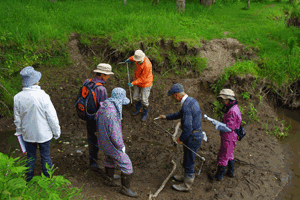 Surveys in FY 2011 are being implemented with funding for river improvement projects by the Foundation of River & Water Environment Management. Another investigation, called the Autumn 2011 Public Participation Survey on the Restored River Environment, is scheduled for September 2011 to investigate natural stream environmental conditions in the lower reaches of the restored old channel.
 |
|
JICA Training Course on Conservation and Wise Use of Wetlands in the Context of Implementing the Ramsar Convention and the Convention on Biological Diversity |
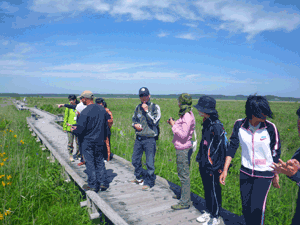 From June 6 to July 19, 2011, we welcomed trainees from the Obihiro International Center of the Japan International Cooperation Agency (JICA) for a group training course entitled Conservation and Wise Use of Wetlands in the Context of Implementing the Ramsar Convention and the Convention on Biological Diversity.
The aim of this course, which was held under the auspices of the Ministry of the Environment, is to promote the conservation and wise use of wetlands. Participants identify challenges facing their countries and plan/implement specific projects to address them. In FY 2011 (the third and final year of the training course), the participants were four national and provincial government officials in charge of wetland and biodiversity conservation from Malaysia, Mongolia and the Philippines. Taking advantage of Japan's environments of rich biodiversity, the training was held in the four locations of Okinawa, Fujiyoshida, suburban Tokyo and Kushiro in Hokkaido as venues that span the range from coral reefs and mangrove swamps in Japan's subtropical zone to peat swamp conditions in its subarctic zone. The trainees inspected facilities tasked with awareness-raising and research institutions, including premises run by the Ministry of the Environment, and attended lectures given by experts in biodiversity conservation and administrators in charge of biodiversity conservation policies. They also participated in eco tours and environmental education programs in these areas. Through such experiences, they gained insights into specific methods for the conservation and wise use of wetlands based on the guiding principles of international conventions and related challenges. At a report presentation session held on the last day of the course, they presented project proposals based on ideas they had formulated as a result of the training course. The proposals included environmental education programs for women and children, and wild bird monitoring surveys to be conducted at schools. During their stay in Kushiro, the participants also had a number of opportunities to interact with locals of all ages and from all walks of life through initiatives such as home-visit and school-visit programs. |
