
|
|
JICA's Jalapao Region Ecological Corridor Project |
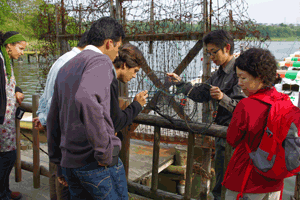 The Japan International Cooperation Agency (JICA) ran a training program in the Kushiro region for officials from Brazil's Ministry of the Environment from June 20 to 23, 2011. During the course, KIWC provided hands-on training on June 21 and 22.
The program was implemented as part of the Ecosystem Corridor Project, under which JICA engages in technical cooperation in Brazil's Jalapao region to support the conservation of biodiversity in the country's subtropical savanna. Three officials from the Chico Mendes Institute for Biodiversity Conservation (ICMBio) - JICA's partner institution in the project - participated in the program. The training introduced wetland conservation initiatives based on public-private partnerships, examples of wise use and awareness-raising techniques through lectures on networking for conservation of the Kushiro Wetland, practical training on environmental education, an inspection tour to facilities to provide nature information, and other activities. |
|
2011 JICA Eco-tour Training Course |
|
From August 29 to October 4, 2011, the JICA Obihiro International Center ran a group training course on Eco-tourism for Sustainable Use of Natural and Cultural Resources with KIWC as the host organization. The course was attended by seven middle-ranking national and regional administrators tasked with natural park management and tourism promotion in Argentina, Kenya, Sri Lanka, Thailand, Uganda, Vanuatu and Vietnam. Eco-tourism attaches importance to the natural and cultural resources of destinations while focusing on their natural and social environments. It has recently attracted attention in developing nations as a method of supporting regional development because it allows local residents to join in with tour operation and ensure the sustainable use of local natural and cultural resources in tourism, thereby enabling them to profit directly. The trainees learned about eco-tourism from various viewpoints during the five-week period, participating in tours that highlighted the existing fishing and dairy faming industries, environmental education sessions, practical training in environmental monitoring and related inspections in the beautiful natural environment of eastern Hokkaido. They also learned about examples of eco-tour programs concerning historic sites and community-based forests in Tokyo and Kyoto with a focus on traditional Japanese culture and its relationship with nature. 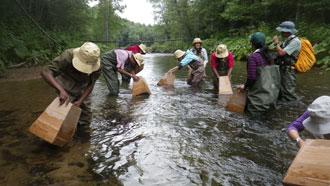 The trainees had a variety of opportunities to interact and build friendships with Japanese people during the course. These included a home-visit program and exchange sessions with locals held in conjunction with a volunteer organization in Kushiro, an experiential environmental education program involving elementary school students, and a workshop with university students studying eco-tourism. The trainees, who were from countries with different natural environments and cultures, exchanged information on current situations and initiatives in their own countries and worked together to ensure a fruitful stay in Japan. The course was completed successfully.
 |
|
Public-participation Survey of a Restored River Environment - Autumn 2011 |
|
The course of the Kushiro River in the Kushiro Wetland's Kayanuma District was straightened in the 1980s in the interests of flood control and farmland development. A part of the district was later designated as a national park, and flow from the lowest 1.6-kilometer-long straightened section was redirected to a 2.4-kilometer-long section of the old meandering channel in 2010 as part of the Kushiro Wetland Nature Restoration Project. On September 10, 2011, this year's second public-participation environmental survey was conducted in the district. This program of monitoring surveys was launched in July 2010 to raise local interest in the Kushiro Wetland and to enhance local awareness of the restoration project. A total of 25 locals ranging from teenagers to those aged 80+ contributed to the latest survey. The participants paddled 5.5 kilometers down the river in three canoes from the area downstream of the restored old channel to the point where it joins the backfilled straight channel and on to the natural stream in the wetland's center. They observed water flows, riverbank erosion, traces of flooding, riparian environments and other aspects of the channel. With the guidance of KIWC senior technical member Mr. Hisashi Shinsho, the surveyors stopped at three sandbanks to examine the composition and other details of riverbank sediment carried from the upstream region. After the canoe survey, the participants visited the Lake Toro Eco-Museum Center (located by Lake Toro in the eastern part of the wetland) to review the results. They presented their findings and shared impressions among canoe groups. Some participants discovered traces of flooding in the restored channel, while others found differences in riparian vegetation between the inner and outer sides of curves in the natural stream. Some spotted red-crowned crane footprints on the sandbanks, and others spoke of the enjoyment of spending time in the huge wetland under the vast sky. Surveys in FY 2011 were implemented with river improvement project funding provided by the Foundation of River & Water Environment Management. 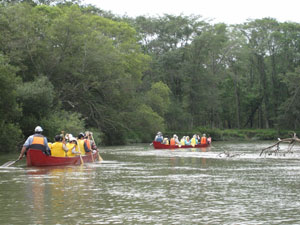 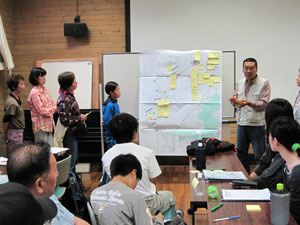 |
|
KIWC Technical Committee On-Site Study Meeting |
|
On August 19, 2011, the KIWC Technical Committee held a study meeting at the site of Lake Akan's marimo algae ball colonies in relation to the committee's study theme for 2010 - 2012: Resident Participatory Water Environment Restoration from the Viewpoint of Biodiversity. Fifteen committee members, including experts in biodiversity conservation from the Kushiro region, attended the meeting and inspected marimo colonies in Churui Bay - a site to which access is usually restricted. Marimo (Aegagropila linnaei) is a species of filamentous green algae that usually grows on rocks at the bottom of bodies of water or as floating filaments dissociated from rock. In Lake Akan, marimo grows into large balls in a phenomenon seen nowhere else in the world. The marimo algae balls in the lake have been designated as a special natural monument of Japan. Isamu Wakana, a KIWC Technical Committee member and Curator of Marimo Laboratory, Lake Akan Eco-museum Center, gave a lecture on marimo, explaining that the spherical form grows only when certain conditions (such as those related to lake-bed terrains and wind-related wave generation) are met, and when the requisite minerals (hot-spring minerals in the case of Lake Akan) are provided. The lecture highlighted how Lake Akan's very limited area miraculously satisfies these conditions, and also clarified that the protection of marimo colonies requires preservation of the entire catchment area (including rivers flowing into the lake and spring water) rather than just the lake itself. 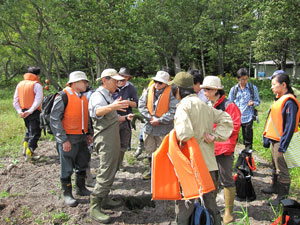 The attendees' activities included inspecting marimo in the lake, looking at the surrounding aquatic environment and observing a marimo growth experiment underway in the Lake Akan Eco Museum Center's marimo laboratory. They then exchanged views and opinions on the environment of Lake Akan and discussed challenges relating to biodiversity conservation.
 |
