
|
|
Eco Life Fair 2012 - Blessings of Wetlands |
|
The Eco Life Fair 2012 was hosted by Japan's Ministry of the Environment in Tokyo's Yoyogi Park on June 2 and 3, 2012, and drew a total of around 66,000 people. Every year, the Board of Municipalities Related to Japanese Ramsar Sites, the Ramsar Center Japan (RCJ) and Wetland International Japan (WIJ) jointly run a booth with the theme Blessings of Wetlands to promote sightseeing spots and goods from local Ramsar site areas. This year's event saw the participation of representatives from 25 organizations and 29 of the 46 sites designated in Japan as Wetlands of International Importance, who publicized tourist spots and local specialties at their wetlands by displaying posters, giving away local goods and fliers, and conducting quizzes and other events. To promote the blessings of the Kushiro region, KIWC ran a booth with posters and pamphlets featuring the local Ramsar sites of Kushiro-shitsugen and Akan-ko, along with local sweets, red-crowned crane origami, paper airplane kits and other materials for distribution and display. |
|
Kushiro Eco-Fair 2012 |
|
This Kushiro Eco-Fair 2012 Executive Committee-sponsored event was held at the Kodomo Yugakukan Kushiro Children's Museum during Environment Month on June 9, 2012, to help locals consider their daily living habits and the environment by promoting eco-friendly activities. Children and adults alike enjoyed quizzes and handicraft activities at exhibition booths run by local environmental groups and in special interactive areas. KIWC participated in this event as a member of the Kushiro Wetland Restoration Committee's Public Awareness Action Plan Working Group. It displayed panels outlining its activities and a chronological table summarizing the history of events concerning the Kushiro Wetland, and gave away kits for making whooper swan/red-crowned crane-shaped paper planes and other materials. |
|
JICA Counterpart Training on Iran's Anzali Wetland Ecological Management Project |
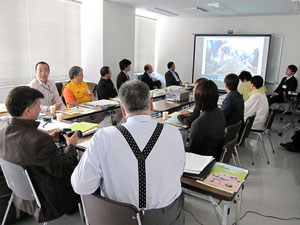 From June 18 to 20, 2012, KIWC ran a JICA training course for officials from Iran's Department of Environment. The course was part of a technical collaborative project implemented by JICA in Iran to conserve the Anzali Wetland, and two officials from Iran's Department of Environment (which has jurisdiction over the project) visited Kushiro.
On the first day of the training, a workshop was held for the trainees and people related to the Kushiro Wetland. The nine attendees from Japan were government officials engaged in the conservation of the wetland and related awareness raising, networking and other activities, along with representatives of NGOs and the general public. The session began with an introduction to the Anzali Wetland, followed by presentations from Japanese attendees who outlined their links to the Kushiro Wetland and described the objectives of related initiatives, challenges and considerations in their respective capacities. The Iranian trainees showed photos and video footage of the Anzali Wetland with beautiful lotus flowers and airborne waterfowl. The images were well received, and it was found that the wetland had a lot in common with the Kushiro Wetland, including geographical proximity to urban areas and a rich sphere of biodiversity that encompasses endangered species. A field tour to the Kushiro Wetland on the second day provided opportunities to observe its natural environment and related facilities. A range of initiatives implemented in regard to the wetland were also highlighted through discussions with local fishermen, tour organizers, facility staff and other related parties. During the training, discussions among the trainees, Japanese officials involved in the Anzali Wetland conservation project and KIWC representatives were held, and a memorandum on technical collaboration between the two wetlands and consideration of international interaction was established. |
|
JICA Training on Conservation and Sustainable Use of Biodiversity in Wetland Ecosystems on a Community Base |
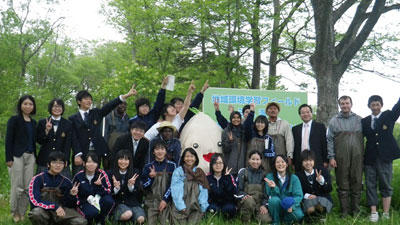 From May 14 to June 26, 2012, guests from the Hokkaido International Center (Obihiro) of the Japan International Cooperation Agency (JICA) were hosted for group training. This course has been held since 1994 with different themes/names under the auspices of the Ministry of the Environment. The trainees are government administrative officials from developing countries who are engaged in wetland/biodiversity conservation. The course on Conservation and Sustainable Use of Biodiversity in Wetland Ecosystems on a Community Base will be run annually for three years from fiscal 2012. This year's course was attended by seven people from six countries (the Philippines, Thailand, Vietnam, Albania, Malaysia and Uganda).
The trainees visited wetlands located in areas from subtropical to subarctic zones in five regions - Okinawa, Fujiyoshida, suburban Tokyo, Miyagi and Kushiro in Hokkaido. They learned about uses of countryside forests (satoyama), environmental education programs, eco-tours and other specific considerations from various related parties, including local residents and representatives of national/local governments and NGOs involved in the conservation of wetland biodiversity, related awareness-raising activities, eco-tours and other matters. They also discussed the development of a mechanism based on grass-roots initiatives for the conservation and sustainable use of biodiversity. Attendees went on field tours, visiting Hokkaido Shibecha High School (where students are working on a system for water purification using wetland vegetation) and talking to farmers based near Miyagi Prefecture's Kabukuri-numa (a Ramsar site along with the surrounding rice paddies) and local government officials. These Miyagi farmers grow rice in environmental harmony with migratory birds that spend winter in their paddies. In Kushiro, trainees also interacted with locals through a home-visit program. At the end of the course, the trainees gave presentations on draft projects they planned to initiate after returning to their respective countries in order to use knowledge and experience gained in Japan for grass-roots wetland conservation and utilization. The numerous ideas they shared included holding workshops for local residents and awareness-raising events capitalizing on existing anniversaries, building a biodiversity database and implementing related monitoring activities. |
|
11th Meeting of the Conference of the Contracting Parties to the Ramsar Convention |
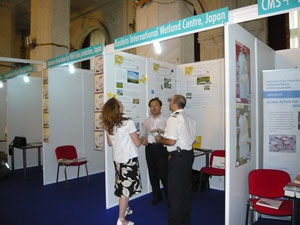 The 11th Meeting of the Conference of the Contracting Parties (COP11) to the Ramsar Convention was held at the Palace of the Parliament, also known as the People's House, in Bucharest, Romania, from July 6 to 13, 2012. Representatives of around 180 institutions (including delegates from contracting parties, NGOs working in wetland conservation and researchers) attended to discuss 22 draft resolutions and other agenda items, including various tasks to be completed by the next meeting in 2015. The theme of COP11 was Wetlands: home and destination. It featured discussions on tourism promotion from the viewpoints of the value and wise use of wetlands and specific related measures, as well as exhibitions and other events focusing on the appeal of wetlands as a tourism resource.
KIWC attended the meeting as an observer from July 5 to 10 and ran a booth to publicize activities for the conservation and wise use of four Ramsar sites in the Kushiro region (Kushiro-shitsugen, Akkeshi-ko/Bekambeushi-shitsugen, Kiritappu-shitsugen and Akan-ko). Particular emphasis was placed on tourism-related initiatives in Kushiro, including wetland tours in collaboration with local industries, considerations relating to plants and animals, and eco-tourism training in Kushiro for developing countries. The KIWC booth was popular for its posters and origami pieces in the forms of Hokkaido sika deer, Blakiston's fish owls and wetland flowers created by professional origami artist Akiko Kasei. Giveaways including origami red-crowned cranes and whooper swan/red-crowned crane-shaped paper plane kits were well received by visitors, many of whom took several as samples of environmental education tools or as gifts for children. After the event, KIWC donated the origami display pieces to the Ramsar Regional Center for Central and West Asia (RRC-CWA) and posters to the Ramsar Regional Center for East Asia (RRC-EA) so that they could also be used in the future. 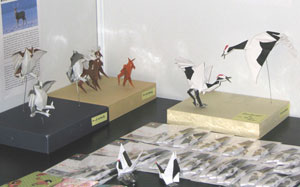 Many former attendees of KIWC training courses and international conferences also visited the KIWC booth, taking advantage of the occasion to discuss recent developments in wetland conservation. KIWC representatives also met with people involved in the conservation of the Hunter Estuary Wetlands Ramsar site (a sister wetland to the Kushiro site) and discussed possible future exchanges with wetlands in the Kushiro region.
|
