
|
|
Award of the Science Ramsar prize to KIWC Technical Committee Chair Dr. Tatsuichi Tsujii |
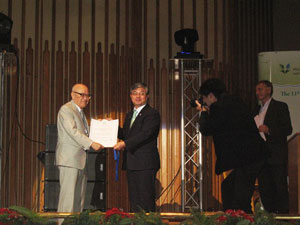 On July 6, 2012, the Ramsar Wetland Conservation Awards were conferred during the Opening Ceremony of the 11th Meeting of the Conference of the Contracting Parties to the Ramsar Convention held in Bucharest, Romania. These accolades are given to recognize and honor the contributions of individuals, organizations and governments around the world toward promoting the conservation and wise use of wetlands. Dr. Tatsuichi Tsujii, KIWC Vice President, Chairman of the KIWC Technical Committee and President of the Hokkaido Environment Foundation, received the Ramsar Wetland Science Award, becoming only the second Japanese person to do so.
Dr. Tsujii has long played a leading role in wetland conservation efforts in Japan and elsewhere, including initiatives to conserve the Kushiro-shitsugen and Sarobetsu-genya Ramsar sites and collaboration in nature restoration projects for India's Chilika Lake and other areas. The award was given in recognition of his many years of contributions in the field. During his acceptance speech, Dr. Tsujii used a humorous analogy based on Japanese ghosts and water goblins to share his thoughts on the importance of protecting beautiful waterside environments. |
|
Discussions with officials related to Iran's Anzali Wetland |
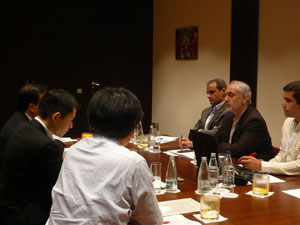 On July 7 in Bucharest, Romania, the Secretary General and another KIWC official met with staff engaged in the conservation of Iran's Anzali Wetland on the sidelines of the 11th Meeting of the Conference of the Contracting Parties to the Ramsar Convention.
The meeting followed JICA's Anzali Wetland Conservation Project training session for officials from Iran's Department of Environment, which had been held in Kushiro the previous month. The four meeting attendees from Iran were the Deputy Head of the Natural Environment Bureau, the Deputy Director General of the Department of Environment's Wetlands and National Parks Section, the National Project Manager of the UNDP/GEF Project (Conservation of Iranian Wetlands), and the Executive Director of the Ramsar Regional Center for Central and West Asia (RRC-CWA) located in Ramsar, Iran. Officials from the Japan International Cooperation Agency (JICA), which supports the Anzali Wetland Conservation Project, also attended. The meeting was characterized by lively discussions on future initiatives and related schedules to promote exchanges between parties linked to the wetlands of Kushiro and Anzali. As a side event of the Ramsar Conference, JICA made a presentation on the Anzali Wetland Conservation Project, illustrating current developments including the establishment of a nature restoration framework, environmental education, and the development of nature conservation facilities at the Anzali Wetland, where population increase, farmland development and other factors in surrounding areas have resulted in deteriorated water quality and sediment inflows. |
|
Public Participation Survey of a Restored River Environment - Summer 2012 (FY 2012 Project Sponsored by the River Environment Fund) |
|
On July 28, 2012, an environmental survey involving locals was conducted in the Kushiro River's middle course in the town of Shibecha, which included the section where the old meandering channel was restored.
It has been implemented every summer since meander restoration carried out as part of a nature recovery project allowed water to flow into the channel again in 2010, and this survey was the third such investigation. A total of 29 locals participated in three groups (an aquatic organism survey team, a sediment/soil survey team and a vegetation survey team), investigating environmental changes through activities such as catching aquatic organisms and analyzing soil composition. The KIWC technical members leading the teams were Hisashi Shinsho (soil), Tsutomu Hariu (fish), Yachiyo Takashima (plants) and Shigeharu Terui (aquatic organisms). In the aquatic organism survey, participants were surprised to find over 100 signal crayfish (Pacifastacus leniusculus), which are designated as an invasive alien species. The sediment and soil survey confirmed that the restoration of the old meandering channel had caused flooding and sandbank formation, and that a large amount of sediment carried from the upstream region had been caught as a result. The status of sedimentation was also observed by the vegetation survey team, which investigated plant types and their growth status. 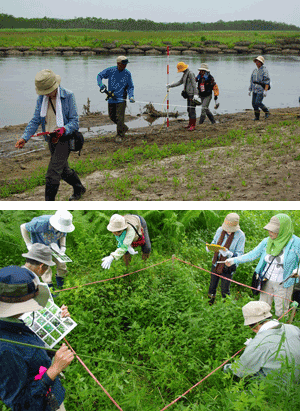 After the survey, the participants visited a nearby spa facility for data summarization and discussions. Following an expert presentation, they considered favorable river environments for riparian organisms and plants and interactively discussed the future of the Kushiro River. In a post-event questionnaire survey, respondents indicated that they had realized the importance of opportunities for locals to visit sites and to collectively consider related matters. Some also expressed a desire to continue participating in the survey so that they could monitor future environmental changes.
The survey was implemented with river improvement project funding from the Foundation of River & Water Environment Management. |
|
Public Participation Survey of a Restored River Environment - Autumn 2012 (FY 2012 Project Sponsored by the River Environment Fund) |
On September 9, 2012, a canoe survey was conducted to investigate the environment of the Kushiro River's middle course, where the old meandering channel had been restored three years earlier as part of the Kushiro Wetland Nature Restoration Project.
A total of 26 locals ranging from elementary school students to senior citizens in their 70s paddled 5.5 kilometers down the river in three canoes, traveling along the restored meandering channel past the point where it joins the backfilled straight channel to the downstream natural river section.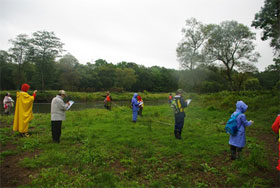 During the two-hour trip, the surveyors made notes to record information on riverbank erosion/sediment deposits, riparian vegetation, landscapes and wildlife. They also stopped at three sandbanks to examine sediment composition, sandbank sizes and other details.
After the canoe survey, the participants reviewed the results and presented their findings on a canoe-group basis. River section-based classification of discoveries showed a particularly high number of observations concerning the river's natural stream section, such as the proliferation of fallen/sunken trees, a diversity of tree species forming riparian forests, and the presence of wildlife including crested kingfishers, minks and dragonflies. 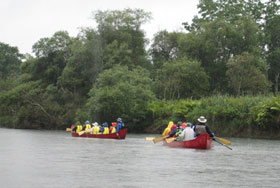 The natural section downstream of the meandering restored part serves as a reference site for the original Kushiro River environment, thus acting as a guide for the nature recovery targeted by the restoration of the old meandering channel. Given this background, the surveyors considered the future of the meandering restored channel section based on their findings. Several participants also expressed favorable impressions despite the day's rain, such as enjoyment of expansive landscapes, comfortable breezes and the beautiful luminescence of water drops. It was clear that the surveyors had enjoyed the early-autumn natural environment of the Kushiro River.
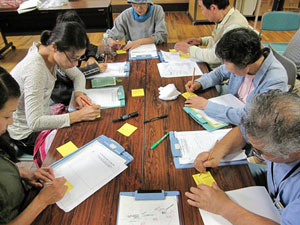 The sediment and soil survey confirmed the presence of sediment from the upstream region in the meandering restored section and the section immediately downstream of it. The participants considered the effects of the meander restoration as part of efforts to protect the river's beautiful natural environment.
|
|
JICA Training on Eco-Tourism for Sustainable Use of Natural and Cultural Resources |
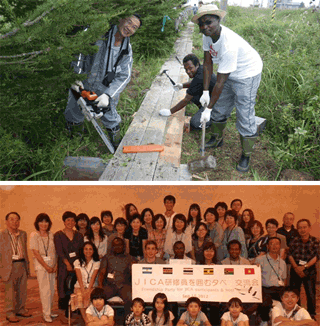 From August 27 to October 1, 2012, the Hokkaido International Center (Obihiro) of the Japan International Cooperation Agency (JICA) ran a group training course on Eco-tourism for Sustainable Use of Natural and Cultural Resources with KIWC as the host organization. The course was attended by national and regional government officials and NGO representatives engaged in natural park management/use and tourism-based regional development in six countries (Argentina, Kenya, Thailand, Uganda, Vanuatu and Vietnam).
Eco-tourism attaches importance to the natural and cultural resources of destinations in consideration of their natural and social environments. It has recently attracted attention, particularly in developing nations, as a way to support regional development because it allows locals to profit directly from the sustainable use of local natural and cultural attractions as tourism resources. However, many countries still lack the elements of infrastructure required, such as legal systems and mechanisms allowing locals to contribute to and directly profit from this type of tourism. 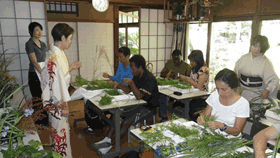 The trainees first experienced eco-tour programs in the beautiful natural environment of eastern Hokkaido, including a guided hike around Lake Shikaribetsu and canoeing on the Bekambeushi River with restrictions to mitigate possible impacts on wildlife. They also experienced sightseeing activities capitalizing on nature's bounties in local primary industries (e.g., fisheries, dairy farming), such as potato harvesting at a farm in the Urimaku region and a seafood enjoyment program featuring interaction with fishermen in the Kiritappu and Akkeshi areas. Through these experiences in addition to the course's lectures and discussions, the trainees also learned about the importance of environmental consideration in the use of natural environments and related awareness-raising/monitoring activities.
During their stay in Hokkaido, the participants also enjoyed interaction and friendship with local families through a home-visit program run in collaboration with a Kushiro volunteer organization.
The trainees first experienced eco-tour programs in the beautiful natural environment of eastern Hokkaido, including a guided hike around Lake Shikaribetsu and canoeing on the Bekambeushi River with restrictions to mitigate possible impacts on wildlife. They also experienced sightseeing activities capitalizing on nature's bounties in local primary industries (e.g., fisheries, dairy farming), such as potato harvesting at a farm in the Urimaku region and a seafood enjoyment program featuring interaction with fishermen in the Kiritappu and Akkeshi areas. Through these experiences in addition to the course's lectures and discussions, the trainees also learned about the importance of environmental consideration in the use of natural environments and related awareness-raising/monitoring activities.
During their stay in Hokkaido, the participants also enjoyed interaction and friendship with local families through a home-visit program run in collaboration with a Kushiro volunteer organization.The trainees then studied eco-tourism theory and practice based on traditional culture and countryside forests (satoyama) in Tokyo and Kyoto. The program included a workshop with university students majoring in eco-tourism and lectures on Japan's eco-tourism and natural park management. 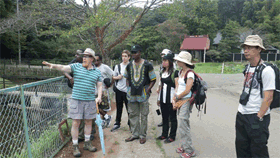 At the end of the course, the participants gave presentations on specific measures they planned to take in order to promote eco-tourism when they returned to their respective countries, describing how they would capitalize on the knowledge and ideas formed during their month-long stay in Japan. Various plans tailored to actual situations in each country were introduced, and including training for local guides, national park development plans, and home-stay tours in rural areas.
|
|
KIWC Technical Committee On-Site Study Meeting |
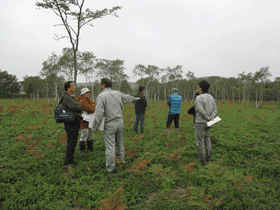 On October 4, 2012, a KIWC Technical Committee On-Site Study Meeting was held in the towns of Akkeshi and Hamanaka. A total of nine committee members and other related parties visited a Citizens' Forest in Akkeshi Town's Oobetsu region and the Saburo River in Hamanaka Town's Nishi-Enshubetsu region.
Akkeshi Town has held annual tree-planting ceremonies involving local residents since 2000 as part of environmental conservation activities for the entire Bekambeushi River basin including Lake Akkeshi. The event is attended by people from various walks of life, including high school students and people from fishery/agricultural cooperatives, construction firms and other companies, neighborhood associations and other organizations. In fiscal 2012, more than 600 people planted around 200 trees including Japanese ash (Fraxinus lanuginosa) and painted maple (Acer mono). This is a significant number of participants considering the town's population of just 10,000. Attendees visited one of the town's several Citizens' Forests where tree-planting activities have been conducted since 2011. They observed the environments of afforested areas, solar-powered electric fences designed to keep out deer, pest control equipment and other facilities with guide commentary from the staff of the Akkeshi Town Office's Environmental Policy Section. 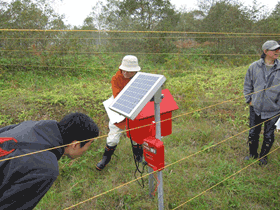 Members of the women's division of the local fishery cooperative were instrumental in initiating the town's tree-planting activities, hoping to support forests at the head of the Bekambeushi River in order to protect the local marine fishing grounds that form the basis of the town's key industry. The local government joined in with these efforts, and the planting work developed into a large project. Even today, government officials highlight to tree-planting volunteers how forests are connected to the sea. Once planting is complete, local seafood dishes such as short-neck clam soup and deep-fried fresh seafood are served. The project is financed by proceeds from the town's waste recycling efforts in which locals separate and recycle waste.
Money saved in this way is used to help conserve forests, which in turn helps preserve the downstream Bekambeushi-shitsugen area, the Bekambeushi River and the sea. Participants are impressed to realize that waste recycling ultimately brings benefits to locals in the form of abundant marine products.
Members of the women's division of the local fishery cooperative were instrumental in initiating the town's tree-planting activities, hoping to support forests at the head of the Bekambeushi River in order to protect the local marine fishing grounds that form the basis of the town's key industry. The local government joined in with these efforts, and the planting work developed into a large project. Even today, government officials highlight to tree-planting volunteers how forests are connected to the sea. Once planting is complete, local seafood dishes such as short-neck clam soup and deep-fried fresh seafood are served. The project is financed by proceeds from the town's waste recycling efforts in which locals separate and recycle waste.
Money saved in this way is used to help conserve forests, which in turn helps preserve the downstream Bekambeushi-shitsugen area, the Bekambeushi River and the sea. Participants are impressed to realize that waste recycling ultimately brings benefits to locals in the form of abundant marine products.Attendees also visited the Saburo River (part of the Furen River System) to observe a fishway next to the Nishien Water Purification Plan in Hamamatsu Town. The structure, which has four triangular parts made of sandbags and logs, was manually installed by dairy farmers and other locals in front of an intake weir in 2008 without using heavy machinery or concrete in consideration of the downstream river environment and fishery activities. 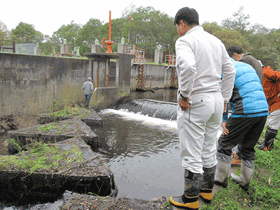 A body of water with a certain length and depth is needed so that fish can pass weirs and other barriers. The fishway dams up water, thereby increasing the height of the water surface immediately below the weir and reducing the previous one-meter difference in water levels to around 50 cm to facilitate the passage of fish. In the spring after the structure was built, a Japanese huchen spawning bed was found upstream of the weir.
In Hamanaka Town, local dairy farmers had long promoted tree planting on their land for registration under a Green Corridor Project. As an extension of this initiative, the fishway was installed to improve the environment of the Saburo River's flow over pasture land. A range of problems first had to be overcome, such as the need to secure financing and legal permission for the construction, choose the best construction method and understand specialized information on river ecosystem impacts. The fishway was eventually installed thanks to the efforts of many people and organizations, including the Kiritappu Wetland National Trust (the conservation organization that financed the work), the local government and experts in the field. During the site visit, KIWC Technical Committee member Atsushi Kawahara told attendees about the mechanism of the fish ladder and the background to its installation. Kawahara was in charge of the project's coordination in his role as then-Director of the Kiritappu Wetland National Trust, and now serves as the Director General of the Secretariat of En no Mori NPO - the Green Corridor Project host organization. On the visit, he shared tips on organizing activities based on local public initiative, such as encouraging locals to get involved in projects by asking them to do just one thing they are capable of. As an example, in order to gain the understanding and cooperation of locals for the challenging task of manually installing the fishway to protect the river environment, experts were invited to attend workshops and design a fish ladder, administrative institutions were asked for legal advice and permission, and dairy farmers were recruited to install the structure. 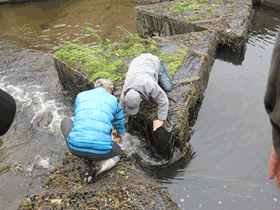 Even today, people who were involved in the fishway's construction go out to check it on rainy days. Being made exclusively of natural materials, the structure is expected to deteriorate, but will be maintained manually as needed. In this regard, the passion and interest of locals are crucial to ensure its optimal condition in the future.
After the field trip, participants expressed hopes that more people would find out about initiatives like this, and that the ideas employed in Akkeshi and Hamanaka would be replicated for activities on the Kushiro Wetland and in other regions. The importance of having coordinators and implementing steady, long-term awareness-raising activities, such as the holding of study meetings, was also pointed out. |
