
|
lssued by the Kushiro International Wetland Centre
Kushiro, Hokkaido, Japan
|
Wetlands Ecotourism in Eastern Hokkaido, Japan
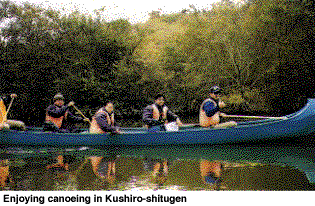 The Kushiro International Wetland Centre Technical Committee examined wetlands ecotourism in eastern Hokkaido, Japan.
The purpose of the study was to point out the necessity of ecotourism in Kushiro-shitsugen,Akkeshi-ko and
Bekanbeushishitsugen and Kiritappu-shitsugen. The Technical Committee concentrated on the following three points for the
promotion of ecotourism.
The Kushiro International Wetland Centre Technical Committee examined wetlands ecotourism in eastern Hokkaido, Japan.
The purpose of the study was to point out the necessity of ecotourism in Kushiro-shitsugen,Akkeshi-ko and
Bekanbeushishitsugen and Kiritappu-shitsugen. The Technical Committee concentrated on the following three points for the
promotion of ecotourism.
1.Benefits for the ecosystem
The purpose of ecotourism is to protect natural resources andencourage their sustainable and wise use. It has little negative
influence on the ecosystem and, compared to mass tourism, the economic effects are less but longer-lasting.
2.Benefits for tourists
Ecotourism helps tourists understand and enjoy the nature and culture of an area, while coming to recognize the importance of
environmental conservation.
3.Benefits for the local community
Ecotourism contributes to the economic and spiritual stimulation of the local community.
 | Economic benefits (profit) from fees paid by visitors for guides,accommodation and facilities
| |
| Employment opportunities involved in or related toecotourism
| |
| As local residents begin to understand the purpose of thesetours, they become interested in their natural
environment and culture and develop pride in their hometown
| |
| Establishment of relationships among local residents,through which they can offer each other spiritual
and material support
| |
| Development of exchanges among local residents and between residents and visitors
| |
| Improvement of facilities to utilize wetlands
| |
| Consensus achieved among local residents, businesses and municipalities on the protection of nature and
promotion of environmental education
|
Possible Kushiro-area wetlands ecotours
a.The eastern part of Kushiro-shitsugen
Various lakes and swamps and the Kushiro River are the important factors in this region.
| Experiencing the wetland: canoeing, cycling and hiking on wooden paths
| |
| Learning about the wetland: observation of landscape, animals and plants, monitoring the environment
and tours to historical relics
| |
| Behaving considerately to protect the wetland: observation of traditional fishing methods and taking
part in swamp tree planting in wetlands
|
b. The western part of Kushiro-shitsugen
This region has a distinctive topography, with hills stretching like capes out of the wetlands. Furthermore, a number of
Japanese Cranes, an endangered species, gather in Tsurui Village.
|
Horseback riding on hills with Hokkaido's native breed of horses |
|
Hiking and cross-country skiing around the wetlands in winter |
|
Observing at feeding places the winter behavior of the Japanese Crane |
c. Akkeshi-ko and Bekanbeushi-shitsugen
Akkeshi-ko is a lagoon, around which saline wetlands are found. Bekanbeushi-shitsugen has a well-maintained natural
environment. However, this area has no base for an ecotour or experience in supporting such a tour, so examination of
potential sites for ecotourism, construction of minimum required facilities, and further examination of the possible impact
of any construction are necessary. The effects of approaching canoes on the breeding habits of Japanese Cranes has been
studied for several years. The influence can be limited by the establishment of an end point for canoeing.
|
Experiencing canoeing: looking at the wetland from the water's surface |
|
Knowing the wetland: bird watching, learning about traditional fishing methods in the lake |
d. Kiritappu-shitsugen
Kiritappu-shitsugen, with Kiritappu River at its center, is a beautiful wetland, separated from the ocean by a row of sand
dunes.
|
Observing the nature and residents of the area: staying in local homes and observing the fishing
industry and wildlife in wetlands |
|
Introduction of the role of nature in daily life with local people |
KIWC Technical Committee
Report on the 1996 KIWC General Assembly
The 1996 KIWC General Assembly was held at the Kushiro ANA Hotel on Tuesday, April 30. "Conservation of wetland
ecology - environmental research of rainwater, spring water and river water," was adopted as this year's research theme
for the KIWC Technical Committee. The budgets and projects agreed upon were as follows:
Main projects and budgets for KIWC in 1996
|
・ | Management of the Technical Committee |  860,000 860,000
| |
・ | JICA Training for Nature Conservation and Management, and JICA Training for Wetland Conservation and Protection of Migratory Birds | 3,600,000
| |
・ | Cooperation in the 2nd Conference on National Parks and Protected Areas in East Asia | 3,815,000
| |
・ | Hosting the International Mire Conservation Group (IMCG) Field Symposium in Kushiro | 9,745,000
| |
・ | Assisting in PLEA '97 International Conference in Kushiro | 3,599,000
| |
・ | Cooperative activities with other concerned organizations | 405,000
| |
・ | Information dissemination and promotion, including publication of newsletters | 860,000
| |
・ | Administrative costs of KIWC Secretariat and other | 816,000
|
|
| |
|
Total | 23,700,000
|
|

|

|
| 次ページ |
|
|