
|
lssued by the Kushiro International Wetland Centre
Kushiro, Hokkaido, Japan
|
|
Dear
Readers |
|
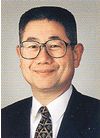
Kensuke Watanuki,President
Kushiro International Wetland Centre
(Mayor of Kushiro)
|
It is a great honor to send through this KIWC Newsletter my greetings to readers concerned with wetlands conservation.
I was appointed President of KIWC on December 4, 1996, succeeding Mr.Toshiyuki Wanibuchi, the former Mayor of the City of
Kushiro.
I believe that wetlands issues are becoming more important to the local community these days, since the importance of community-based wetlands management was pointed out at the Ramsar Brisbane Conference. Accordingly, I intend to make every effort to raise public awareness of wetlands and to involve local people in conservation activities.
Since its establishment in 1995, KIWC has conducted a series of activities to this end and is now undertaking preparatory work for an international workshop/conference on community-based management of the Ramsar sites, to be held with the cooperation of the Caddo Lake Institute, IUCN and WWF.I believe that the workshop will be effective in following up Recommendation 6.3, adopted at the Ramsar Brisbane Conference, and will produce fruitful results, making a valuable contribution to further discussions at the next Ramsar Conference in 1999.
KIWC hopes to contribute to the promotion of wetlands conservation. Any advice or suggestions regarding KIWC activities would be very much appreciated. |
Seventh International Mire Conservation Group (IMCG) Field Symposium
Kushiro, August 25 - September 7, 1996
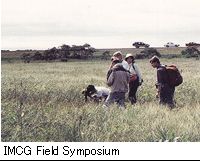 It may seem odd that two recurring themes throughout the 7th IMCG Field Symposium - a symposium devoted to the conservation of mire ecosystems around the world - should turn out to be volcanoes and partnership. Perhaps things become a little clearer if I explain that the volcanoes of Hokkaido repeatedly proved to have had a profound ecological effect on the various mires which the IMCG visited during its time on the island. Time and time again the question was heard, "Is there an ash layer in the peat?" and time nd time again, peat core-samples demonstrated that there was indeed a layer of volcanic ash, often close to the present surface. IMCG members who had come to Japan from Canada, China, and a host of European countries - in all, 17 countries from around the globe were represented - found that this rich layer of volcanic minerals produced a range of mire vegetation types which were both strange and exciting, and of considerable conservation value. It may seem odd that two recurring themes throughout the 7th IMCG Field Symposium - a symposium devoted to the conservation of mire ecosystems around the world - should turn out to be volcanoes and partnership. Perhaps things become a little clearer if I explain that the volcanoes of Hokkaido repeatedly proved to have had a profound ecological effect on the various mires which the IMCG visited during its time on the island. Time and time again the question was heard, "Is there an ash layer in the peat?" and time nd time again, peat core-samples demonstrated that there was indeed a layer of volcanic ash, often close to the present surface. IMCG members who had come to Japan from Canada, China, and a host of European countries - in all, 17 countries from around the globe were represented - found that this rich layer of volcanic minerals produced a range of mire vegetation types which were both strange and exciting, and of considerable conservation value.
The second theme, of partnership, was therefore of profound significance and it was very encouraging to see such active examples of this on so many of the mires we visited. The fact that local towns, and the City of Kushiro, had effectively "adopted" the mires in their districts, supporting them financially and encouraging their use as both conservation and education centres, offered real hope for the long-term conservation and wise use of these important areas. The ideas seen here in southeastern Hokkaido, and other ideas discussed during the symposium, led to the drafting of the Kushiro Declaration, a document which will be sent to all Contracting Parties to the Ramsar Convention, the Convention on Biological Diversity and the World Heritage Programme, urging them to improve mire conservation programmes around the world. A number of resolutions were also drawn up for a range of nations, including Japan, highlighting the respective areas where these particular countries could do more for mire conservation.
Finally, the IMCG extends its grateful thanks to all our kind hosts. For your information, the next IMCG Workshop/Symposium will be held in the Solovetsky Islands, in Russia's White Sea, in August 1997, and a full Field Symposium will be held in Estonia and Latvia in the summer 1998.
Richard Lindsay, Chairman, IMCG
Report on the KIWC Technical Committee
After the establishment of the Kushiro International Wetland Centre in 1994, a technical committee was organized for the purpose of providing technical advice on wetlands conservation. The theme of the committee's work in 1996 has been
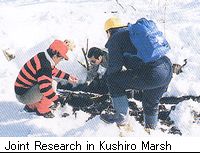 "Conservation of wetlands ecosystems - environmental research of river water, rainwater and springs." Water's influence on forests and many other topographical, geographical and biological issues related to wetlands is widely known, thus it was chosen as the theme for the committee's studies. The experts involved have conducted research following this theme in a variety of respective study areas, including aquatic plants, the water cycle, forests, aquatic animals, grass species, land use and birds. "Conservation of wetlands ecosystems - environmental research of river water, rainwater and springs." Water's influence on forests and many other topographical, geographical and biological issues related to wetlands is widely known, thus it was chosen as the theme for the committee's studies. The experts involved have conducted research following this theme in a variety of respective study areas, including aquatic plants, the water cycle, forests, aquatic animals, grass species, land use and birds.
On February 18, 1996, joint research on springs took place in Kushiro Marsh. During and after the field research, participants discussed a number of issues, such as the classification of springs and means to measure spring quantities. The KIWC Technical Committee will issue an interim report in March 1997. The report will also include the results of the joint research of springs. In the 1997 Japanese Fiscal Year, the Technical Committee will continue its activities and research, based on the same theme as JFY 1996, and the final report will be published by the end of JFY 1997.

|

|
| 次ページへ |
|
|