|

Lake Kutcharo
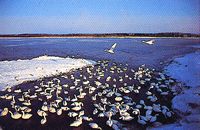 Around the time of the year when the spring sun begins to melt the snow covering the mountains and the water gently flows into Lake Kut-charo, the lake welcomes more than 10,000 whistling swans who have wintered elsewhere in Japan. The lake, the northernmost in Japan, is also a resting place for tens of thousands of ducks, including Eurasian wigeons, pintails and tufted ducks, who rest here before heading for their breeding grounds in Siberia. Around the time of the year when the spring sun begins to melt the snow covering the mountains and the water gently flows into Lake Kut-charo, the lake welcomes more than 10,000 whistling swans who have wintered elsewhere in Japan. The lake, the northernmost in Japan, is also a resting place for tens of thousands of ducks, including Eurasian wigeons, pintails and tufted ducks, who rest here before heading for their breeding grounds in Siberia.
When the trees surrounding the lake put on their fresh green colors and the grasses and flowers begin to bud, these messengers of spring simultaneously fly off to their breeding places. After the lively sounds of the migratory birds have died off, white-tailed sea eagles, ospreys and other birds of prey which live on fish come to the lake and perform their exciting dives.
In summertime, the air around the lake is filled with the chirping of such summer birds as Latham's snipes, Schrenk's reed warblers and yellow wagtails. During the short summer, lovely flowers such as lily species (Hemerocallis middendorfii var. esculenta), iris species (Iris setosa), sundews and cranberries adorn the fen and bog mires surrounding the lake.
When the forest is dressed in the red and yellow of broad-leaved trees, chum salmon ascend the rivers to spawn in the lake. More than 10,000 whistling swans, which spend the summer in Siberia, return to the lake with their young. Flying the 3,000-km distance for the first time, the still-innocent-looking young birds rest here briefly before flying south for the winter. The returning birds sing merrily, as if they are encouraging each other to brave the coming cold season.
Frost begins to appear in the marshland and Lake Kutcharo turns into a silver world. During the winter, the entire lake is frozen, except for areas around river mouths, where approximately 1,000 whistling swans remain.
 A dozen (and sometimes a score) of white-tailed sea eagles and Steller's sea eagles come, trying to catch ducks. A dozen (and sometimes a score) of white-tailed sea eagles and Steller's sea eagles come, trying to catch ducks.
As winter deepens, the trees around the lake replace their leaves with ice, which glitters in the winter sun. The Sea of Okhotsk is visited by sea ice.
People can learn of both the beauty and severity of each season at Lake Kutcharo, which has witnessed the repeated changes in seasons over and over since the days before humans arrived here.
Town of Hamatombetsu
|
TOPICS |
|
PLEA International Conference
 The 14th PLEA International Conference was held at the Center for Tourism and International Exchanges in Kushiro from January 8 through 10. The theme of the Conference, which was jointly hosted by the Architectural Institute of Japan and the PLEA 1997 Japan Committee, was "Sustainable Communities and Architecture - Bioclimatic Design in Cold Climates." The 14th PLEA International Conference was held at the Center for Tourism and International Exchanges in Kushiro from January 8 through 10. The theme of the Conference, which was jointly hosted by the Architectural Institute of Japan and the PLEA 1997 Japan Committee, was "Sustainable Communities and Architecture - Bioclimatic Design in Cold Climates."
PLEA stands for Passive and Low Energy Architecture, an international research network, which aims to establish environmentally friendly low-energy architecture by making use of natural energy sources, such as solar and wind power. The PLEA international conferences have been held almost every year around the globe since 1982. The Kushiro Conference, the second in Japan after the Nara Conference 1989, was mainly characterized by the fact that the conference, focusing on the utilization of natural energies, was held in a severely cold area.
During the three-day conference, 155 research papers and architectural works were presented by researchers and specialists, and discussions, including panel discussions, were held on architecture, city planning and environmental issues.
A variety of associated events were held to spread the spirit of the PLEA. Such events included the Citizens' Idea Contest, which was held prior to the Conference for the people of Kushiro and Nemuro and in which prizewinners made unique proposals for the development of Kushiro. A seminar for students was also held on a ferry from Tokyo to Kushiro.
The Kushiro PLEA Conference was the largest ever, with 1,174 participants from 34 countries.
Miwako Takeuchi, PLEA '97 Secretariat |
|