|
Deer management in eastern Hokkaido and opening of the Eastern Hokkaido Wildlife Research Station of the Hokkaido Institute of Environmental Sciences
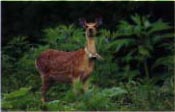
Meanwhile, the Hokkaido Guidelines for Wildlife Management were established in 1996 to conduct appropriate wildlife management based on research results. A management plan applying these guidelines will be prepared in FY 1997 for Sika deer in eastern Hokkaido, where damage is particularly serious. In the past, research on Sika deer was mainly conducted by the Hokkaido Institute of Environmental Sciences in Sapporo. In June this year, however, the Eastern Hokkaido Wildlife Research Station was established in Kushiro Subprefecture as an agency of the Institute to promote basic research regarding management of Sika deer. Research has already started and seasonal migration and causes of death are being studied by attaching transmitters to Sika deer. Helicopter monitoring of the deer population, and research on the environmental carrying capacity in eastern Hokkaido will be conducted in cooperation with local communities, to further promote proper management of Sika deer in the future.
International Tourism Symposium in Kushiro
This symposium was organized by the City of Kushiro, the Kushiro Tourism Association and the Kushiro Chamber of Commerce and Industry, with the cooperation of the Japan International Cooperation Agency (JICA), the International Tourism Development Institute of Japan and the Japan International Cooperation Center. The symposium attracted participants from around the world: Cameroon, Costa Rica, Dominica, Egypt, Ethiopia, Guatemala, Jordan, Laos, Malta, Mexico, Mongolia, Nepal, Oman, Palestine, Peru, Philippines, Tanzania and Zimbabwe. A total of 90 people, including those from local tourism organizations and citizens, took part in the Symposium. Hisashi Shinsho from the Kushiro City Museum gave a presentation entitled "Tourism promotion and environmental conservation in Kushiro," which provided an overview of the wetland via slides, discussing its wise use. After Mr. Shinsho's presentation, three participants reported on their countries' situations and opinions were exchanged among those present. Those who presented country reports were Mr. German Arnoldo Cerezo Casado from Guatemala, Mr. Luay Eliase Zawwad Al-Farraj from Jordan and Ms. Petronilla Netsai Ngara from Zimbabwe. They outlined the current status of tourism in their countries and introduced tourism promotion measures now being taken. In the ensuing discussions, participants expressed hopes that more Japanese would travel to their countries and asked questions on Japan's first-aid systems. At the Symposium venue, public information corners were established for the international participants to display posters and travel brochures and show tourism promotion videos. Not only the participants, but many local citizens visited these corners.
Hanasaka Jiisan Project
The project to revegetate native varieties on the embankment has been conducted by the Kushiro Development and Construction Department since 1993 to match the retarding basin embankment with the surrounding natural landscape, as well as to minimize the embankment's impact on the ecosystem of the surrounding wetlands. This is done using the ecological mixed-seeding method. Approximately 40 willow cuttings, which can survive under strong winds and direct sunlight, are planted in a circle with a diameter of 3 m as a windbreak to protect seedlings of wetland plants, which are planted in the circle. It can be safely carried out even by children. In the future, 1) it will be continued as a project involving local residents and 2) changes will be observed from a long-range viewpoint, instead of pursuing short-term results, while adopting inn ovative ideas. After observing natural vegetation of a nearby wetland, participants planted a total of approximately 1,200 willows and other trees on the embankment slope. Remarks of children who participated in the project included, "It was a very interesting field activity," "I would like to see how such small seeds and seedlings would turn into big trees," and "I am going to come again with my family or friends, and I am looking forward to it." The Flood Control Section of the Kushiro Development and Construction Department is expecting that the good condition of Kushiro-shitsugen will be maintained by promoting through this project the children's awareness of nature and their understanding of the need for the conservation of rivers and wetlands, as they will be the leaders of the future. Hanasaka Jiisan:An honest old man who made lifeless trees bloom in a famous Japanese folktale.
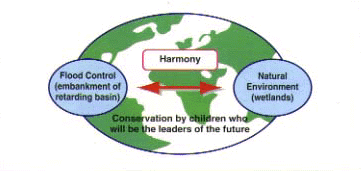
Photo & Image: Kushiro Development and Construction Department
|
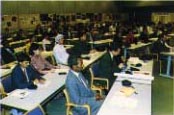 The International Tourism Symposium in Kushiro was held at the Kushiro Tourism & International Relations Center on July 16, with the theme "Tourism promotion and environmental conservation."
 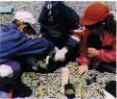 A project to regenerate wetland vegetation around the embankment of the Kushiro River retarding basin was implemented on May 27 with the participation of 94 local elementary school students.