|
Utonai-ko −
Lake Utonai and Its Natural Surroundings
|
|
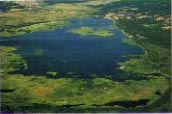
View of Lake Utonai
|
Lake Utonai is situated at the foot of Mt. Tarumae, where the slope of the mou
ntain meets Yufutsu Plain in eastern Tomakomai, on the lower reaches of the Bi
bi River, which originates in Chitose. The fresh-water lake covers 230 ha of
the 510 ha wetland, and its average depth is only 0.5 to 0.6 meters.
On December 12, 1991, Lake Utonai was designated as the third internationally protected wetland in Hokkaido and the fourth in Japan.
Lake Utonai is adjacent to an urban area in central Hokkaido. It is also close to the Shikotsu-Tarumae volcanic foothills and the sea. It is extremely valuable as a freshwater lake with a diverse natural environment which includes dunes, volcanic ash wilderness, hilly forests and wetlands surrounding rivers, lakes and marshes. It also has great biodiversity and in 1981, in recognition of its role as a relay point for migratory birds, the lake was designa ted by the Wild Bird Society of Japan as the nation's first bird sanctuary.
During the migratory seasons in spring and autumn, whooper swans, whistling swans, white-fronted geese, bean geese, pintails, mallards and other wild geese and ducks arrive at the lake. In summer, the lake becomes a major breeding place for wild birds such as yellow-breasted buntings, Siberian
rubythroats, common cuckoos, Schrenck's reed warblers, black-faced buntings, long-tailed rose finches and grasshopper warblers. More than 250 species of wild birds
, including land birds in the surrounding area, have been observed in the sanctuary.
The Bibi, Tokisatamappu, Otarumappu and other rivers flow into Lake Utonai. While its surroundings consist mainly of low moors covered in reeds and
sedges, it is also dotted with shrubs such as Spiraea salicifolia and Lonicera
caerulea, as well as broad-leaved trees, including alders, Quercus mongolica
and willows. In the southeastern area, where dunes are surrounded by trees, mountain plants such as Halenia corniculata and Euphrasia maximowiczii can be found. Beach plants such as sweet brier, Arabis
stelleri, Linaria japonica and
Carex caryophyllea, and alpine plants such as Pentstemon frutescens, Polygonum
weyrichii, Cladonia stellaris and Polytrichum piliferum coexist here. Some
446 species of higher plants and over 60 species of bryophyte and lichens have
been found in this area.
|
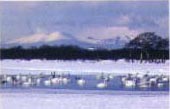
| Lake Utonai in winter |
Such a diversified environment allows the existence of large numbers and many types of insects, particularly aquatic insects and ground beetles. Approximately 3,800 species of insects have been found in the area.
| Nature Conservation |
| Division, |
| City of Tomakomaia |
|




 For further information, please contact: