|
Current Status of Actions under the Brisbane Initiative
Because the fifth and the sixth regular meetings of the Conference of the Contracting Parties to the Ramsar Convention were held at Kushiro in 1993 and at Brisbane in 1996 respectively, conservation activities on migratory birds in the Asia-Pacific region have been increasingly enlarged.
The Asia-Pacific Migratory Waterbird Conservation Strategy: 1996-2000 (hereafter called Strategy) is a guideline for the activities in the Asia-Pacific region. Following the Kushiro Initiative, adopted in 1994 at an international workshop on the "Conservation of Migratory Waterbirds and Their Habitats in the East Asian-Australasian Flyway," the Waterbird Conservation Strategy was produced by the Wetlands International Asia-Pacific (formerly Asian Wetlands Bureau:
AWB) and the Wetlands International Japan (formerly International Waterfowl and Wetland Research Bureau Japan Committee:
IWRB-J) with the financial support by the Environment Agency of Japan and the Environment Australia (formerly Australian Nature Conservation Agency:
ANCA).
One of the actions proposed under the Strategy is the development of the migratory waterbird flyway networks. Objectives of the networks are encouraging public awareness of the importance of wetlands as the
waterbirds' habitat and promoting educational and training programs among site managers, local administrators and other people involved in the network site. Recommendation 6.4. of the Ramsar Convention which is called the "Brisbane Initiative" calls on the Contracting Parties to support the Waterbird Conservation Strategy and to join the Shorebird Reserve Network.
In the Strategy, development of three species groups of the networks, namely shorebirds, cranes and Anatidae (ducks, geese and swans) were encouraged. Two of the Networks, namely shorebirds (participants: 9 countries with 24 sites) and cranes (participants: 6 countries with 18 sites) were launched while the Anatidae Network will be developed in 1999.
The Strategy also stresses compiling and implementing migratory waterbird action plans to encourage migratory waterbirds and the habitat conservation. At present, shorebird and crane action plans are in the progress of the compilation.
In Japan, domestic activities, such as information exchanges, regarding the Networks have been started among related municipalities and NGOs. For example, national species committees were established for shorebirds and cranes to follow the Network activities. For future tasks, development of the Anatidae Network as soon as possible and enhancement of the effectiveness of the networks by encouraging participation of the regional countries and sites to the networks and compiling and implementing the action plans.
| Wildlife Division, |
| Nature Conservation Bureau, Environment Agency |
10th Anniversary of the Tsurui-Ito Tancho Sanctuary
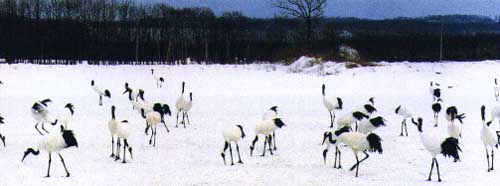
Tancho(Red-crowned cranes)
The Tsurui-Ito Tancho Sanctuary marked its 10th anniversary in November 1997. To commemorate this, a symposium and various other events were held.
The Wild Bird Society of Japan established the sanctuary in 1987 on land it bought and borrowed from Yoshitaka Ito, who had fed red-crowned cranes in the area. The Society collected donations from throughout Japan to establish this sanctuary.
The Society regularly stations staff as rangers to protect wintering and breeding environments for red-crowned cranes and to prevent the birds from harming agricultural activities. The Society also conducts research and studies in the area and promotes environmental education. As one of its major projects, the society has bought wetlands to conserve breeding environments for the birds. The Society has to date purchased a total of 640 ha of breeding area for seven pairs of red-crowned cranes. The red-crowned crane, a Special National Natural Monument, was once endangered. Thanks to efforts such as feeding by local residents in Tsurui and elsewhere in the east part of Hokkaido, approximately 600 red-crowned cranes have been confirmed, according to a survey on their population.
A project to restore their breeding environment is now attracting wide attention.
Osamu Harada
Chief Ranger
Tsurui-Ito Tancho Sanctuary
Wild Bird Society of Japan |
Red-crowned Crane Ties Knot of Sister Affiliation
 On February 9, the Japan-Korea Friendship Association in Kushiro and the Crane Protection Association in Cholwon signed a sister affiliation agreement. The affiliation takes its rise in the similarity of both regions as a habitat of red-crowned crane. The bird, designated Japan's Special National Natural Monument, is the district bird of
Cholwon-gun, Kangwondo, R.O. Korea.
On February 9, the Japan-Korea Friendship Association in Kushiro and the Crane Protection Association in Cholwon signed a sister affiliation agreement. The affiliation takes its rise in the similarity of both regions as a habitat of red-crowned crane. The bird, designated Japan's Special National Natural Monument, is the district bird of
Cholwon-gun, Kangwondo, R.O. Korea.
Cholwon-gun is located at around 38。 N latitude. In winter, approximately 250 red-crowned cranes and 100
white-naped cranes simultaneously visit this area in the Demilitarized Zone. Exchanges between the two associations began two years ago. Common goals include the protection of red-crowned cranes so they may grow amidst unspoiled natural surroundings, including wetlands in both regions. At the same time, we aim to promote tourism in harmony with urbanization. During the last two years, a wide variety of exchange activities have been held based on the appreciation of natural, historical and cultural aspects of both regions. These activities have included visits to red-crowned crane protection facilities and various facilities in urban areas, lecture meetings on red-crowned cranes and exchanges of opinions involving administrative bodies and junior chambers. The establishment of a sister affiliation will enable us to expand the friendship activities. We intend to conduct detailed research and implement concrete measures for the conservation of red-crowned cranes and the environment. Also, the Japan-Korea Friendship Association in Kushiro is willing to extend support to
Cholwon-gun so that it can be designated as a Ramsar Site as soon as possible. To realize this, the Association will offer information and advice to the Crane Protection Association in
Cholwon.
Although there are many other private-level organizations which promote exchanges between Japan and Korea, most are established for economic purposes. Our association is one of the few which promote exchanges based on the conservation of nature and wildlife.
We are proud of the natural splendor of both regions and take great pleasure in them. We hope our activities will promote grassroots friendships and develop into movements to encourage people to conserve the environment, thus contributing to the promotion of friendly relations between our two regions.
Kenji Murata
Chairman
Japan-Korea Friendship Association in Kushiro |

|

|
| 次ページへ |
|
|