
|
Izunuma and Uchinuma
|
|
Izunuma
|
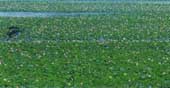
Izunuma and Uchinuma are lakes in plains situated at 38。43' N latitude and 141。06' E longitude, in the middle of the Tohoku region on Honshu, Japan's main island. They cover a total area of 3.87 km2 and their deepest point is 1.4 m. The majority of the surfaces of these shallow lakes are covered with water plants such as lotuses, water-snowflakes and water caltrops.
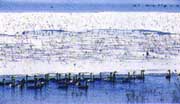
Located in the northernmost area of the warm-temperate zone, the surfaces of Izunuma and Uchinuma rarely freeze over, even during the coldest seasons. This makes them a popular wintering area for such waterfowl as whooper swans, Middendorf's bean geese, white-fronted geese and ducks, as these birds from the North can spend entire winters here with abundant feed. Last winter, 1,600 whooper swans, 35,000 geese and 15,000 ducks were recorded here. In particular, the number of white-fronted geese have markedly increased during the last several years, probably due to the worsening conditions of their East Asian habitats.
As many people live in the area around Izunuma and Uchinuma, the water quality of these lakes, like many other lakes in Japan, deteriorated from around 1975 to at least 1990. Fortunately, however, such contamination was not enough to damage the ecosystems of Izunuma and
Uchinuma. Meanwhile, various measures have been taken to improve water quality in the area. These include sewerage improvement projects for river basins and sewage and drainage improvements of communities around the lakes. Also, plants were transplanted into the lakes to purify the water, and feeding ponds with plants' purifying functions were installed at the lakes. Water quality thus improved gradually over the last couple of years. Accordingly, floating-leaved plants and submerged plants have increased.
From 1991 to 1994, the area around Izunuma and Uchinuma became publicly owned.Wild rice, reeds, willows and alders have since been planted extensively to recover natural vegetation. In particular, wild rice, a staple for whooper swans, have been planted annually in an area of 20 or 30 ha with the participation of local residents, including primary and junior high school students.
|
| Uchinuma |
These conservation projects at Izunuma and Uchinuma have been promoted by the Izunuma-Uchinuma Environmental Foundation, which was founded in 1988. The foundation promotes wetland conservation projects to realize the symbiosis of nature and people. Specifically, it has conducted basic research and monitoring of wetland environments in cooperation with research facilities.
Toru Shibasaki
Chief Research Worker
The Miyagi Prefectural
TIzunuma-Uchinuma
Environmental Foundation |
|

Soap Use Project in Akkeshi

Waterfronts have long been places where people have gathered and lived. In
Akkeshi, Akkeshi-basho (a site in Akkeshi) was established in the Kan-ei period (1624 - 1644). Remains of pit dwellings found around the lagoon's shore and shell mounds excavated from this area indicate that indigenous people once came here for the area's abundant natural blessings.
Although synthetic detergents have long been known to be harmful to the environment and health, the Akkeshi municipal government required a good deal of time and ample reasons before taking up this issue. It held lecture meetings, asked scholars and experts for their opinions and collected information from other regions which had already taken measures against this problem. From this, the municipality began a project in December 1997 to provide subsidies to people purchasing soap (non-synthetic cleansing agent). Specifically, people can buy soap in 11 designated stores in Akkeshi at a 25% discount.
The town has since received many opinions on its project from various circles, as well as offers from soap wholesalers. At the same time, inquires have been made by people wondering if the pollution of Lake Akkeshi is really so serious.
Lake Akkeshi, located close to the Akkeshi Bay, is a brackish lake which collects water from rivers flowing through
Bekanbeushi-shitsugen. It is also famous for its brand of oyster.
The town has regularly conducted monitoring of water quality of the lake and rivers flowing into it. It has also concluded environmental pollution prevention agreements with operators of golf courses and other local businessmen. The River Basin Environment Conservation Council, which consists of municipalities along the upper reaches of the rivers flowing into the lake, was established. All of these moves were intended to conserve the water quality and the waterfront environment of Lake
Akkeshi.
During the latter half of this century, the environment has been subject to various influences. Although it has been noted that synthetic chemical products, including detergents, cause serious damage to the environment, it may take time to change people's attitudes and replace all synthetic detergents with soap. We should, however, be aware that well-conserved examples of nature are now rare (scarcity value) and many are vulnerable. Lake Akkeshi is no exception. Measures should thus be taken to prevent the pollution of Lake Akkeshi before it becomes unrecoverable.
|
Town of Akkeshi
|

|
