
|
lssued by the Kushiro International Wetland Centre
Kushiro, Hokkaido, Japan
|
Report on Spring Water by KIWC Technical Committee
March 1998, Kushiro
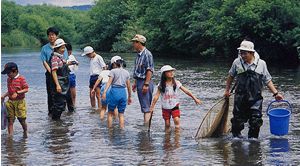 The Technical Committee conducted spring water research in "Kushiro-shitsugen," "Akkeshi-ko and Bekanbeushi-shitsugen" and "Kiritappu-shitsugen" over two years from 1996 to 1997. Although wetlands are recharged with various kinds of water, few studies have been conducted on spring water. In this study, the Technical Committee has investigated the types and quantities of spring water and the relationships of spring water with vegetation and aquatic life in these Ramsar sites. The Technical Committee conducted spring water research in "Kushiro-shitsugen," "Akkeshi-ko and Bekanbeushi-shitsugen" and "Kiritappu-shitsugen" over two years from 1996 to 1997. Although wetlands are recharged with various kinds of water, few studies have been conducted on spring water. In this study, the Technical Committee has investigated the types and quantities of spring water and the relationships of spring water with vegetation and aquatic life in these Ramsar sites.
It was found that spring water plays an important role in all three wetlands. The minimum quantity of spring water observed was 1 to 2 tons/day per measurement spot and the largest was 4 to 12 tons/day. Concerning the relationships between the spring water and the surrounding environments (when there are several springs in an adjacent hill within 500 m of the wetland), it is estimated that a larger quantity of spring water (20 tons/day) is available when the hill is covered with a mixed forest of naturally growing coniferous and broad-leaved trees, compared with the case where the hill is covered with replanted broad-leaved trees.
Given these findings, it is assumed that spring water plays an important role as a water supply source to the wetlands, although an accurate measurement of the quantity of spring water flowing into the wetland is difficult to calculate.
The following are rough calculations based on the above-mentioned figures. When Kushiro-shitsugen, approximately 100 km in circumference, is supplied with spring water of at least 10 tons/day per 500 m (i.e. 20 tons/day per 1 km) on average, 2,000 tons/day (100 times of 20 tons/day) will be supplied to the entire area of Kushiro-shitsugen. Considering that spring water is not generated equally all around the wetland or throughout the year, this figure might actually be half (10,000 ton) or a quarter (5,000 ton) of the estimate. Still, these are noticeably large figures.
As spring water is provided from around the wetland, its water quality and quantity is closely associated with the surrounding environments. To maintain the current level of water quality and quantity, it is necessary to protect the environment of the surrounding area, particularly when the springs are shallow. The relationships between spring water and the forest type have been referred to in the above-mentioned example. Differences in vegetation, such as forests or grassland, are expected to greatly affect spring quality and quantity. Meanwhile, when forests change to grassland, or conversely, when grassland or bamboo grass communities develop into forests, there is an influence on spring water both in terms of quality and quantity. An example of this has been demonstrated in the Ota Pilot Forests near Akkeshi-ko and Bekanbeushi-shitsugen.
Spring water is valuable not only because of its quantity but also for its steady temperature. It has been confirmed that the temperature of the spring water remains approximately 6 C in winter, even when the water quantity is small, and 6 to 10。C when the quantity is large. This means that the spring water never freezes, an important factor in maintaining the habitats of aquatic life, birds and other creatures.
Close relationships between open water and birds' lives and movements have been observed in Akkeshi. It has also been found in Kushiro that open water serves as an important habitat for crayfish.
Endangered species described in the red data book, such as Polemonium caeruleum, Montia fontana, Rumex longifolius, Corydalis ochotensis and Rumex gmelini, have been observed around the springs. Introduced species or those not naturally distributed, such as Nasturtium officinale and Wasabia japonica, have also been found. This means the environment around the springs plays an important role in their growth.
The use of spring water by local residents in the Kiritappu-shitsugen area was investigated through survey interviews. Data on the use of ice, a source of spring water, has also been obtained. This provides us with interesting clues in investigating the history of the use of spring water. The committee was able to examine the difference in the existence of spring water in Kiritappu-shitsugen between cases where there are forests in the surrounding hill and cases where there are no forests. It was confirmed that spring water had disappeared in the deforested areas. These facts are interesting as they demonstrate that forests have a water recharging function. Small forests of Taxus cuspidata, which favor water, were typically found around the springs. It was also confirmed that a variety of creatures, nourished by or associated with spring water, inhabit Kiritappu-shitsugen.
Spring water is one of three major water recharging sources for wetlands, together with running water and rainwater. Although the other two are "visible" water sources, spring water is "invisible." In this study, the existence of spring water as an invisible water source has been confirmed and new perspectives have been obtained on relationships between spring water and wetlands. We expect that this study will contribute to raising awareness of spring water as an invisible water source and confirming the existence of spring water in wetlands across Japan. We also hope that this study will encourage studies on the significance of spring water and methods for its preservation.
Tatsuichi Tsujii
Professor of Agriculture
Chairman of the Technical Committee
Kushiro International Wetland Centre

|

|
| 次ページへ |
|
|