|

Sakata
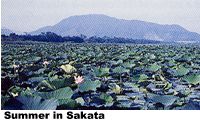
Sakata is located in the Akatsuka district in southwestern Niigata, at 37¡49' N lat. and 138¡52' 30" E long. Sakata is also part of the Sado-Yahiko-Yoneyama Quasi-National Park. This lagoon and its surrounding area is designated as a special district under the Natural Parks Law, and also as the Sakata National Protection Area for Birds and Mammals.
Sakata is a sand dune lake formed on a lowland between sandbanks of the Niigata Sand Dune, and consists of two lagoons: the small Kami-sakata in the southwest and the large Hongata in the northeast.
These lagoons cover a total area of approximately 43.6 ha and are situated 5 m above sea level. Averaging 1 m, the water depth is quite shallow. The lake bottom is shaped like the bottom of a ship. No river flows into the lagoons, which collect water from rainwater and springs in the surrounding sand dunes. Reeds and other emerging plants grow on the shore. The water quality is fresh water and is well-balanced. Sakata is classified as a eutrophic lake with an abundance of nutrient salts, such as nitrogen and phosphorus.
Sakata is generally known as a place which wild geese and ducks fly over. Surrounded by dry-farming land and forests, this area attracts various kinds of birds. In previous surveys, a total of 157 species of birds, belonging to 37 families of 17 orders, have been observed here. In particular, there are 73 species of water birds, including wild geese, ducks, shore birds, herons and great reed warblers, which account for 46% of all the birds observed here. Every winter, some 3,000 swans and other large water birds, such as white-fronted geese and bean geese, fly over to winter.
Vegetation in Sakata consists mainly of a reed community in damp ground around lagoons and lotus and water chestnut communities on the water surface. There are such rare plants as Euryale ferox and Monochoria Korsakowii, both of which are endangered in Japan, as well as such valuable hygrophytes as Saururus chinensis, Polygonum Maackianum and Lysimachia thyrsiflora. These facts demonstrate that Sakata is an important wetland preserving significant natural diversity.
The City of Niigata has designated the area - a Ramsar site - consisting of lagoons and surrounding wetlands as Sakata Park area under the Urban Park Law, limiting its land use in order to preserve the lagoons. In addition, the municipal government intends to develop this area as an ecology observation park, where people can become familiar with nature. Finally, a variety of environmental studies have been conducted to obtain scientific information for the conservation of Sakata.
In order to promote appropriate conservation of Sakata, a Ramsar site, the City of Niigata intends to formulate plans for conserving the environment in Sakata and its adjoining areas, based on the findings of the aforementioned studies, while listening to opinions of local residents and environmental protection groups.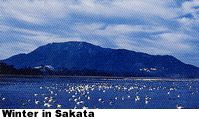
Environmental Affairs
Department,
City of Niigata
Winter in Sakata
�@
�@
|
TOPICS |
Nesting of Red-Crowned Cranes in Bamboo Grass Fields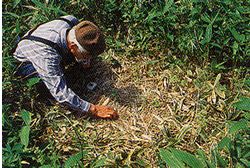
Sarorun-kamui (or Sarurun-kamui), an Ainu word for Red-crowned Cranes - "Tancho" - means "the god of wetlands." Red-crowned cranes are widely known as a symbol of wetlands in Hokkaido. This bird usually builds nests and breeds in wetlands.
Recently, however, I found that a pair of Red-crowned Cranes are building a nest in an unexpected place: a bamboo grass covering a large area. When I found the nest while conducting airborne research, I couldn't believe my eyes. Later, I went back to the spot and confirmed on the ground what I saw from the sky. The nest was built among bamboo leaves which were as high as my knee. No water existed here or in the surrounding area. The nest was built primarily of bamboo stems. Approximately 100 m away from the bamboo bush, there was a shallow pond with a small stand of reeds. I wonder why the cranes dare to choose the bamboo grass.
Actually, a nest and Red-crowned Crane eggs were also found in this area in 1985, about 10 years ago. Even though I saw a photo taken by a local citizen who happened to find the nest, I was unable to totally believe what I saw. At that time, I could not confirm it with my own eyes.
Does this demonstrate the great adaptability of Red-crowned Cranes? Or is it an extraordinary case displaying the shortage of suitable places for the cranes to build nests? We should pay attention to further changes in their nesting environments.
Kunikazu Momose
Yamashina Institute for Ornithology |
|