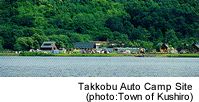
The Kushiro Workshop 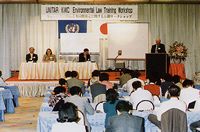 On September 13-19 1998, a Workshop on Multilateral Agreements Related to Biological Diversity was organized by the United Nations Institute for Training and Research (UNITAR) and the Kushiro International Wetland Centre, in cooperation with the Government of Japan, UNDP/Capacity 21, UNESCO/World Heritage Centre, the National University of Singapore, the Institute for Global Environmental Strategies and the Japan Wildlife Research Center. On September 13-19 1998, a Workshop on Multilateral Agreements Related to Biological Diversity was organized by the United Nations Institute for Training and Research (UNITAR) and the Kushiro International Wetland Centre, in cooperation with the Government of Japan, UNDP/Capacity 21, UNESCO/World Heritage Centre, the National University of Singapore, the Institute for Global Environmental Strategies and the Japan Wildlife Research Center.This training activity was directed to enhance the capacity of government administrators in the Asia-Pacific region in applying international Convention requirements in the area of biological diversity. Participants included 41 representatives from some 21 countries (Australia, Bangladesh, Bhutan, Cambodia, China, India, Indonesia, Iran, Japan, Kazakhstan, Rep. of Korea, Kyrgyz Rep., Malaysia, Mongolia, Nepal, Philippines, Singapore, Solomon Islands, Sri Lanka, Thailand, and Viet Nam). The Workshop also benefitted from the presence of 18 Resource Persons from 9 countries (Argentina, Australia, France, Italy, Japan, Singapore, Sri Lanka, Switzerland and the USA). We were delighted that this Workshop provided the occasion for the return to Kushiro of Dr. Daniel Navid, the Ramsar Bureau's Secretary General at the time of the 1993 Ramsar Conference, who is now serving as Senior Programme Coordinator at UNITAR and Mr. Lawrence Mason, one of the Chairpersons at the 1993 Conference, who assisted as a Workshop expert. The Workshop focussed upon implementation requirements for three of the main international agreements concerning biological diversity, the Ramsar Convention, the World Heritage Convention and the Convention on Biological Diversity. It featured a series of interactive lectures and participatory sessions leading to the identification of elements for national implementation policies and legislation to be promoted in countries throughout the Asia-Pacific region. Participants were also provided with published training materials from UNITAR's Courses of Correspondence Instruction. Once again, in late August 1999, as part of the UNITAR Programme of Training for the Application of Environmental Law, a second Kushiro Workshop for government administrators in the Asia-Pacific region will be held. Greatest stress in the 1999 Workshop will be placed upon how the application of International Environmental Agreements concerned with biodiversity can foster an ecosystem-based approach for environmental management. The Kushiro Marsh will provide a very valuable example of how international designations under these Agreements can contribute to wider conservation goals. Further information on the Kushiro Workshop programme is available from UNITAR at postal address: Palais des Nations, 1211 Geneva 10, Switzerland; fax: +41 22 917 8047 or E-mail: elp@unitar.org Lake Takkobu Included in Ramsar Site In an official gazette published on January 27, 1999, an announcement was made that the area of Kushiro-shitsugen, which is designated as a Ramsar site, will be expanded to include Lake Takkobu. By adding the entire water area of Lake Takkobu (137 hectares), the total area of Kushiro-shitsugen registered as a Ramsar site will become 7,863 hectares. East Hokkaido Area Town of Shibecha In 1998, the Town of Shibecha purchased about 150 hectares of private land on the shore of Lake Toro in the Kushiro-shitsugen National Park. Forest trees were cut down to promote charcoal production before and after World War II, and to expand farmland for dairy farming around 1955. In an attempt to change the barren land in the area to grassland to earn a living, local residents removed shrubs, altered river flows and changed the appearance of the wetland. In exchange for economic development, the citizens deprived rare plants and animals - including Japanese Cranes - of their habitats. As a result, the wetland, as well as the public's affection for it, has gradually dried. The greatest reason behind the municipal government's decision to purchase the land is the protection of the River Omoshironbetsu, which flows through the area into Lake Toro. This river, a minor tributary of the Kushiro River - "the lifeline of Kushiro-shitsugen," still retains a primeval image. If domestic wastewater, soil and sand flow into the river as a result of development activities, the environment of Lake Toro and Kushiro-shitsugen will be severely damaged. The municipal government has thus decided to purchase the land out of its tight budget. This is significant in that it will put an end to the town's history of selling its assets piece by piece - a practice conducted for a long time to make a living and promote dairy farming, which boasts an annual output of \15 billion - instead of preserving them for future generations. With this decision, Shibecha has taken the first step toward coexistence with nature of its own accord. Town of Shibecha
|