|

Yatsu-higata
 The tidal flat surrounding Tokyo Bay was reclaimed at a rapid pace to make more land available during Japan's high economic growth days. As a result, the original tidal flat has shrunk to one-tenth of its former size over the last 50 years. Yatsu-higata, with an area of 40 hectares, was once a part of the large tidal flat, but now is connected to Tokyo Bay by two water channels, each of which is 2 kilometers long and 8 meters wide. Seawater flows in and out twice a day through the channels, in accordance with the ebb and flow of Tokyo Bay, and the tidal flat appears at low tide. The tidal flat surrounding Tokyo Bay was reclaimed at a rapid pace to make more land available during Japan's high economic growth days. As a result, the original tidal flat has shrunk to one-tenth of its former size over the last 50 years. Yatsu-higata, with an area of 40 hectares, was once a part of the large tidal flat, but now is connected to Tokyo Bay by two water channels, each of which is 2 kilometers long and 8 meters wide. Seawater flows in and out twice a day through the channels, in accordance with the ebb and flow of Tokyo Bay, and the tidal flat appears at low tide.
Yatsu-higata was created in the 1960s. The rectangular-shaped tidal flat remained after all the surrounding area was reclaimed. The name was taken from a district in Narashino, Chiba Prefecture, in which the tidal flat is located. Although the reclamation of Yatsu-higata was once planned, local conservation groups objected to the plan. This, combined with increasing awareness of environmental protection in society and government policy changes, has helped save the tidal flat.
Yatsu-higata was later designated a wildlife protection area and registered as a Ramsar site. In addition, the Yatsu Higata Nature Observation Center was established as a base for conservation activities.
Yatsu-higata is characterized by a large number of birds migrating to the area and unique activities organized by the Yatsu Higata Nature Observation Center.
The center promotes environmental education on the importance and preciousness of Yatsu-higata. It also recruits volunteers and coordinates their activities, enabling ordinary citizens to participate in the conservation activities. The Observation Center, opened in 1994, attracts more than 50,000 annual visitors, equivalent to one-third of the population of Narashino. At present, 100 people have registered as volunteers, participating in a total of 1,500 days of activities annually. Since the center is open 300 days a year, this is equivalent to five volunteers being stationed at the center every day.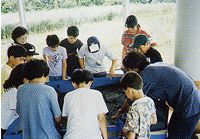
Yatsu-higata has also participated in the East Asian-Australian Shorebird Reserve Network. In February 1998, a sister wetland affiliation was signed between Yatsu-higata and Boondall Wetlands, Australia. The purpose is to promote exchanges between citizens and volunteers and develop networks for the exchange of technologies promoting environmental protection and education, as well as to foster information exchanges on shorebird trips.
Tatsuyuki Tomioka
Head of Resource
Management Section,
Sanctuary Center
Wild Bird Society
of Japan
|
TOPICS |
World Wetland Day - Commemorative Event in Lake Biwa
 It has been five years since Lake Biwa was designated as a Ramsar site under the Ramsar Convention to promote the conservation of wetlands serving as habitats for waterbirds. To commemorate the fifth anniversary, various events were held around Lake Biwa on several days, including February 2 (World Wetland Day). It has been five years since Lake Biwa was designated as a Ramsar site under the Ramsar Convention to promote the conservation of wetlands serving as habitats for waterbirds. To commemorate the fifth anniversary, various events were held around Lake Biwa on several days, including February 2 (World Wetland Day).
Starting from early in the morning on February 7 (Sun.), the main event "Live Waterbird Count Around Lake Biwa" was held. With the cooperation of staff members for wildlife protection, the number of waterbirds was counted at 100 locations along the lakeshore. On the same day, a waterbird observation event was also held at 20‚³ places around the lake. A total of 2,000 people from within and outside of the prefecture participated and observed birds following the instructions provided by the local municipal officials and volunteer group members. The existence of 45,000 waterbirds was confirmed, helping the participants recognize the importance of Lake Biwa as a wintering place for waterbirds.
In the venue established at the Shiga Prefectural Lake Biwa Museum, an electronic forum was held by linking Lake Biwa to Kushiro-shitsugen (Hokkaido) and Izunuma and Uchinuma (Miyagi) - both of which were registered as Ramsar sites prior to Lake Biwa - via a teleconferencing system. From Kushiro-shitsugen, it was reported that its registration as a Ramsar site has enabled the area to attract worldwide attention and encouraged people to recognize its importance. >From the venue at Izunuma and Uchinuma, it was reported that coexistence with local people is a matter of great importance to these wetlands, which are located in a rural district, the same as Lake Biwa. Opinions were exchanged on the "wise use" of wetlands, as stated in the Ramsar Convention. Audiences at each venue enthusiastically listened to the discussion.
These events have helped us recognize the importance of information exchanges between wetlands and the necessity of the participation of local people in conservation activities. We have been assured that we will be able to promote the conservation of Lake Biwa by disseminating information on and raising the public's awareness of the Ramsar Convention.
Nature Conservation Division,
Shiga Prefectural Government |
|