
|
lssued by the Kushiro International Wetland Centre
Kushiro, Hokkaido, Japan
|
On-Site Environmental Education in Eastern Hokkaido Wetlands
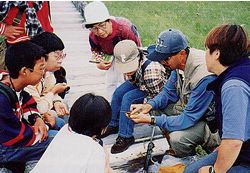 Since 1998, the Kushiro International Wetland Centre has been involved in environmental education studies targeting wetlands in eastern Hokkaido. A research group, consisting of nine members and headed by Prof. Tatsuichi Tsujii, president of the Hokkaido Environment Foundation, was established and has studied environmental education in five specific settings - universities, elementary through high schools, local communities, national parks and outdoor observation programs. Since 1998, the Kushiro International Wetland Centre has been involved in environmental education studies targeting wetlands in eastern Hokkaido. A research group, consisting of nine members and headed by Prof. Tatsuichi Tsujii, president of the Hokkaido Environment Foundation, was established and has studied environmental education in five specific settings - universities, elementary through high schools, local communities, national parks and outdoor observation programs.
Wetlands in eastern Hokkaido are targeted in this research. Prof. Tsujii, chairperson of the research group, says that this area features diverse environments and is thus ideal for environmental education. There are brackish water wetlands, tidal flats and intertidal wetlands along the coast, as well as freshwater wetlands. These freshwater wetlands also contain bogs, marshes, rivers, lakes, ponds and swamp forests.
In the Local Culture Course offered at the Kushiro Campus of Hokkaido University of Education, programs to study the relationship between nature and people and train future instructors for environmental education are now being developed. Students taking this course participate in field training lasting five days and four nights, conducted both in summer and winter. Through the hands-on experience of camping, canoeing and nature skiing, students surely acquire basic knowledge and skills as nature guides, learning the joys of the outdoors and becoming aware of various environmental problems.
Toya Elementary School near Kushiro Wetland has introduced environmental education programs based on the natural environment in the school district of Kushiro Town. These programs will enable students to recognize and appreciate the nature around them through hands-on experiences, acquire the wisdom and knowledge required to live with nature, and enhance children's sensitivity to the environment. Under the themes of (1) examining nature in Toya, (2) understanding the current status of Toya and (3) thinking about the future of Toya, students look for and observe the creatures living in the wetland, such as crawfish, fresh water fish, dragonflies, butterflies and insectivorous sundews (Drosera rotundifolia). By doing so, children recognize the pollution level of rivers running through the wetland. Questionnaires were conducted asking local people about Toya's environmental conditions in the past. Respondents said that, because there were few buildings in the past, the fireworks displayed at festivals in Kushiro City could be seen from their houses. Others said that rivers running through the downtown area were cleaner and they were able to catch fishes. Based on the information obtained through these activities, the students have established a new study theme: "developing Toya in coexistence with nature."
The Kiritappu Shitsugen Center has promoted the conservation and wise use of wetlands, and conducted environmental education by relating it to the lives of local people. Because the existence of wetlands is indispensable to the maintenance of the kelp harvesting areas along the coast, the center offers visitors an opportunity to experience kelp harvesting. This program intends to link wetland conservation and local industries and raise public awareness of their interdependence. This program will be developed as a local eco-tour.
Lake Toro Eco Museum Center, located on the shore of Lake Toro in Kushiro Wetland, is an information center for wetland visitors. This center also serves as a base for promoting environmental education involving local people. It takes a unique approach to providing interactive information on nature. Inside the museum, the map of Lake Toro is displayed on the Nature Information Board. This map is used to exchange information on wildlife and nature and share the results of environmental education among the center's staff, members of the National Park Volunteer Rangers and wetland visitors.
As for environmental education in outdoor observation activities, research has been conducted on topics such as aquatic organisms, fish, wild birds and plants.
Given the necessity of nurturing children's sensitivity toward nature while they are young (before entering elementary school), methods have been developed to enable them to observe the world of plankton living in puddles using a microscope. This has enabled children to experience a micro-world of 0.09 mm zooplankton and 0.06 mm phytoplankton.
Methods to enable children to closely observe various creatures living in water have also been developed. Using the traditional method of cast netting, instructors catch fish alive and put them in a small aquarium so students can observe them. This method enables children not only to understand fish habitats but also to observe and admire living fish.
In Lake Akkeshi and Bekanbeushigawa Wetland, where whooper swans (Cygnus cygnus) and many other water birds migrate in winter, a waterfowl observation program using local trains is introduced. These trains run at a speed slow enough to allow passengers to observe nature through the train window. The water birds are not alarmed by these trains, which run regularly through this area, enabling passengers to observe a variety of wild birds and their habitats from the train window. This program is expected to be used as a local eco-tour program. Participants in this program also have the best opportunity to observe sea eagles, which visit this area to feed on small fish disposed of by local fishermen because they have no commercial values. Therefore, this program also involves fishery activities.
Because the wetlands are completely covered with snow for about half of the year, the annual environmental education program starts with the arrival of spring. The first field study of the year is the "finding the first signs of spring" program. Participants walk around spring-fed ponds, riverbanks and lakeshores where snow still remains to find spring plants sprouting from the dead grass. They experience firsthand the arrival of spring by observing spring ephemeral plants, measuring water and atmospheric temperatures and solar radiation.
These studies will be continued and the results will be compiled as a report in 2001.
Members of the research group
Chairperson
Tatsuichi Tsujii, Professor, Hokusei Gakuen University
Members
Tadaichi Takahashi, Assistant Professor, Hokkaido University of Education, Kushiro Campus
Shin-ichi Hiruta, Assistant Professor, Hokkaido University of Education, Kushiro Campus
Satoshi Kobayashi, Assistant Professor, Kushiro Public University of Economics
Sumie Endo, Teacher, Toya Elementary School
Tsutomu Haryu, Curator, Kushiro City Museum
Toshikazu Ito, Project Chief, Hamanaka Town Kiritappu Shitsugen Center
Tatsuo Shibuya, Specialist, Akkeshi Waterfowl Observation Center
Mitsunori Sato, Instructor, Lake Toro Eco-museum Center
Yachiyo Takashima, Member of the Association of Kushiro-shitsugen National Park Volunteer Rangers
|
1999 Project Plan |
Training
Assisting with the JICA Training Course on Nature Conservation and Natural Parks Management (Sept.); Commissioned to conduct the JICA Training Course on Management / Administration and Wise Use of Natural Parks (Ecotourism) (Sept.); Commissioned to conduct the JICA Training Course on Conservation of Wetland Ecosystems and their Biological Diversity (Oct.)
Conferences & workshops
UNITAR / KIWC Environmental Law Training Workshop (Aug.)
Research & monitoring
Technical Committee activities: "On-site Environmental Education in Eastern Hokkaido Wetlands"
Awareness-raising & promotion campaigns
Issuance of newsletters; Publication and translation of a book entitled "Economic Valuation of Wetlands" (March)
International cooperation & cooperation with other organizations
Cooperation by participating in networks of sites critical for waterbird conservation; Cooperation with the conference of municipalities involved with the Ramsar Sites; Cooperation by participating in the Working Group to respond to Recommendation 6.3 and Participation in Ramsar COP7 |

|

|
| 次ページへ |
|
|