|

Katano-kamoike
 1.Overview and History of Katano-kamoike 1.Overview and History of Katano-kamoike
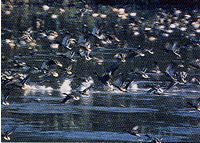
Katano-kamoike is one of Japan's most famous waterfowl migrating areas. About 2,000 white-fronted geese (Anser albifrons) and 300 bean geese (Anser fabalis) visit here to spend the winter. Both numbers are larger than for any other area west of the Hokuriku region.
This 10-hectare pond has been designated as Ishikawa Prefectural Government's natural monument, Class I special zone of the Echizen-kaga-kaigan Quasi-National Park, a Special Protection Area of national wildlife protection areas, and a Ramsar site.
The Daishoji Goose Hunting Area Cooperative Association has preserved a traditional goose hunting method called Sakaami-ryo, which was first used over 300 years ago during the Edo era. This method is based on the philosophy of wise use, because hunters catch only a small number of geese using nets while protecting the overall population of geese. Other conservation activities, such as controlling the pond water level, cutting the grass and monitoring people's entrance to the area, have also been conducted.
Since the Edo era, farmers in the area have produced rice by using the pond as an agricultural reservoir to irrigate surrounding rice paddies in summer. It is said that it was very difficult to produce rice in the past, because these rice paddies as well as part of the marshy area are filled with water and an expanded area of open water is created for migratory birds in winter and farmers had to start making ridges between rice fields in spring. Thanks to a large amount waterfowl droppings, however, they were able to produce very delicious rice without using fertilizer.
2. Kaga Kamoike Observation Center and Citizen Participation
The City of Kaga established the Kamoike Observation Center in 1985 as part of the eco-tourism project to promote the conservation of Kamoike, environmental education and the local hot spring tourism industry. The Wild Bird Society of Japan was involved in this center's construction project from its designing stage. Since the opening of this center, it has been managed and operated by the society's members, who serve as rangers and guides. In 1988, the Friends of the Kaga Kamoike Observation Center was established to support the conservation activities from the citizens' standpoint. The Friends of the Kaga Kamoike Observation Center asked for citizen participation in creating waterfowl stopover places and habitats for various wildlife. As a result, the Kamoike Tanbo (Rice Paddy) Club was established and is now responsible for paddy field cultivation in the pond.
The municipal government has restored about 700 square meters of paddy fields in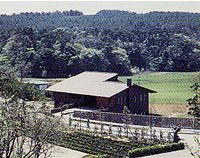 front of the Observation Center, where a large number of geese fly over. This has pleased visitors to the center, because they can observe the birds closely. The City of Kaga has also established a liaison committee to promote environmental protection around the Katano-kamoike area. This committee has conducted experiments on filling Katano-kamoike with water in winter to improve the conditions of the pond and surrounding rice paddies, which are geese feeding grounds. front of the Observation Center, where a large number of geese fly over. This has pleased visitors to the center, because they can observe the birds closely. The City of Kaga has also established a liaison committee to promote environmental protection around the Katano-kamoike area. This committee has conducted experiments on filling Katano-kamoike with water in winter to improve the conditions of the pond and surrounding rice paddies, which are geese feeding grounds.
The City of Kaga joined the Anatidae Site Network in the East Asian Flyway in May 1999 and will strive to conserve Katano-kamoike - our valuable asset - in cooperation with many people involved.
Greenery Promotion Office
Industry and Environment Division,
City of Kaga
|
TOPICS |
A Report on Wetland Management Involving the Local Community in Japan
 KIWC published a report from the Japan Workshop, a part of the International Workshop on Ramsar Site Management Involving the Local Community, held in 1998 in Kushiro. KIWC published a report from the Japan Workshop, a part of the International Workshop on Ramsar Site Management Involving the Local Community, held in 1998 in Kushiro.
The Workshop was organized by IUCN, WWF, the Caddo Lake Institute and KIWC as part of a project in response to Recommendation 6.3. Its aim was to prepare a draft plan of guidelines for implementing wetland management with the cooperation of local and indigenous people. The accomplishments were incorporated into Resolution VII. 8 on local communities and indigenous people which was adopted at the 7th Ramsar Conference.
This report consists of abstracts from presentations on community-based wetland management in Japan, which were part of the 2nd Day Program. Involvement of the local community is considered a key issue in the promotion of wetland conservation in developing countries, but many case studies from Japan confirmed that it is also necessary in developed countries. The contents cover the following subjects: Four Ramsar sites (Kushiro-shitsugen, Akkeshi-ko and Bekanbeushi-shitsugen, Katano-kamoike and Utonai-ko), Sone Wetland, Fujimae Tidal Flats, Isahaya Bay, Kinashibetsu-shitsugen, Kabukuri-numa Marsh, Red-crowned Crane, Saunders' Gull, Hooded Crane and shorebirds. Case studies from Thailand and Nepal were also included.
Copies of the report were distributed at the Ramsar Conference and are still available. Anyone interested in this report should please contact the KIWC Bureau. |
|