Morning walks
Date and departure time may differ by course. Confirm details at
conference site.
Participants will be brought back to the conference site by 8:00 a.m.
Transportation, usually by bus, will be provided.
1. Lake Harutori and Kushiro City Museum
2 km east of the conference site.
Trees and flowers such as MIZUNARA Quercus mongolica subsp. crispula,
ITAYAKAEDE Acer mono f. marmoratum, and NAGABAYANAGI Salix
sachalinensis, HAMANASU Rosa rugosa, HIMEIZUI Polygonatum humile,
EZOICHIGO Rubus idaeus f. concolor, IWANOGARIYASU Calamagrostis
langsdorffii grow thickly from the lakeside of Kushiro's Lake Harutori
(36.1 ha., 5.7 m deep) to the nearby hills.
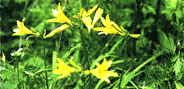
Many wild birds, including KINKUROHAJIRO Aythya fuligula, MAGAMO
Anas platyrhynchos platyrhyncos, KAITSUBURI Podiceps ruficollis poggei,
AOSAGI Ardea cinerea jouyi and seagulls can be seen on the lake which
is also home to HIBUNA Carassius auratus langsdorfii. Natural and cultural
data are exhibited in Kushiro City Museum under the themes of "Nature and
culture in the North," "The land Mammoth walked on," and "Kushiro Marsh,
breeding ground of TANCHO Grus japonensis."
2. Kushiro Marsh Observatory - Satellite Promenade
About 15 km northwest of conference site.

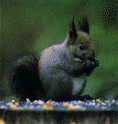
Kushiro Marsh Observatory exhibits specimens of creatures living in the
marsh. The course starts and ends at the observatory. It is a 2.5 km-long
wooden walkway, which passes through green hilly areas (about 80 m above
sea level) with such trees as MIZUNARA Quercus mongolica subsp. crispula,
HANNOKI Alnus japonica and SHIRAKAMBA Betula platyphylla var. japonica.
From Satellite Viewpoint, you can observe a forest of HANNOKI Alnus japonica
scattered among bog mire of YOSHI Phragmites communis and SUGE Carex spp.,
and birds such as some species of tits, AOSAGI Ardea cinerea jouyi, TANCHO
Grus japonensis, YAMAGERA Picus canus and AKAGERA Dendrocopos major.
3. In and around Kushiro Shitsugen Wildlife Center
About 13 km east of conference site.
This is the only facility in Hokkaido which exhibits, surveys and studies the
endangered species specified under the wildlife protection policy of the
Environment Agency.
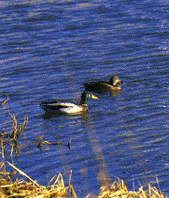
MAGAMO Anas platyrhynchos platyrhyncos and KAITSUBURI Podiceps ruficollis
poggei swim in the front pond, and you can enjoy watching OJISHIGI Gallinago
hardwickii fly. YACHIBOZU tussock grass, the upraised roots of sedges like
HIRAGISHISUGE Carex augustinowiczii and KABUSUGE Carex caespitosa, grow
aggregatively, and there are vast marshy areas of HIOGIAYAME Iris setosa
in the area.
4. Onnenai Visitors Center and Wooden Walkway in the Marsh
About 18 km northwest of the conference site.
The 3 km walkway which runs through a HANNOKI Alnus japonica forest and
marshland at different stages of development, from fen mire to bog mire.
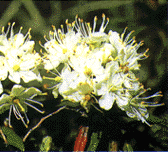
Flowers like ISOTSUTSUJI Ledum palustre var. diversipilosum,
TSURUKOKEMOMO Vaccinium oxycoccus, GANKORAN Empetrum
nigrum var. japonicum, HIMEKAIUCalla palustris and HOZAKISHIMOTSUKE
Spiraea salicifolia can be observed here.
You may also hear the songs of AOJI Emberiza spodocephala
personata and NOGOMA Erithacus calliope, and see some species
of tits, AOSAGI Ardea cinera jouyi and TANCHO Grus japonensis
looking for food. Furthermore, you will find many EZOAKAGAERU
Rana pirica tadpoles in the water.
5. Toro Motomura Paru and Shore of Lake Toro
About 28 km north of the conference site.
Lake Toro is the largest inland sea-lake in Kushiro Marsh
(637 ha., 7 m deep). Floating leaf plants such as NEMUROKOHONE
Nuphar pumilum, EZONOHITSUJIGUSA Nymphaea tetragona var. tetragona
and ONIBISHI Trapa japonica bloom on this lake.
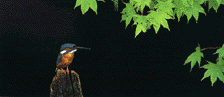
You will see MIZUDOGUSA Equisetum fluviatile, KAWAAISA Mergus
merganser and KAWASEMI Alcedo atthis on the lake shore, and EZOSHIKA
Cervus nippon yesoensis on the opposite shore. Near the lake, there is a
local museum which exhibits natural and cultural data of the area.
6. Around Takkobu
About 18 km north of conference site.
This walking course includes a 2.2 km long walkway (in some areas bicycle are
acceptable) from the campsite on the shore of Lake Takkobu (136 ha., 3 m deep)
to the viewpoint, from where the Kushiro River can be seen, and a 1.3 km long
wooden walkway which runs through the marsh.
OBANANOENREISO Trillium kamtschaticum and EZOOSAKURASO Primula
jesoana var. pubescens flowers bloom on the lake shore, and birds such as
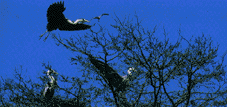
OJIROWASHIHaliaeetus albicilla, AOSAGI Ardea cinerea jouyi, OJISHIGI
Gallinago hardwickii, NOBITAKI Saxicola torquata stejnegeri as well as
some species of tits and AKAERIKAITSUBURI Podiceps grisegena holbollii
inhabit the area.
7. Otanoshike seashore
About 13 km west of the conference site.
A sandpit spreading out over this area is over 6,000 years old and landlocked
parts of the marsh to form the marsh of today. You can observe sand dunes as
well as both alpine and polar plants. MITSUGASHIWA Menyanthes trifoliata,
TSURUSUGE Carex pseudocuraica, HIOGIAYAME Iris setosa, HAMANASU Rosa rugosa
and HAMABOFU Glehnia littoralis can be found here.
8. Katsurakoi
About 10 km east of conference site.
This seashore to the east of Kushiro City consists for 20 to 30 meter sea-eroded
cliffs where seabirds breed.
You will see flowers such as SUMIRE Viola mandshurica, OSAKURASO Primula
jesoana, EZOKANZO Hemerocallis middendorfii var. esculenta and HAKUSANCHIDORI
Orchis aristata, and hear the songs of NOGOMA Erithacus calliope, KOYOSHIKIRI
Acrocephalus bistrigiceps and SHIMASENNYU Locustella ochotensis ochotensis.

9. Hosooka Marsh Viewpoint
We will leave JR Kushiro Station and proceed to Hosooka Marsh Viewpoint where
we will explore the surrounding area. From the viewpoint, one can see the winding
Kushiro River, the marsh, and Mt. Meakan and Mt. Oakan (both active volcanoes).
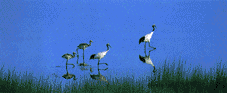
A nesting place for TANCHO Grus japonensis can also be seen in the distance. We
will walk 2.5 km along the Kushiro River, and return to the conference site by bus.
10. Kushiro Zoo
Opened in 1975 and covering an area of 55 ha., Kushiro Zoo is the largest as
well as easternmost zoo in Japan. Taking advantage of its natural northern
environment, it started as a northern zoo featuring arctic animals. It promotes
protection and propagation of the endangered TANCHO Grus japonensis, SHIMAFUKURO
Ketupa blakistoni blakistoni, OWASHI Haliaeetus pelagicus pelagicus and OJIROWASHI
Haliaeetus albicilla.
11. Japanese Crane Reserve
The Japanese crane reserve opened in 1958 in order to protect and propagate the
endangered TANCHO Grus japonensis.
At first, the ecology of TANCHO Grus japonensis was not known at all and the
reserve had to start with a trial and error method. After 10 years, the reserve
succeeded in artificial hatching. Since then, the reserve has propagated many
TANCHO Grus japonensis.
Entire renovation of buildings, including a management office, was carried our
from 1987 to 1989. A lecture room and an exhibition room were established, and
the reserve began functioning not only as a visiting place but also an academic facility.
At present, 17 TANCHO Grus japonensis freely roam and live at the reserve.

�@