KIWC Website Renewed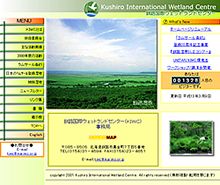 KIWC opened a new website in March 2001. Although KIWC's official website has already been established, it is solely intended to run KIWC English newsletters. Thus it was difficult to introduce our activities to many people through the website. KIWC opened a new website in March 2001. Although KIWC's official website has already been established, it is solely intended to run KIWC English newsletters. Thus it was difficult to introduce our activities to many people through the website.Therefore, we decided to renew it to enable more people in Japan and abroad to know about our activities and, in order to contribute to the promotion and the raising awareness of "wetland conservation," "wise use of wetlands" and "environmental education in wetlands." In addition to information on KIWC's activities, the new website introduces the KIWC Technical Committee, Ramsar sites, sister wetlands, and literature translated and published by KIWC. It is linked to the websites of Japanese and international wetland conservation organizations to develop Web-based networks. We hope that this website will contribute to the development of networks that will encourage many people to cooperate for the promotion of wetland conservation at various levels. Website: http://www.kiwc.net Translation / Publication of "Economic Valuation of Wetlands" Following the publication of "The Ramsar Convention on Wetlands: Its History and Development" in 1995, KIWC translated and published "Economic Valuation of Wetlands" in 2000. The original book titled "Economic Valuation of Wetlands: A Guide for Policy Makers and Planners," authored by Dr. Edward B. Barbier and others, was translated into Japanese by Dr. Satoshi Kobayashi, assistant professor of Kushiro Public University of Economics, and others. The English book was published by the Ramsar Convention Bureau in 1997 based on a recommendation for the "Promotion of cooperation on the economic valuation of wetlands," adopted at the 6th Meeting of the Conference of the Contracting Parties, Brisbane, Australia. 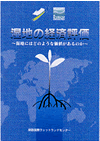 The aim of this book is to provide guidance to government officials, researchers and other people involved in wetland conservation, about the possibilities and methods of economic valuation of wetlands. This book explains in detail various wetland valuation methods, presents case examples of research on wetland valuation, and provides guidelines for using valuation results in determining policies on wetlands. For further information, please contact KIWC Bureau: E-mail: kiwc@marimo.or.jp Environmental Education regarding Wetlands in Eastern Hokkaido 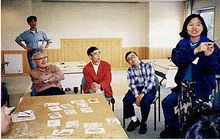 Established in 1995, the KIWC Technical Committee conducted research under the theme "Ecotourism in Wetlands" in FY 1995 and "Environmental Education regarding Wetlands in Eastern Hokkaido" from FY 1996 to 1997. Established in 1995, the KIWC Technical Committee conducted research under the theme "Ecotourism in Wetlands" in FY 1995 and "Environmental Education regarding Wetlands in Eastern Hokkaido" from FY 1996 to 1997. Recently, we have come to face a variety of environmental challenges around the globe, causing us to become more and more aware of the importance of environmental conservation. Accordingly, not only conservation, but also the "wise use of wetlands" for the economic benefits of local communities and "Environmental Education regarding Wetlands" to be conducted to promote and raise awareness of environmental conservation, have come to attract much attention. Under the theme "Environmental Education regarding Wetlands in Eastern Hokkaido," the KIWC Technical Committee focused on environmental education and eco-tour programs to be conducted in eastern Hokkaido wetlands. In order to contribute to the conservation of wetland ecosystems, the importance of which has been internationally recognized, we conducted research from diverse viewpoints from FY 1998 to 2000 by examining the objectives, significance and role of the promotion and awareness raising of regional environmental education. Committee members performed research and studies primarily in our own specialized fields in 1998, compiling the progress of our research projects into an interim report in the following year. In 2000, the final year for the research, we met together to conduct field work. At the first Technical Committee meeting in FY 2000, we presented the results of case studies on environmental education programs currently conducted at universities, museums and nature centers, exchanging information and views on the effectiveness of these educational programs and participants' responses to them. We also discussed how to conduct follow-up activities for participants and how to evaluate these programs. In September 2000, the Technical Committee conducted joint field research in Kiritappu-shitsugen and at the Kiritappu Shitsugen Center (Hamanaka Town), together with the participants of the JICA Training in Management / Administration and Use of Natural Parks (Ecotourism). This joint research was supported by the JICA Hokkaido International Center Obihiro and the Kiritappu Shitsugen Center. The committee members and the JICA trainees experienced the environmental education programs actually conducted at the Kiritappu Shitsugen Center for its visitors. Through this hands-on experience, we were able to observe the programs objectively from the viewpoints of participants of the programs. This also served as an important opportunity for us and the Japan International Cooperation Agency (JICA) trainees to learn from the instructors' ideas and skills. JICA trainees responsible for environmental education and ecotourism in their respective countries seemed to be impressed by conservation activities involving the municipal government, people and industries in Hamanaka Town where the training field of Kiritappu-shitsugen is located. They enthusiastically discussed local-level activities for wetland conservation with the center's staff. The content of this joint research will be included in the final report. The research activities for environmental field education will be completed in FY 2000. However, to offer interesting, appealing environmental education programs to local people, it is necessary to develop new educational programs and help instructors acquire expertise and skills. Therefore, we intend to continue our efforts through 2001 and beyond to exchange information and techniques by consolidating networks relating to environmental field education. KIWC Technical Committee KIWC Technical Committee KIWC Technical Committee members  Chairperson Tatsuichi Tsujii Professor Hokusei Gakuen Univ.
|