
|
lssued by the Kushiro International Wetland Centre
Kushiro, Hokkaido, Japan
|
RA Memorial Lecture Celebrating the 20th Anniversary of Kushiro-shitsugen's Designation as a Ramsar Site
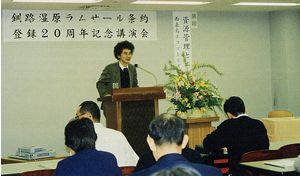 A lecture commemorating the 20th anniversary of Kushiro-shitsugen's designation as a Ramsar site was held on February 2 (World Wetlands Day) at the Kushiro City Tourism & International Relations Center. About 90 local citizens visited the venue. A lecture commemorating the 20th anniversary of Kushiro-shitsugen's designation as a Ramsar site was held on February 2 (World Wetlands Day) at the Kushiro City Tourism & International Relations Center. About 90 local citizens visited the venue.
This lecture, held as one of the commemorative events to celebrate the anniversary, was organized by the Kushiro-shitsugen National Park Liaison Association and KIWC. Mr. Akio Maita, Project Co-ordinator of the Japan Wildlife Research Center and an expert on eco-tourism, lectured under the title of "Natural Resource Management and Eco-Tourism - based on examples of eco-tourism on Iriomote Island." He discussed whether eco-tourism can successfully unite resource management and sustainable use, by introducing examples in Iriomote Island in Okinawa Prefectural Government.
In his talk, Mr. Maita stressed the importance of reconciling two standpoints in the process of building eco-tourism: protection and development. He then described the wildlife and culture of Iriomote Island using slides, the history of the island after it was returned to Japan, and the development and current status of eco-tourism there. The specific measures taken on Iriomote, such as making a list of specialists and natural resources and phenology calendars, gave the audience many suggestions.
To promote eco-tourism as an industry, he stressed the importance for local people to find values in local culture and nature and regain pride in them. He also said that it is necessary for local people, tourist agencies, researchers and administrative bodies to cooperate under common goals and to create systems to train guides and contribute to the development of the local area.
Workshop on the Anatidae Site Network in the East Asian Flyway
The Anatidae Site Network in the East Asian Flyway was launched at the Seventh Meeting of the Contracting Parties to the Ramsar Convention in Costa Rica in May 1999. Twenty-five anatidae habitats from six countries (Republic of Korea, China, Japan, the Philippines, Mongolia and Russia) are participating in the Network. The first workshop was held in Hamatombetsu-cho in Esashi-gun, Hokkaido, on October 24, 1999, as an event commemorating the 10th anniversary of the designation of Kutcharo-ko (Lake Kutcharo) as a Ramsar site.
Some 100 people, from Japan and abroad, attended the workshop, at which Noboru Yamauchi, who is called Hakucho-ojisan (Uncle Swan) of Kutcharo-ko, and Mr. Kurechi, the chairperson of the Anatidae Working Group, gave keynote lectures. After that, representative from five foreign countries, including the U.S.A. and Russia, and from seven Japanese sites (Akkeshi-ko and Bekanbeushi-shitsugen, Kushiro-shitsugen, etc.) reported on local activities for the conservation of geese and ducks. The workshop was concluded by adopting the Hamatombetsu Statement, which endorsed mutual cooperation among participating sites of the Network and the promotion of conservation activities at
Kutcharo-ko.
Nature Conservation Section
City of Kushiro
Visiting Wetlands by Wheelchair
On November 7, 1999, the Kushiro-Shitsugen Wheelchair Group of nine members, consisting of people with visual and physical handicaps and senior citizens living in Shibecha, and 19 volunteers from Shibecha and its neighboring town of Teshikaga walked through the wooden path established in Kushiro-shitsugen in Onnenai (Tsurui Village). This plan was prompted by the completion of a barrier-free wooden path. Also, the group members hoped for an opportunity to try what they learned in last summer's wheelchair training course, organized by the Shibecha Welfare Association.
We left Shibecha on the Welfare Association's bus. Five veteran guides from the Yachi-no-Kai, a group conducting activities mainly in Kushiro-shitsugen, also came to help us. To our great satisfaction, it was easy to push normal wheelchairs along the wooden path, and there was nothing to obstruct our views. Members of the Yachi-no-Kai provided excellent explanations, which greatly pleased participants with visual handicaps. This made us realize the necessity of providing explanation.
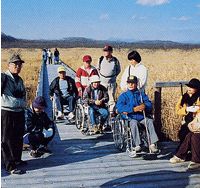 A round trip using the wooden path in Onnenai is about four kilometers - a distance which might make not only physically handicapped people but also people with weak legs hesitant to go. Now that the wooden path and facilities to enable everyone to observe wetland have been completed, the only thing required is that more people offer support. An organization offering wheelchair tours should be established in the future. Nonetheless, I believe that this tour was the first step to this end. A round trip using the wooden path in Onnenai is about four kilometers - a distance which might make not only physically handicapped people but also people with weak legs hesitant to go. Now that the wooden path and facilities to enable everyone to observe wetland have been completed, the only thing required is that more people offer support. An organization offering wheelchair tours should be established in the future. Nonetheless, I believe that this tour was the first step to this end.
There still remain many problems to be solved, and the most urgent one is how wheelchairs can be used during period of snow. We hope to overcome this problem before next season by asking for advice from people involved.
Takumi Hoshi (Shibecha)

|

|
| 次ページへ |
|
|