|
Familiarizing Ourselves with Kushiro-Shitsugen
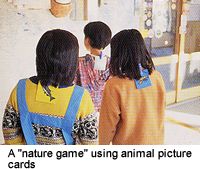 Kushiro-shitsugen (Kushiro Wetland), which is under our protective gaze, is Japan's largest wetland and was designated as Japan's first Ramsar site in 1980. This year is the 20th anniversary since that designation. Currently, about 700,000 people visit Kushiro-shitsugen annually, not including the 12,000 who come for canoeing, 3,000 for marsh exploration on Dosanko horses (which are native to Hokkaido), 180,000 for JR Norokko Train* & SL Winter Marsh Train rides and 3,000 for the Kushiro-shitsugen Eco-Tour. Many other activities, including dog sledges, also attract an increasing number of participants every year. Kushiro-shitsugen (Kushiro Wetland), which is under our protective gaze, is Japan's largest wetland and was designated as Japan's first Ramsar site in 1980. This year is the 20th anniversary since that designation. Currently, about 700,000 people visit Kushiro-shitsugen annually, not including the 12,000 who come for canoeing, 3,000 for marsh exploration on Dosanko horses (which are native to Hokkaido), 180,000 for JR Norokko Train* & SL Winter Marsh Train rides and 3,000 for the Kushiro-shitsugen Eco-Tour. Many other activities, including dog sledges, also attract an increasing number of participants every year.
Although Kushiro-shitsugen's landscapes and ecological characteristics are very unique and attractive to these visitors, some people in the region tend to feel nothing special about them and view them as just natural features.
Japan's Ministry of Education intends to implement new school curriculums, in which a new subject "Sogo-gakushu (general studies)" is added. One of the main themes of this subject is "the environment." Although this subject will be taught in school from April 2000, few materials showing the specific features of Kushiro-shitsugen have been made available.
Given these situations, the Kushiro-shitsugen Triangle Network discussed methods to enable students to study creatures living in the local area with interest. Because it is more important for children to discover knowledge for themselves than to be taught, we decided to make picture cards featuring animals living in Kushiro-shitsugen and with accompanying explanation. Ayako Ujihara illustrated the 32 picture cards and the author added explanations to them. In April 1999, we applied to the Project Coordination Section of the Hokkaido Environment Foundation for a subsidy, which was granted in June that year. With this aid, we were able to complete the picture cards.
We intend to continue helping children recognize the natural splendor of the local area by enhancing their innocent question of "What is this?"
* Norokko Trains are known as the slowest trains in Japan.
Yoshihito Sato
Secretariat of the Yachi-no-Kai
(NPO status applied for)
Secretariat of the Kushiro-shitsugen
Triangle Network
Protection and Management of Sika Deer
Sika deer (Cervus nippon yesoensis) were once on the verge of extinction due to overhunting in the early Meiji era and heavy snowfall. After the enactment of hunting regulations and changes in habitat, however, Sika deer populations increased and its range expanded. As a result, the damage to the agriculture and forestry industries has become serious, reaching \4.2 billion in eastern Hokkaido in fiscal year 1996.
To cope with this problem, the Hokkaido Prefectural Government in 1994 designated areas where, for the first time in 74 years, female deer hunting is allowed. Research on the distribution of deer populations has been conducted since fiscal year 1984 to obtain basic data on the ecology of Sika deer. As a result, its major habitats, estimated populations, seasonal migration, age structures, pregnancy rates and nutrition levels have been clarified. Based on these results, a Sika deer protection and management plan has been prepared to maintain its population at a stable level in the future while avoiding extinction.
The estimated deer population as of March 1994 was 120,000 (±46,000), which is expressed as a reference number of 100 in this plan. It is aimed to lower this number to 50 in three years starting from fiscal year 1998 and maintain it around 25 in the future. The reference number as of March 2000 was 80.
Meanwhile, due to poor catches of cod in the Shiretoko region in recent years, Steller's eagles and white-tailed eagles flying over in winter have come to eat Sika deer carcasses left by hunters, which sometimes contain lead splinters from rifle bullets. Because some eagles have been found suffering from lead poisoning, the Hokkaido Prefectural Government is preparing to introduce a regulation for the use of lead bullets in the fiscal year 2000 hunting season.
Environment and Lifestyle Division,
Kushiro Subprefectural Office,
Hokkaido Prefectural Government
Enjoying the Norokko Train Ride Through the Wetlands in Winter
 The Hakucho Norokko train has been operating in Akkeshi since January 1999. Norokko trains are known as the slowest trains in Japan. The Hakucho Norokko train has been operating in Akkeshi since January 1999. Norokko trains are known as the slowest trains in Japan.
This train runs for a limited period - only January last season and from December 1999 to January 2000 this season. The train window commands the best view of the Lake Akkeshi and the Bekanbeushi Marsh - a Ramsar site and one of Japan's most famous staging and wintering sites for whooper swans. Running at a slow speed, this train enables its passengers to fully enjoy the winter landscapes and living creatures.
During the Hakucho Norokko train's operation period, an observation trip is organized several times by the Akkeshi Waterfowl Observation Center. Participants can closely watch the flocks of more than 1,000 whooper swans. Accipitridae, such as Steller's sea eagles and white-tailed sea eagles, and Ezo deer also visit this area, enabling visitors to fully appreciate the attraction of Akkeshi's wetlands in winter.
Tatsuo Shibuya
Specialist,
Akkeshi Waterfowl Observation Center
JICA Training Course on Conservation of Wetland Ecosystems and Their Biological Diversity
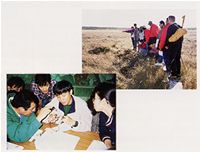 In cooperation with the Environment Agency, the JICA Hokkaido International Centre, Obihiro and KIWC hosted a JICA training course on the conservation of wetland ecosystems and their biological diversity from October 11 to November 6, 1999. This year, 10 environmental conservation specialists from 10 countries (Cambodia, China, Indonesia, Laos, Mongolia, Papua New Guinea, Peru, Thailand, Viet Nam, Latvia) participated.ハ The course was conducted primarily at the Ramsar sites in the Kushiro region, Yatsu-higata (a tidal flat designated at the convention), Shunkunitai Wild Bird Sanctuary and the Biodiversity Center of Japan. This training course was aimed at enabling participants to expand their expertise on the conservation of wetlands and their diverse wildlife.ハ To this end, a wide variety of curriculums covering subjects from practical research methods to monitoring and bird banding research, were offered. This year's participants have contributed their comments. In cooperation with the Environment Agency, the JICA Hokkaido International Centre, Obihiro and KIWC hosted a JICA training course on the conservation of wetland ecosystems and their biological diversity from October 11 to November 6, 1999. This year, 10 environmental conservation specialists from 10 countries (Cambodia, China, Indonesia, Laos, Mongolia, Papua New Guinea, Peru, Thailand, Viet Nam, Latvia) participated.ハ The course was conducted primarily at the Ramsar sites in the Kushiro region, Yatsu-higata (a tidal flat designated at the convention), Shunkunitai Wild Bird Sanctuary and the Biodiversity Center of Japan. This training course was aimed at enabling participants to expand their expertise on the conservation of wetlands and their diverse wildlife.ハ To this end, a wide variety of curriculums covering subjects from practical research methods to monitoring and bird banding research, were offered. This year's participants have contributed their comments.

|

|
| 次ページへ |
|
|