|
North-East Asian Crane Site Network
The North-East Asian Crane Site Network was established in Beidaihe, People's Republic of China, on March 7, 1997. This project is in line with the Kushiro Initiative, which proposed the formation of networks by species of migratory birds of habitats along flyways. The proposal was made at a meeting
 held in Kushiro in 1994 attended by nations located under the migratory birds' flyway extending from Russia to Australia. held in Kushiro in 1994 attended by nations located under the migratory birds' flyway extending from Russia to Australia.
Based on the Kushiro Initiative, the East Asian-Australasian Shorebird Reserve Network was established during the Ramsar Brisbane Conference. The creation of these networks was also advocated in Recommendation 6.4., which was jointly issued a year ago by the governments of Australia and Japan and officially adopted as the Brisbane Initiative.
The establishment of the Shorebird Reserve Network was vigorously promoted by ANCA (now reorganized and called Environment Australia) and the Environment Agency of Japan. It was part of an effort to take specific regional action on the occasion of the Ramsar Conference spanning the Asia-Pacific region from Kushiro to Brisbane. Several NGOs (non-governmental organizations) such as AWB (now reorganized into Wetlands International Asia-Pacific) and IWRB Japan Committee (currently called Wetlands International Japan) have helped the two governments implement those projects by offering the use of their worldwide networks. The Wild Bird Society of Japan offers technical support for the North-East Asian Crane Site Network.
The Brisbane Conference is highly regarded for shifting the focus of wetland importance from that of migration of waterfowl to humans. At the same time, the Brisbane Initiative clearly referred to the presence of migratory birds which link wetlands across national boundaries, and the essential need for international cooperation in their protection.
While the shorebirds' flyway extends from Russia to Australia and New Zealand, crane habitats are concentrated in Northeast Asia. In recent years, this area has attracted worldwide attention not as a crane habitat, but rather as an area undergoing remarkable political and economical changes. However, it is truly encouraging that many regions which cranes inhabit have expressed their willingness to participate in the Crane Site Network.
Kaori Matsui
Executive Director
Wetlands International Japan
Report on the Training Course on Wetland Conservation and Protection of Migratory Birds
Japan International Cooperation Agency (JICA) Training Course on Wetland Conservation and Protection of Migratory Birds was held at Ramsar sites such as Kushiro Marsh, Akkeshi-Bekanbeushi Marsh and Kiritappu Marsh, in eastern Hokkaido, Japan, over one month from October 4 to November 3, 1996.
Wildlife protection and nature conservation officials from Bhutan, Indonesia, Laos, Papua New Guinea, the Philippines and Thailand took part in the training course.
In the program on protection of migratory birds, trainees captured dozens of wild birds in wetlands by setting up nets before sunrise, and attached bands to them. The wild birds in wetlands include long-tailed rose finches, long-tail tits, black-faced buntings and Japanese gray buntings. Trainees will confirm the presence of these birds in their respective countries.
 In the previous year's program, nest boxes were constructed for the Blakiston's fish-owl, an endangered bird species in Japan. Trainees returned to clean the nest boxes and were surprised at being driven away by a father owl. In the previous year's program, nest boxes were constructed for the Blakiston's fish-owl, an endangered bird species in Japan. Trainees returned to clean the nest boxes and were surprised at being driven away by a father owl.
Trainees studied the use of satellite pictures in wetlands monitoring and confirmed the effectiveness of the method. They learned about technologies related to wetlands fisheries products to promote sustainable use of natural resources and spoke with local specialists.
They participated in ecotours designed to entertain and provide a better understanding of the wetlands and the surrounding hills and grassy plains, with no harm to either the local ecosystem or wildlife. The ecotours included horseback riding, mountain biking and canoeing. The trainees also hiked along a wetland footpath made by volunteers and were reminded of the importance of public awareness among local people in wetlands conservation and protection of migratory birds.
The trainees were eager to discuss their experiences and we thus tended to fall behind schedule during the course of the training period.
The results of the program can be seen in the action plans prepared by the trainees. They will attempt to apply those action plans after returning to their respective countries.
The JICA training program is expanding and will continue in 1997.
Hisashi Shinsho, Course Leader
Marsh Exploration on Dosanko* Horseback
(* Dosanko is the Japanese name for a native horse in Hokkaido)
A 50-minute drive from Kushiro will bring you to Tsurui Village, a dairy farming community with a population of approximately 2,500, which is known nationwide as the home of the Japanese crane. Southeast of the village lies Kushiro Marsh, the value of which was not fully appreciated until it was named a National Park in 1987. With that designation as a turning point, Kushiro Marsh has since come to attract a great deal of attention.
A year after the designation, the National Park Office (now East Hokkaido National Parks and Wildlife Office) organized the "Exploring Nature on Dosanko Program" to encourage discussion on ways to protect Kushiro Marsh and conduct nature exploration tours on horseback. The event was held again the following year, organized by Village of Tsurui this time. The village continued to hold the tours every year, amid growing popularity. In 1996, the marsh tour was established on a regular, year-round basis and more than 1,000 people have since participated.
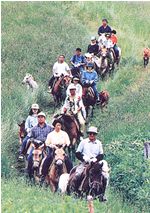
This horse riding can be enjoyed by everybody, as beginners are given time to practice in the paddock before the tour begins. The small Dosanko horse is easier to ride than Thoroughbreds or crossbred horses, and the horses are tied to one another during the trip, which also soothes the worries of the inexperienced. Experienced riders are, of course, welcome to ride on their own.
The highlights of the tour are the breathtaking views from Miyajima Ridge and Kirakotan Ridge. After enjoying riding through the grasslands, forest paths and hills, participants get off their horses and walk out on the ridges. Throughout the tour, the participants are continuously fascinated by the unique scenery. The grasslands of reeds, sedges and alders call to mind the African savanna and the lakes, ponds and meandering rivers are reminders of days long ago. While admiring these landscapes over lunch, you are sure to feel a little closer to the horses accompanying you.
Village of Tsurui

|

|
| 次ページへ |
|
|