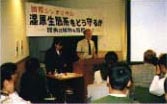
Community-based Wetland Management Workshop
An International Workshop on Community-based Wetland Management will be held in Kushiro as part of the project. At the workshop, the abovementioned partners in the project will review case studies from Asia and Oceania. Case studies from North America and the Neo-tropics were presented at the Conference on Communities Working Together for Wetlands in Alexandria, U.S.A., and those from Europe and Africa will be discussed at the US Wetlands Month Conference in Washington, D.C. Project participants and invited experts will also discuss and develop the following items for consideration at the Seventh, to be held in San Jose, Costa Rica, in May 1999.
Kiritappu International Symposium for the Conservation of Wetland Ecosystems June 7, 1997 An international conference was held at the Kiritappu Shitsugen Center, to which we invited two British entomologists, Mr. Ian J.L. Tillotson and Mr. Nigel Alex-Lewis. At first we were worried. What could we do about the language barrier during the excursion? Their cheerfulness and positive attitude helped, however, and they enjoyed the charms of Kiritappu-shitsugen. Due to the size of the conference site, we were afraid that there might be too many people, even though we wanted many people to come. On the day of the conference, the hall was packed with people who enjoyed the symposium, listening enthusiastically to the presentations, which were sprinkled with humor. The fruitful conference was concluded with the unanimous adoption of the Kiritappu Appeal by some 60 participants.
Kiritappu Appeal on Wetlands Conservation 1997
Wetlands are a unique and unparalleled existence in the realm of nature. Their ecosystems evolved gradually, resulting in a special growth. Therefore, the destruction of wetlands means extinction without opportunities for recovery and restoration.
Subsidy System for Research on Wetlands in Eastern Hokkaido This year, the town of Akkeshi introduced a subsidy system for research of Akkeshi-ko and Bekanbeushi-shitsugen, which are both designated Ramsar sites. The system supports research activities by subsidizing for travel expenses for researchers coming to the town for wetland research. It has been tentatively decided that \1 million will be granted in its first year for five research projects, including the Role of Eelgrass in the Circulation of Nutrient Salt in Akkeshi-ko. The local community hopes that research data will be collected and used for future wetland conservation and utilization. The neighboring town of Hamanaka has also since 1993 been conducting a subsidy system for research of Kiritappu-shitsugen, which is located in the town. A total of \3.4 million in subsidies have been granted for 21 research projects (including for this year), including Formation Mechanism of Groundwater Quality in Kiritappu-shitsugen and Its Impact on the Surrounding Water Environment. Last year, a German student stayed in the town for six months to conduct research thanks to this successful system, and he had many friendly exchanges with local residents.
|
 The International Union for Nature Conservation (IUCN) Social Policy Group has prepared a project in response to Recommendation 6.3 of the Sixth Ramsar Conference of Contracting Parties, held in Brisbane, Australia, in March 1996, which called upon the Contracting Parties "to make specific efforts to encourage active and informed participation of local and indigenous people at Ramsar listed sites and other wetlands and their catchments, and their direct involvement, through appropriate mechanism, in wetland management." Under the project, which was developed in direct response to the resolution, a partnership has been established involving the IUCN, WWF International, the Caddo Lake Institute and the Kushiro International Wetland Centre (KIWC).