|
Reports on the Activities of the Association of Kushiro-shitsugen National Park Volunteer Rangers
To commemorate the 10th anniversary of the establishment of the Association of Kushiro-shitsugen National Park Volunteer Rangers, we have organized an event entitled "Experience the Marsh - Let's go to Onnenai!," and invited the hearing impaired. The participants were divided into four groups, each consisting of five participants, one sign language expert, one interpreter and three of the Volunteer
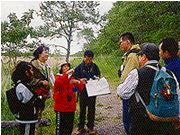 Rangers (VR) members. Under the theme: "The environment and plants differ depending on the type of wetlands," each group headed for various destinations, such as fen mires, bog mires and hills. On their way, participants enjoyed a camera game and were amazed to see the depths of marsh pond. They later wrote in their letters Rangers (VR) members. Under the theme: "The environment and plants differ depending on the type of wetlands," each group headed for various destinations, such as fen mires, bog mires and hills. On their way, participants enjoyed a camera game and were amazed to see the depths of marsh pond. They later wrote in their letters
We began preparations for this event in March, making a special "sheet map" and preparing white boards. We even rehearsed for this day. Due to the extraordinary cooperation among the participants and sign language experts, the event was a success. Some of the participants requested that we host the same event in different seasons. Such responses made us feel that our hard efforts in preparing this event were rewarded. This year, we are planning to host an event to experience wetlands with students at a school for the visually impaired. Every one of the VR members is striving to encourage people's awareness of the importance of
nature.
Hisae Suzuki
Secretary General
Association of Kushiro-shitsugen
National Park Volunteer Rangers
Establishment of Kushiro-shitsugen Triangle Network
I got on my favorite horse Yuki-go early in the morning of June 21, 1997, in Tsurui Village, which is known as a habitat of Red-crowned Cranes, a bird that symbolizes the Kushiro-shitsugen. I was about to visit Kushiro-shitsugen to investigate how the area changed over the last 10 years.
The story goes back to June 1987, 10 years ago. I toured Kushiro-shitsugen to collect materials for a newspaper article. Our party consisted of a senior breeder of Hokkaido horses, a newspaper reporter, a photographer and me. This tour was intended to investigate the feasibility of a project to utilize Hokkaido horses in Kushiro-shitsugen. Our investigation trip has become an important test case for the later implementation of the project.
A total of 615,000 people visited Kushiro-shitsugen National Park in 1995. From this figure, the number of visitors in 1998 is expected to exceed 1 million. In particular, over 5,000 people used in 1998 the canoeing service offered by two companies between Lake Toro and the Hosooka Canoe Center along the Kushiro River, a Class A river. The number of visitors to the Hokkaido Horse Ranch in Tsurui Village is also expected to exceed 2,000 in 1998.
Until recently, however, users of these facilities had to obtain access information by themselves. There were no networks established between these facilities. The canoeing service customers, however, are also potential customers of the Hokkaido horseback riding service. Given this, Mr. Naito, manager of the Hokkaido Horse Ranch in Tsurui; Mr. Ujihara, representative of the Canoe-ya R in Kushiro; and I, secretariat of Yachi-no-Kai, which offers a paid tour guide service in Kushiro-shitsugen, have established the Kushiro-shitsugen Triangle Network (a tentative name). As all of us have access to multimedia via personal computers, we have established links connecting each other's homepages, which publicize our individual businesses. This has made it easy for users to make plans to use Kushiro-shitsugen from any place with access to the Internet.
We have received a favorable response from our customers. We plan to cooperate with leading travel agents and establish the Kushiro-shitsugen Triangle Plan to attract more people here.
The idea of the Triangle Network was born out of our philosophy: "If we don't have it, why don't we make it ourselves?" As the three of us are all former businesspeople, this was nothing but another creative business we are familiar with. This network has thus been created from the general public's perspective.
We should stop just claiming "wise use" of wetlands; it is time to take action. We are determined to promote the use of wetlands in a way harmonious with nature.
Yoshito Sato
Secretary General
Yachi-no-Kai
Study on Current Status of the Grey Heron Colony
The Association of Kushiro-shitsugen National Park Volunteer Rangers has investigated the current status of the grey heron colony every year in February since 1995, marking its fourth time this year.
The grey heron colony (flock nesting area) is located near the center of the wetland and the east end of the alder forests which extend from the west to the center of the wetland.
The fen, where reeds and sedges grow, extends around the nesting area. Because of the high groundwater level here, it is difficult to walk into this area during the bird's mating season. Our research is thus conducted in winter, when the wetland freezes. As the grey heron colony is located 1.5 km away from the right bank of the Kushiro River, we use cross-country skis to go there. The survey items include the types, diameters, heights and the degree of stand decay for trees in which nests are built, and the number, diameters and heights of the nests.
According to the survey results for the past four years, the number of nests is decreasing, from 192 in the first year to 170 and then 164, becoming 145 this year. This means 47 nests have disappeared over the past four years. Such a decrease is partly caused by nests falling out of the trees when they are blown by strong winds, or because of the aging of the trees.
An accumulated number of 35 volunteer ranger members have so far participated in this survey. As this is truly an interesting and meaningful project, we are determined to continue this survey to the fifth and even tenth year, while encouraging the public to join us.
Masao Sawada
Member of the Association of
Kushiro-Shitsugen National Park
Volunteer Rangers
Planting of Rosa rugosa along the Otanoshike Coast
The coastline extending from the seafood processing complex in Otanoshike in Kushiro to Shiranuka is called the Otanoshike Coast. There used to be a vast, beautiful natural flower garden with communities of Rosa rugosa and Iris setosa. Due to gravel mining work which began around 1950, however, many of these diverse plant communities have been lost: only a few remain in limited places.
To restore the former state of coastal vegetation, since 1988 the City of Kushiro has - at the request of the Nature Conservation Society of Kushiro - planted seedlings of Japanese roses annually along the Otanoshike coast. Approximately 18,000 seedlings have been planted with the cooperation of the organizations including the Society, Kushiro Nishi High School, Otanoshike neighborhood associations and senior citizens' clubs.
The planting this year, the 11th since this activity began, was conducted on June 12. Some 100 citizens attended despite the foggy, chilly weather that day. Along the Otanoshike coast which was covered with beautifully blossoming Hemerocallis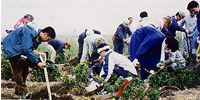 esculenta, Thermopsis lupinoides and Lath yrus japonicus, the participants carefully planted the seedlings one by one, following the instructions of the chairman of the Kushiro Gardening Construction Industry Association. It took only 20 minutes to plant all 480 seedlings scheduled for this year. The participants have reaffirmed the importance of continued efforts to restore a beautiful coastline. esculenta, Thermopsis lupinoides and Lath yrus japonicus, the participants carefully planted the seedlings one by one, following the instructions of the chairman of the Kushiro Gardening Construction Industry Association. It took only 20 minutes to plant all 480 seedlings scheduled for this year. The participants have reaffirmed the importance of continued efforts to restore a beautiful coastline.

|

|
| 次ページへ |
|
|