|
Meeting of Japanese Municipalities Involved with Ramsar Sites
The Fourth Meeting of the Japanese Municipalities Involved with Wetlands Designated Under the Ramsar Convention was held in Tomakomai, which features Lake Utonai - the fourth Ramsar site in Japan - on October 23, 1998. Some 60 mayors and representatives from Ramsar site municipalities participated, making this year's meeting the largest ever in scale. The meeting also included the mayors of Naha City and Tomigusuku Village, Okinawa, which are expected to have their wetlands registered as a Ramsar site.
The meeting was opened with a greeting from Mayor Tadayuki Torikoshi of Tomakomai, followed by a keynote speech by Kojiro Mori, Director of the Wildlife Protection Division of the Environment Agency. Subsequently, the bylaws of the meeting, including rules for officials and membership fees, were agreed upon. In addition, it was reaffirmed that the municipalities involved would strive to promote conservation activities through mutual cooperation.
After that, representatives from four municipalities gave presentations on the current status and challenges of their Ramsar sites. At the end of the meeting, the Lake Utonai Declaration was adopted. In this declaration, the principles of the meeting in promoting conservation activities through mutual cooperation were clarified as follows: 1) assuming responsibility for passing down wetlands and their surrounding environments to future generations; 2) raising the awareness of wetlands not yet registered as Ramsar sites; 3) playing a leading role in promoting citizens' activities for the conservation of wetlands; and 4) designating more wetlands as Ramsar sites.
City of Tomakomai
Current status of JICA trainees

In cooperation with the Environment Agency, KIWC has annually supported the JICA Training Course on Wetland Conservation and Protection of Migratory Birds as a training institution since 1994. The total of 25 trainees have participated so far. To understand achievements of these trainings in each country, we intend to introduce the active roles they are playing in society in each issue.
My name is Narong Veeravaitaya of the Office of Environmental Policy and Planning (OEPP) of the Ministry of Science, Technology and Environment, Thailand. I received training entitled "Wetland Conservation and Protection of Migratory Birds" by KIWC under a JICA program in 1996. Even though one month and a week in Japan was a short period, I learned a lot and had a wide variety of experience - not to mention a warm hospitality I received - that can be modified to suit my job.
My current responsibilities include wetland management programs developed by OEPP, which is acting as secretariat of the National Committee on Wetland Management. I am also a member of and assistant to the committee. One important task during the past five years has been to clarify the goals of the Ramsar Convention (Convention on Wetlands of International Importance especially as Waterfowl Habitat). For instance, how is it important for wetland management issues, what will be the benefits if Thailand joins the convention, as well as how we can select which wetland sites should be proposed for the list under the Ramsar Convention. Later on we will need to disseminate information about this issue to all stakeholders for consideration - especially policy makers. When I was in Japan during the training, I visited many Ramsar sites and learned how they can be managed. My experience can be modified to deal directly with these issues. In 1998 Thailand became the 110th contracting party of the Ramsar ConventioAdditionally, two important issues I learned about were public awareness through education and providing sophisticated facilities at a Wetland site visitor's center, especially for children.
Another advantage of healthy wetlands is for ecotourism activities such as canoeing, horseback riding and mountain biking. I have been assigned as a coordinator for the National Wetlands Inventory Project funded by DANCED (Danish Cooperation for Environment and Development) and the Thai Government. The purpose of this project is to update our wetlands inventory and to compare it with the previous inventory conducted by IUCN and the Royal Forest Department 10 years ago. This project will be completed by the end of June 1999.
In addition, I am also working as a coordinator collaborating with Thai Universities, which are conducting many projects to establish management plans for various critical wetlands such as Thale Noi Non-Hunting Area in Patalung Province, Sam Roi Yod National Park in Prajuab Kirikun, Phu Ban Mai Koa peat swamp forest in Phuket and other areas.
From my own personal viewpoint, due to the fact they are dynamic systems, I would like to insist that we - persons whose work deals with wetlands - need to share our experiences with each other and constantly stay up-to-date on the relevant academic subjects if possible. Otherwise we cannot secure our wetlands. We could describe the benefits of wetlands as a "Supermarket for Local People." Finally I wish to express my gratitude and sincere thanks to JICA, the Environment Agency of Japan, KIWC and OEPP for the support they provided me for participating in the training course.
Report from a Workshop Encouraging the Participation of Hokkaido Sites in an International Shorebird Network
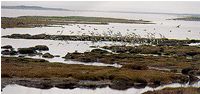
A flock of shorebirds taking flight
(photo: Shunkunitai Wild Bird Sanctuary Nature Center)
The second Hokkaido workshop to encourage the participation of Hokkaido sites in the Shorebird Reserve Network was held in Nemuro in August 22 and 23, 1998. The event was organized by WWF Japan, the Wild Bird Society of Japan and the Shorebird Committee of the Japan Wetlands Action Network (JAWAN). The objectives of the workshop were to introduce the East Asian-Australasian Shorebird Reserve Network system to people involved in shorebird research and protection activities in Hokkaido and to encourage more Hokkaido staging sites to be included in the Network. The workshop, attended by 19 people including the organizers, was conducted in a congenial atmosphere.
Ms. Fujioka from the JAWAN Shorebird Committee reported that a shorebird counting survey organized by the committee was conducted at 23 Hokkaido sites in total until the spring of 1998. Of them, the shorebird populations counted at Lake Komuke, Notsuke Point - Lake Odaito and Lake Furen, respectively, met the criteria for designation as Ramsar sites. In light of the Network's criteria, meanwhile, the number of shorebirds counted at Kiritappu-shitsugen and the Koetoi Coast was large enough to qualify for inclusion in the Network.
Participants commented that, although it would be difficult for these sites to join the Network at once, they would like to continue their activities by making the most of the network established among workshop participants. The workshop ended with participants assuring each other that they will continue exchanging information.
Sadayosi Tobai
Wetland Conservation Officer
Nature Conservation Division
WWF Japan

|

|
| 次ページへ |
|
|