|
JICA Training Course on Management / Administration and Wise Use of Natural Parks (Eco Tourism)
KIWC presented a monthlong training course titled "JICA (Japan International Cooperation Agency) Individual Training Course on Management / Administration and Wise Use of Natural Parks (Eco-Tourism)" both in fiscal 1998 and 1999, supported by JICA Hokkaido International Centre, Obihiro. The training course was conducted mainly in eastern Hokkaido, aiming at introducing methods of management / administration of natural parks, various kinds of eco-tourism such as horseback hiking and canoeing, and techniques of research on wetland-forests and wildlife to the trainees. Here are messages from the trainees who attended the training course.
Ms. Choong Poh Wan, Malaysia
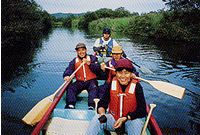 I traveled throughout eastern Hokkaido and visited more than nine nature centers with a course leader, a coordinator and Mr. Hidayat, a participant from Indonesia. The training course was beautifully packaged with fruitful discussions, visits to parks and recreational activities such as horseback riding, canoeing and trekking. We had exciting first-hand experiences of eco-tourism in Japan. I traveled throughout eastern Hokkaido and visited more than nine nature centers with a course leader, a coordinator and Mr. Hidayat, a participant from Indonesia. The training course was beautifully packaged with fruitful discussions, visits to parks and recreational activities such as horseback riding, canoeing and trekking. We had exciting first-hand experiences of eco-tourism in Japan.
This training inspired and motivated me for my work back home in Malaysia, in Paya Indah Wetland Sanctuary. My organization is responsible for developing and promoting the Sanctuary as a premier eco-tourism destination in Malaysia. We are tasked with restoring land that was degraded by previous tin mining operations, to turn it into a green wetland. I strongly believe that our sanctuary will become a showcase for well-protected wetland and an attractive eco-tourism destination in Malaysia.
 When I visited the Lake Toro Eco-Center Museum and Kiritappu Shitsugen Center, I realized that these Centers are our role models. I also recognized the significance of the participation and commitment of the local community in wetland conservation. This is very important to ensure the success of the nature center. This training is the first step for greater cooperation in eco-park management between Japan and Malaysia. When I visited the Lake Toro Eco-Center Museum and Kiritappu Shitsugen Center, I realized that these Centers are our role models. I also recognized the significance of the participation and commitment of the local community in wetland conservation. This is very important to ensure the success of the nature center. This training is the first step for greater cooperation in eco-park management between Japan and Malaysia.
Mr. Mohd Khairul Effendi, Malaysia
 I was very grateful for the great opportunity to attend this training course. During the training course, I visited beautiful wetland sites in Hokkaido such as Lake Shikaribetsu, Lake Toro, Shunkunitai Wild Bird Sanctuary, Kiritappu-shitsugen and Kushiro-shitsugen, which was quite an eye opener for me. I was very grateful for the great opportunity to attend this training course. During the training course, I visited beautiful wetland sites in Hokkaido such as Lake Shikaribetsu, Lake Toro, Shunkunitai Wild Bird Sanctuary, Kiritappu-shitsugen and Kushiro-shitsugen, which was quite an eye opener for me.
The training provided me with considerable hands-on knowledge and experience of wetland management as well as eco-tourism in Hokkaido, Japan.
I was very impressed by the way local people contribute to the management of wetlands and eco-tourism. I realized that the participation of the local people would ensure sustainable existence of wetlands, to be inherited by following generations, and that it would also help the relevant government agencies to manage the wetlands more efficiently.
Last but not least, the sharing of ideas and experiences with other participants and Japanese counterparts made the training more fruitful and meaningful.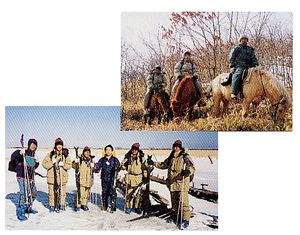
|
The UNITAR/KIWC Environmental Workshop |
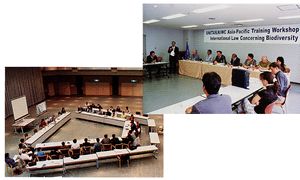 The second Workshop on Multilateral Agreements Related to Biological Diversity was held August 28 - September 2, 1999 in cooperation with the Japanese Government, UNDP, the World Heritage Centre, the Institute for Global Environmental Strategies, the National University of Singapore and the City of Kushiro. The second Workshop on Multilateral Agreements Related to Biological Diversity was held August 28 - September 2, 1999 in cooperation with the Japanese Government, UNDP, the World Heritage Centre, the Institute for Global Environmental Strategies, the National University of Singapore and the City of Kushiro.
As part of its global pro-gramme for the Application of International Environmental Law, the United Nations Institute for Training and Research (UNITAR) organized a training programme for the Asia-Pacific region on the Implementation of Multilateral Agreements related to Biological Diversity.
The first Workshop in this series consisted of a general introduction to the field of international law related to biological diversity. The second year, the focus widened for more in-depth attention to the theme of Legal Measures for Integrated Conservation and Development Planning and to the subject of Environmental Negotiations. Twenty-eight representatives from some 21 countries participated. They benefited from the presence of 13 specialists from 8 countries.
This training activity was considered most successful in raising awareness of and enhancing the capacity for environmental law implementation requirements among government administrators in the Asia-Pacific region. UNITAR has established a network between the "Kushiro alumni" which includes a data base of information about the professional activities undertaken by the participants after each Workshop. The participants have reported considerable concrete achievements on a national level, including the drafting of national legislation and regulations as a result of their training in Kushiro.
On the basis of these accomplishments, the organizations/people concerned and the participants hope that this programme will continue to take place on an annual basis.
Further information on the Kushiro Workshop programme is available from UNITAR at postal address: Palais des Nations, 1211 Geneva 10, Switzerland; fax: +41 22 917 8047 or E-mail: elp@unitar.org |

|

|
| 次ページへ |
|
|