This time the Environment Agency of Japan provides and article on the
administration of the conservation of wetlands.
Ramsar Sites in Japan - Series 1
�@Japanese wetlands designated under the Ramsar Convention
The 5th Ramsar Convention of Contracting Parties (Ramsar Conference)
held in Kushiro in 1993 attracted much attention from various circles.
It made people recognize the significance of the conservation of wetlands,
which had not been widely understood. It also highlighted the fact that many
Southeast Asian countries which are not contracting parties, attended the
conference, and that this may have facilitated some of them to sign the
Convention.
In response to an increasing awareness of the conservation of wetlands,
both within Japan and abroad, the Environment Agency is making further
efforts to conserve wetlands. Some of the Agency's activities are
presented below:
Improvement and construction of waterbirds-wetland centers:
To facilitate the propagation, education and academic research regardingthe protection of the waterbirds in Ramsar sites, waterbirds-wetland
centers equipped with exhibition and training rooms, as well as with research
laboratories, have been constructed since 1994. The construction of the Akkeshi
Waterbirds Observation Center and the Hamatonbetsu Lake Kutcharo Waterbirds
Observation Center were begun in 1994, and both of them opened in early 1995.
Construction the Lake Biwa Waterbirds-Wetland Center will be completed in
two years, starting from 1995. The construction of similar centers at other
Ramsar sites is being considered.
Promotion of international cooperation:
In order to protect migratory birds whose migration routes lay along theeastern edge of the Eurasian continent, it is important that Japan, together
with other eastern Asian nations, promote the conservation of wetlands.
In this respect, starting in 1989, the Environment Agency has been drawing
up preservation and management plans for important wetlands in Asian regions
in cooperation with the countries in these areas. This project has been
executed in the Philippines and Thailand since 1994. With a wide range of
cooperation from the Wild Bird Society of Japan, Bird Life International, the
governments of Asian countries and NGOs, the agency is preparing the RED DATA
BOOK of Asian birds as a five-year project which began in 1994. In addition,
the agency cooperates in training personnel of developing Asian countries through
a bird banding workshop and a group training program for the protection of wetlands
and migratory birds held by JICA, both of which are undertaken in Asia.
Additional registration of Ramsar sites:
"Kiritappu-shitsugen" and "Akkeshi-ko and Bekanbeushi-shitsugen" in Hokkaido,"Yatsu-higata" in Chiba, "Katano-kamoike" in Ishikawa, and "Biwa-ko" in Shiga
were newly registered as Ramsar sites at the Ramsar Conference in Kushiro.
As a result, the number of Ramsar sites in Japan increased to nine including
previously registered "Kushiro-shitsugen," "Kutcharo-ko" and "Utonai-ko" in
Hokkaido, and "Izu-numa and Uchi-numa" in Miyagi. In order to designate additional
wetlands as Ramsar sites in the 6th Ramsar Conference in Brisbane, Australia,
in March 1996, the Environment Agency, in coordination with the municipalities
concerned, is selecting certain wetlands it hopes to register to the Convention.
Nature Conservation Bureau,
Environment Agency
TOPICS
First Successful Breeding of Blakiston's Fish-Owl in Captivity
The Blakiston's fish-owl; (ketupa blakistoni blakistoni) is the largest bird ofthe Ketupa family. It is distributed in eastern Russia, northeastern China,
Sakhalin, the southern Kuriles and Hokkaido. Only 80 to 100 birds live in Japan,
in eastern Hokkaido, and the species is endangered.
The Kushiro City Zoo began to keep Blakiston's fish-owls in 1975 and is currently
keeping eight birds (three females and five males in three pairs).
It was confirmed that they have been laying eggs since 1982 but that none have
hatched. The zoo attempted reshuffling of the pairs in 1991, which led to a successful
hatching in April 1994 for the first time. However, the chick did not survive to reach
independence because the parents gave up rearing the young halfway in its development.
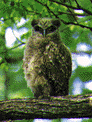
In early March 1995 the same couple laid two eggs, and one egg was put into a
hatchery, while the other was left to the parents. Unfortunately, the hatchery
chick died just before hatching. The other chick hatched in mid April. After the
hatching, we gave a special care to feeding and maintaining the rearing environment
and continued to monitor the sounds with a microphone installed in the nest.
The young was seen to leave the nest on June 19. It was a little smaller than its
parents and was covered with gray down except for its wings. Its eyes we ringed
with black, contrasting dramatically with the bright of its yellowish eyes.
It took almost 20 years of trial and error, to the arrival of the first chick.
We hope this one will have offspring. We would like to gather relevant data
through our breeding efforts in captivity and to contribute to the conservation of
the species and their return to the wild.
For further information, please contact:
KIWC Bureau: c/o Kushiro Tourism and International Relations Center
3-3 Saiwai-cho, Kushiro City, Hokkaido 085 Japan
Tel: +81-154-23-5547
Fax: +81-154-23-8041
E-mail: 18104314@people.or.jp